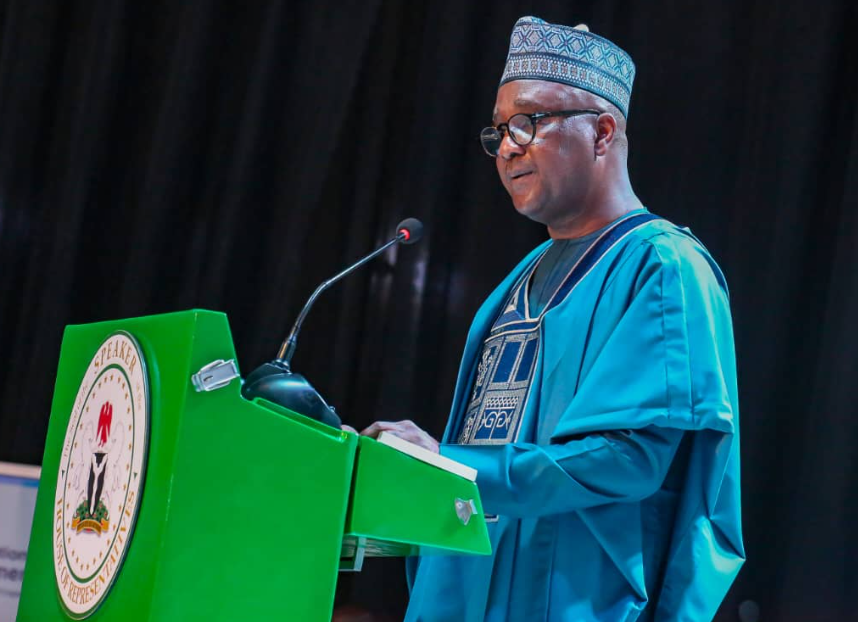
The Speaker of the House of Representatives, Abbas Tajudeen, has said that the National Assembly will continue to push tax reforms as part of Nigeria’s long-term plan to support energy transition and strengthen the country’s commitment to climate responsibility. He made this known on Monday during a one-day policy dialogue with lawmakers on taxation for fossil fuel phase-out, held in Lagos.
Abbas, who was represented by the Chairman of the House Committee on Media and Public Affairs, Akin Rotimi, explained that Nigeria cannot delay actions on climate change because the country is already facing the impact. He noted that environmental challenges such as desertification, flooding, erosion, oil pollution, and biodiversity loss are threatening food systems, damaging livelihoods, and putting pressure on communities across the country. He added that the legislative agenda of the House has made it clear that climate policies and economic development must progress together.
He stated that Agenda 8 of the House of Representatives focuses on climate change and environmental sustainability. According to him, lawmakers are working to strengthen the National Council on Climate Change Act and enforce compliance with the Climate Change Act of 2021. He said the House is also reviewing the National Climate Change Policy and Response Strategy and examining how to speed up renewable energy adoption, reduce gas flaring, and support the restoration of communities affected by industrial activities. He added that the National Assembly is also following up on the implementation of Nigeria’s Energy Transition Plan, which was introduced after the COP26 climate conference where the Federal Government announced its commitment to achieve carbon neutrality by 2060.
Speaking on the importance of fiscal policy, Abbas explained that tax legislation plays a crucial role in shaping Nigeria’s energy future. He said tax laws can attract investment, support innovation, discourage harmful environmental practices, and expand access to clean technologies. He stressed that Parliament will continue to explore how tax tools can strengthen policy alignment, close gaps, and support low-carbon development without leaving any community or economic sector behind. He noted that the ongoing national tax reforms, which are led by the Executive and supported by the Legislature, are meant to improve transparency, efficiency, and stability in the tax system, making it more investment-friendly.
He added that the National Assembly understands that tax laws must be continuously reviewed to reflect Nigeria’s economic and environmental priorities. He praised civil society organisations, especially the Civil Society Legislative Advocacy Centre (CISLAC), for providing research, insights, and advocacy that help lawmakers make informed decisions.
Also speaking at the event, the Chairman of the House Committee on Foreign Affairs, Oluwole Oke, commended civil society groups for keeping issues of governance, environmental protection, and sustainability on the national agenda. He noted that the increase in coal mining in Nigeria has caused environmental damage and that the world’s continued dependence on fossil fuels requires countries like Nigeria to carefully decide their position on energy transition. He said lawmakers must continue to deliberate on these issues and work together to protect the planet for future generations.
During his opening remarks, the Executive Director of CISLAC, Auwal Musa (Rafsanjani), drew attention to the behaviour of some companies benefiting from tax incentives without contributing to national development. He explained that some firms register, collect tax holidays, change their names once the period expires, and apply again. He said this practice has cost the country revenue, and that incentives must be well-designed, transparent, and closely monitored. He stressed that the National Assembly must continue to strengthen its lawmaking, oversight, and budget powers to address these challenges.
On the technical side of the conversation, Director of Policy, Planning and Strategy at the Nigeria Extractive Industries Transparency Initiative (NEITI), Dr Bassi Dieter, said Nigeria faces a delicate balance between energy security and energy poverty. He noted that the country has opportunities in rare earth minerals such as lithium, which can support a new economy in electric vehicles and battery production. He said Nigeria must build local refining capacity and develop a full value chain to benefit from global demand. He added that energy transition will require retraining industries, promoting local content, and investing in technology transfer.
Commenting on Nigeria’s ability to meet its 2060 net-zero target, Dieter said the goal is achievable, but only if the government commits to proper funding, strong governance, and effective monitoring. He also highlighted opportunities available through external funding and green bonds, which can support Nigeria’s transition efforts.
