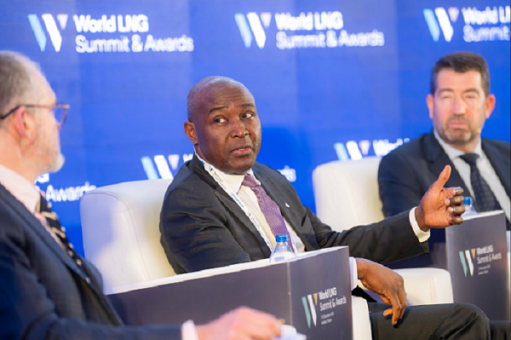
Nigeria LNG Limited (NLNG) has called on global energy leaders to deepen cooperation and strategic partnerships to stabilise Liquefied Natural Gas (LNG) supply, improve affordability for emerging economies, and secure long-term global energy expansion in a world facing rising geopolitical tension and trade uncertainty.
The call was made by the Managing Director and Chief Executive Officer of NLNG, Mr. Philip Mshelbila, during his keynote address at the World LNG Summit & Awards held in Istanbul, Turkey. He spoke under the theme “Energy Expansion in a Challenging Global Trade Environment,” where he highlighted key risks facing the global gas market and the urgent need for a new approach to LNG contracting and collaboration.
Mshelbila warned that without coordinated action across the entire LNG value chain, the global community risks widening the existing energy gap, weakening energy security, and slowing progress toward a balanced and lower-carbon global energy system. He said the current global energy landscape is shaped by growing geopolitical tensions, unilateral national policies, trade disruptions, and sanctions that have increased instability in energy markets.
According to him, the traditional LNG contract model that focuses only on price and volume is no longer sufficient. He explained that LNG contracts must now evolve to actively manage sovereign and geopolitical risks. This, he said, can be achieved through diversified supply sources, flexible delivery routes, and more adaptive contract terms that can respond quickly to global shocks.
“To safeguard global energy security from the risks of geopolitics and unilateral policies, LNG contracts must evolve beyond simply defining volume and price to actively managing risk through diversified supply sources and flexible delivery systems,” Mshelbila stated.
He stressed that global energy expansion could slow down if major structural issues around LNG supply, pricing, project financing, and decarbonisation are not urgently addressed. He warned that the current market situation poses serious risks to developing countries that are already struggling with volatile and often unaffordable gas prices.
Reflecting on changes in global trade patterns following the 2022 supply shock, Mshelbila explained that the LNG market has experienced renewed interest in long-term contracts. At the same time, short-term and spot contracts remain attractive. He said this dual demand reflects growing global uncertainty and the desire by both producers and buyers to lock in supply and price stability.
The NLNG chief outlined three key pillars that must guide the future of LNG in the global energy mix. These pillars are availability, affordability, and decarbonisation. He explained that although natural gas is often described as a transition fuel, it will remain relevant beyond the next few decades if these three areas are strengthened through policy support and sustained investment.
Mshelbila also spoke about global supply expansion efforts, pointing to major LNG projects in the United States and Qatar, as well as NLNG’s own Train 7 project in Nigeria. He disclosed that Train 7 is designed to add eight million tonnes per annum to NLNG’s production capacity. He said these large-scale investments are critical to meeting expected long-term global demand growth and ensuring stable LNG supply.
However, he warned that affordability remains the most critical challenge facing LNG today. He noted that persistently high LNG prices have forced several developing countries to return to cheaper, carbon-intensive fuels such as coal and heavy fuel oil. This, he said, undermines global climate change targets and slows the transition to cleaner energy.
He added that achieving a realistic balance between energy security, economic growth, and climate goals will require stronger collaboration among producing countries, consuming nations, financiers, and technology providers. He said no single country or company can solve the global energy challenge alone.
The World LNG Summit, now in its 25th year, remains one of the world’s leading platforms for LNG policymakers, producers, buyers, financiers, and technology innovators. The annual event continues to shape discussions around global LNG trade, pricing, investment, and energy transition amid growing geopolitical and economic uncertainty.
