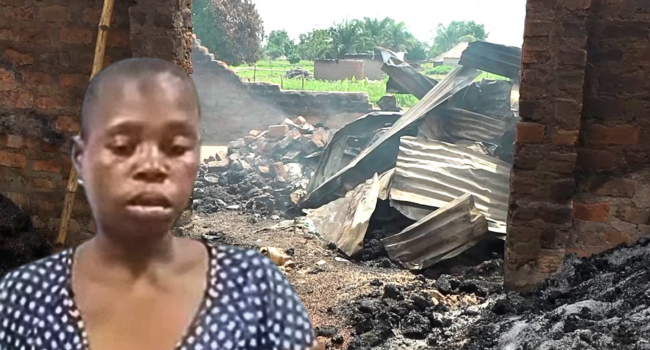
A survivor of the June 2025 Yelwata attack in Benue State, Msurshima Apeh, has narrated how she watched the killing of her five children during the overnight assault by suspected armed herdsmen. She shared her experience while addressing the United States Congress on Thursday, during a hearing on Nigeria’s return to the Country of Particular Concern list.
The hearing, held by the House Subcommittee on Africa, focused on President Donald Trump’s decision to reinstate Nigeria on the list over alleged ongoing religious persecution. Apeh joined the session virtually from Benue State and gave a detailed account of how the attack happened.
According to her, she and her children were asleep around 9 pm when armed men invaded their camp in Yelwata. She said the attackers locked them inside before unleashing violence with guns and cutlasses.
“When we went to sleep that night around 9 pm, the Fulani terrorists attacked us where we were sleeping. We were locked inside the camp, Yelwata, and they were butchering them with cutlasses and shooting guns as well,” she told the panel.
Apeh explained that the attackers later poured petrol on the building and set many people on fire. She said she was able to save herself after spotting a tree nearby. She climbed the tree to hide, but from there she watched her five children being killed.
“In the course of this action, I saw a tree when I lifted my eyes. I raised my hands on the tree and climbed up where I was able to hide myself. My five children that I left below were crying, and in my presence, they were being slaughtered by the terrorists,” she said.
After surviving the night, Apeh ran into the bush and hid until rescuers arrived. She was later moved to a new camp with others who fled the attack.
“I ran out into the bush at some point, and those who came for rescue will now bring me out of that place at some point, and I was able to witness the whole drama. When the people came, we were now relocated to a new camp,” she added.
The Yelwata attack, which took place in June 2025, left many people dead, including civilians and five security operatives. Among the security personnel killed were two soldiers, a police officer, and two others. Several houses, shops, and market stalls were burnt after petrol was poured on them. Many internally displaced persons also lost entire families. One of the widely reported cases involved a family of 15 who were all killed.
The scale of the violence led to strong reactions nationwide. President Bola Ahmed Tinubu cancelled other official duties and travelled to Benue State to meet stakeholders and victims of the attack. During his visit, he promised to assess the situation closely and support efforts to restore peace to the affected communities. He also visited injured victims receiving treatment in various hospitals.
Inspector-General of Police, Kayode Egbetokun, condemned the killings, describing them as direct threats to Nigeria’s sovereignty. He announced that more police officers would be deployed to protect residents in vulnerable areas. The police chief also confirmed that 26 suspects linked to the attack had been arrested.
The incident has continued to generate national outrage. Political leaders, religious organisations, civil society groups, and international rights advocates are calling for justice and stronger action to prevent future attacks. Many of them believe that consistent prosecution, community engagement, and early-warning systems are needed to end the cycle of violence in Benue and other states affected by similar clashes.
As global attention grows, the testimony of survivors like Msurshima Apeh is now shaping international discussions about security, religious freedom, and humanitarian conditions in Nigeria.
