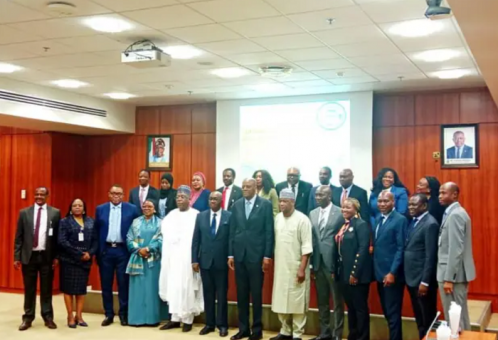
The Central Bank of Nigeria (CBN) has charged the newly inaugurated Board of the Agricultural Credit Guarantee Scheme Fund (ACGSF) to ensure that lack of collateral and remote location no longer prevent Nigerian farmers from accessing agricultural credit.
The charge was given by the Governor of the Central Bank of Nigeria, Mr. Olayemi Cardoso, during the board’s inauguration ceremony held in Abuja. He described the Scheme as a critical national institution that must evolve to meet the financing needs of modern agriculture in Nigeria.
Mr. Cardoso explained that the ACGSF, which is 48 years old, remains one of Nigeria’s longest-standing development finance programmes. He said the Scheme is not a return to ad-hoc interventions by the apex bank but a continuation of its statutory responsibility to support productive sectors of the economy. According to him, the key focus going forward is to make agricultural finance more accessible, inclusive, and effective.
“Our goal should be that a lack of collateral or remote location is no longer an insurmountable barrier to financing,” Cardoso said. He stressed that agriculture remains central to Nigeria’s economic structure, contributing over one-fifth of the country’s Gross Domestic Product (GDP) and employing nearly two-thirds of Nigeria’s working population. Despite this, he noted that the sector receives less than five percent of total bank lending in the country.
He recalled that the ACGSF was created to reverse this imbalance and encourage banks to lend to farmers and agribusinesses by reducing their risk exposure. Since its establishment by Decree No. 20 of 1977, the Scheme has guaranteed up to 75 percent of agricultural loans, enabling financial institutions to extend credit to categories of farmers that would would otherwise be excluded.
Cardoso urged the new Board to ensure that the Scheme becomes a dependable partner for farmers seeking financing. He said every hardworking farmer with a viable project should be able to approach the ACGSF and receive the support needed to grow their farm business, expand production, and improve income.
The CBN Governor also called for stronger monitoring and evaluation systems to track the impact of guaranteed loans. He said the era when funds were disbursed without proper verification of results must come to an end. According to him, the Board should champion the use of data and technology to improve transparency and accountability.
He specifically mentioned the use of satellite imagery to track crop growth and farm development, as well as digital dashboards to monitor loan disbursement and utilisation in real time. He said this would help prevent misuse of funds and ensure that loans are applied strictly for their intended agricultural purposes.
Cardoso added that proper monitoring will help the Scheme identify early warning signs such as regional loan defaults and operational risks. He said with reliable data, the Board can respond proactively through borrower support, loan restructuring, or adjustments in lending strategies. He stressed that clear evidence of increased output, higher farm incomes, and improved food security must guide future policy decisions.
He described the timing of the Board’s inauguration as important, noting that Nigeria urgently needs to close its long-standing agricultural financing gap. He said millions of smallholder farmers across the country have been constrained by limited access to formal credit and modern farming inputs.
The CBN Governor also highlighted the 2019 amendment that increased the share capital of the Scheme from N3 billion to N50 billion, placing it on a stronger financial footing. He praised the broader composition of the new Board, which now includes a representative of Nigerian farmers, describing this as a strategic move to deepen collaboration between policymakers, financial institutions, and farming communities.
Cardoso explained that modern agriculture is now more complex, with long value chains, advanced technologies, climate change risks, and security challenges. He said the ACGSF must be repositioned as a dynamic and forward-looking institution capable of responding to these realities.
He aligned the objectives of the Scheme with the Federal Government’s Renewed Hope agenda, which seeks to build a resilient, technologically advanced, and inclusive agricultural economy. He said dismantling long-standing barriers to credit access, especially for smallholder farmers who produce most of the country’s food, is now a national priority.
He also urged the Board to deepen financial inclusion for women and youths, noting that women play key roles in agriculture but often lack access to finance and technology. He revealed that nearly 60 percent of rural women do not use mobile internet, which limits their access to digital financial services.
He called on the Board to collaborate with microfinance banks, cooperatives, and fintech companies to design flexible loan products using group lending, agent banking, and digital platforms.
Quoting the philosopher Aristotle, Cardoso said institutions must not be left unattended or weakened. He urged the Board to approach its responsibilities with innovation, integrity, and commitment, promising full support from the Central Bank of Nigeria.
