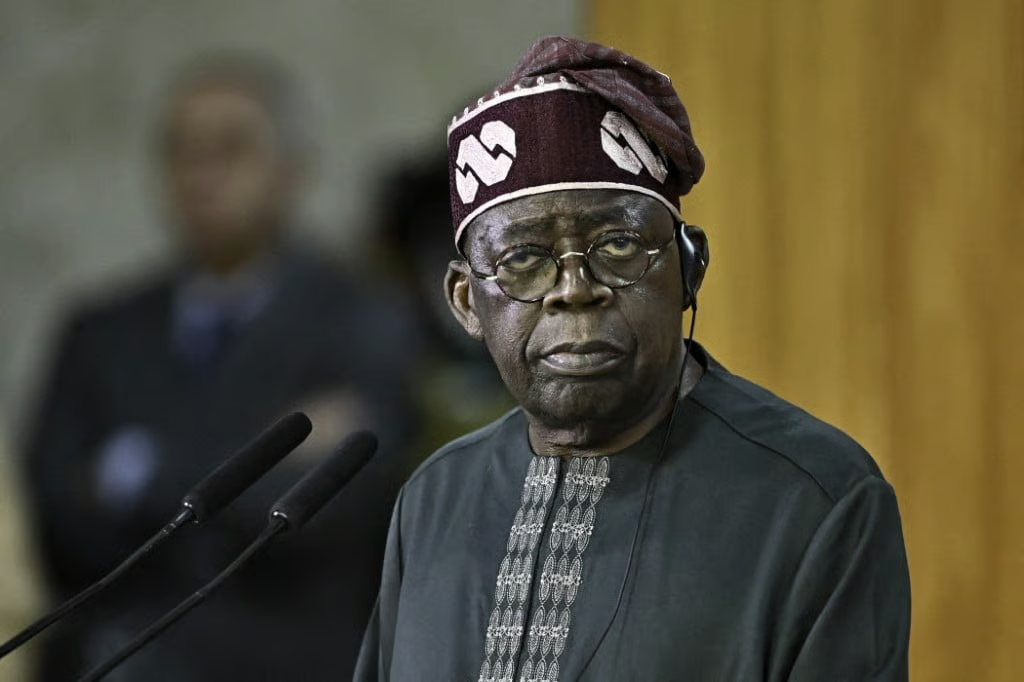
Despite recent commendations from the World Bank for Nigeria’s macroeconomic reforms under President Bola Tinubu, experts warn that the country’s approach risks prioritising optics over real change. Kingsley Moghalu, former Deputy Governor of the Central Bank of Nigeria and President of the Institute for Governance and Economic Transformation (IGET), emphasises that without behavioural reforms—accountability, transparency, and rule-of-law governance—the reforms are “a well-funded mask for governance decay.”
Moghalu notes that while macroeconomic stability is important, it is a tool, not a destination. He argues that Nigeria’s current reforms, including the removal of fuel subsidies and steps to stabilise the naira, do little to address the systemic weaknesses in human development, basic services, and institutional integrity that underpin sustainable growth.
The Central Bank has recorded successes in stabilising the exchange rate and reducing inflation, and Nigeria’s foreign reserves have risen to $46 billion, the highest in a decade. Yet, the impact on ordinary Nigerians remains limited, as the removal of subsidies was implemented with minimal planning for mass transit and other social infrastructure, and federal savings have yet to translate into visible improvements in healthcare, education, or water supply.
Moghalu stresses that structural transformation, not just macroeconomic metrics, drives development. He cites Southeast Asian examples, noting that countries like Singapore, Malaysia, and Indonesia paired economic policies with stringent behavioural reforms to achieve lasting growth.
Human development indicators paint a sobering picture: Nigeria ranks 140 out of 180 on Transparency International’s Corruption Index, 164 out of 193 on the UN Human Development Index, and only 32% of citizens have safe drinking water at home. According to the World Bank’s Human Capital Index, a child born today in Nigeria has only a 36% chance of reaching full productive potential.
The country’s economy remains heavily dependent on oil, with manufacturing contributing just 8–10% of GDP and electricity supply constrained at roughly 5,000MW—far below the level needed to unlock real industrial productivity. Moghalu warns that without reforming governance behaviours and investing in human capital, macroeconomic gains will remain largely symbolic.
He urges a shift from the “growth delusion” to a development strategy grounded in transparency, accountability, and citizen-centered policies, arguing that only such a foundation can transform Nigeria’s latent potential into tangible prosperity.
Moghalu is the author of Emerging Africa: How the Global Economy’s Last Frontier Can Prosper and Matter, and his insights draw on experience as Deputy Governor of the Central Bank of Nigeria from 2009 to 2014.
