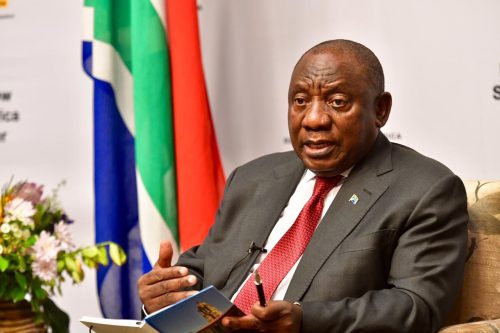
In 2023, South Africa confronted what a senior minister in the ruling African National Congress described as the single greatest threat to the country since the end of apartheid — a devastating electricity crisis that left households and industries in prolonged darkness.
The minister, Kgosientsho Ramokgopa, was not referring to crime, poverty or corruption, though all remain pressing concerns. Instead, he pointed to the collapse of reliable power supply, as rolling outages lasting up to eight hours daily crippled the nation for about 280 days in a single year.
The crisis, largely blamed on years of mismanagement at state-owned utility Eskom, worsened during the presidency of Jacob Zuma, when key institutions were weakened by corruption and political interference. At its peak, analysts warned that the national grid risked total failure, a scenario that could have plunged the country into social and economic chaos.
With industry grinding to a halt and growth stagnating, corporate leaders concluded they could no longer remain spectators. According to Martin Kingston, Africa head at Rothschild and chair of Business for South Africa, companies mobilised resources and expertise in what he described as a national rescue effort.
Major firms joined forces with government, funding the deployment of hundreds of engineers and specialists to stabilise failing power stations and lay groundwork for structural reform. At the same time, businesses responded to appeals from President Cyril Ramaphosa to invest in renewable energy, particularly after restrictions that had capped private generation were lifted and eventually scrapped.
The impact of this collaboration became evident within two years. By 2025, rolling blackouts had dropped sharply to just 17 days, compared with near-daily outages in 2023, marking one of the most dramatic operational turnarounds in the country’s recent history.
The improvement coincided with the rise of Operation Vulindlela, a joint programme between the presidency and treasury established in 2020 to fast-track structural reforms. Initially little known outside policy circles, the initiative has steadily expanded its influence, opening sectors such as rail, ports and utilities to private participation.
Political analyst Jonny Steinberg observed that businesses now wield unprecedented influence over both infrastructure and regulatory policy, arguing that the “nuts and bolts” of state delivery are increasingly shaped through public-private cooperation.
Evidence of progress has begun to surface. The country was removed from the monitoring list of the Financial Action Task Force following intensified anti-corruption reforms, while data from Nedbank showed private-sector investment announcements tripled to more than R382 billion last year. The JSE All Share Index also recorded strong gains, reflecting renewed investor confidence.
Economic growth reached 1.2 per cent in 2025 — modest but double the previous year’s rate — prompting cautious optimism among economists. Busisiwe Mavuso, head of Business Leadership South Africa, said reforms were beginning to yield measurable results after years of stagnation.
Operation Vulindlela itself was modelled loosely on the delivery unit introduced by former British prime minister Tony Blair, designed to accelerate policy implementation and improve public-sector efficiency. Co-head Rudi Dicks described it as essentially a business-style execution mechanism adapted to local realities.
Observers say the initiative’s growing prominence reflects lessons learned from the institutional decline that followed years of state capture, as well as the personal trajectory of Ramaphosa, a former protégé of Nelson Mandela who later built a career in business before entering national leadership.
Resistance to market-friendly reforms once ran deep within the ANC, particularly among supporters of radical economic transformation policies. Some of the most vocal critics have since left the party, including allies of Julius Malema, leader of the Economic Freedom Fighters, and figures linked to Zuma’s uMkhonto weSizwe movement.
The ruling party’s electoral losses in 2024 accelerated the shift toward pragmatism. After failing to secure a parliamentary majority, it formed a coalition government that included the pro-market Democratic Alliance, strengthening support for reforms.
Changes are also visible in logistics. Freight volumes on the network operated by Transnet had collapsed in recent years due to neglect, vandalism and cable theft. Transport minister Barbara Creecy said opening rail routes to private operators would help reverse the decline while keeping infrastructure under state ownership.
At the ports, Philippine-based operator ICTSI recently secured a 25-year concession to upgrade a major container terminal after rival bidder AP Moller-Maersk lost a legal challenge, a development officials say will inject global expertise and efficiency into the system.
Despite these advances, critics argue reforms remain too slow. Democratic Alliance chair Helen Zille recently highlighted infrastructure failures by posting footage of herself standing in water from a burst pipe, while Songezo Zibi, leader of Rise Mzansi, said progress was constrained by internal political resistance.
Energy reform remains particularly sensitive. Plans to restructure Eskom into separate generation, transmission and distribution entities — widely seen as essential — have encountered obstacles, including reluctance to transfer grid assets to an independent operator. Even so, Ramaphosa has assured investors that a fully state-owned transmission body will ultimately control the network.
Some analysts remain sceptical. Political commentator Moeletsi Mbeki dismissed the reform drive as insufficient, arguing it merely patches up an outdated economic model rather than replacing it.
Yet momentum toward greater private-sector involvement appears to be growing. Deputy President Paul Mashatile, regarded as a possible successor to Ramaphosa, recently signalled that market-driven solutions should no longer be treated as taboo.
For reform advocates, the priority now is speed. With Ramaphosa’s leadership of the ANC set to end next year and his presidential tenure limited to 2029, supporters say the objective is to entrench structural changes before political winds shift again.
As one official involved in the programme put it, the ultimate goal is simple: complete the reforms, lock them in, and ensure they cannot easily be reversed.
