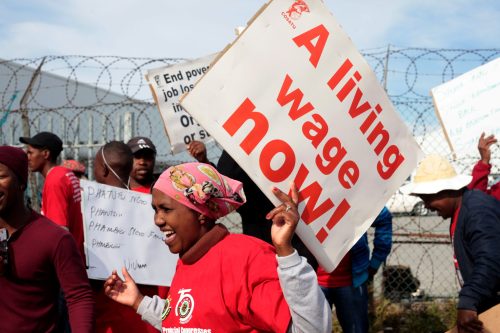
Fresh concerns have emerged over possible job losses in South Africa following the Federal Government’s approval of a new national minimum wage benchmark, a development that has reignited debate among labour leaders, economists and employers about the fragile balance between worker welfare and employment growth.
Minister of Employment and Labour, Nomakhosazana Meth, announced on February 3, 2026, that the statutory wage floor will rise by five per cent from R28.79 to R30.23 per hour effective March 1. The increment of R1.44 was calculated using the Consumer Price Index plus an additional 1.5 per cent, in line with recommendations by the National Minimum Wage Commission.
According to the minister, the adjustment is intended to improve the earnings of vulnerable categories of workers, including farm labourers and domestic employees. She stressed that under existing labour law, employers are legally bound to comply, with enforcement overseen by the Department of Employment and Labour and the Commission for Conciliation, Mediation, and Arbitration, both empowered to sanction violators.
However, reactions from organised labour and business groups suggest the new wage has opened fresh fault lines in Africa’s most industrialised economy. The General Industries Workers Union of SA argued that despite the increase, the rate remains far below a living wage, estimating workers still face a monthly deficit of about R2,000 to meet basic needs. The union is pressing for a minimum monthly salary of R15,000.
Employers, on the other hand, caution that higher wage mandates could discourage hiring, particularly for young and low-skilled workers already struggling to enter the labour market. Business leaders warn that small firms operating on tight margins may be forced to reduce staff or delay recruitment.
Economic analysts have also weighed in. Renowned economist Thomas Sowell has long argued that wage floors, though designed to raise incomes, can inadvertently exclude vulnerable workers from employment, noting that when labour costs rise beyond productivity levels, job opportunities often shrink.
Echoing similar concerns, Gerhard Papenfus of the National Employers’ Association of SA described the policy as a potential “barrier to work,” urging authorities to prioritise pro-growth reforms capable of stimulating investment and job creation.
Agricultural stakeholders are equally uneasy. The farmers’ group AgriSA warned that wage increases above inflation could threaten farm viability, especially as producers battle rising input costs and disease outbreaks affecting livestock.
The controversy underscores a broader structural challenge. With unemployment still among the highest globally, particularly for young people, labour-market decisions carry heavy political and economic consequences. Policymakers now face a delicate test: whether raising statutory pay can protect low-income earners without worsening joblessness in an already strained economy.
As implementation begins in March, analysts say the real measure of success will lie in whether authorities can sustain wage growth while simultaneously expanding employment opportunities nationwide.
