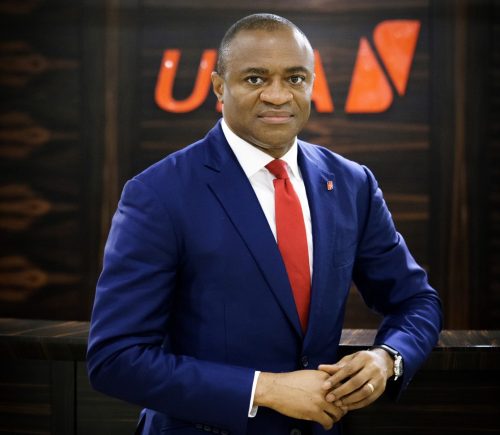
There are bankers who build balance sheets, and there are institutional leaders who build meaning into the balance sheet. Oliver Alawuba belongs to the second category. His leadership of United Bank for Africa is not merely about supervising one of the continent’s most recognisable financial institutions; it is about deepening the architecture of a bank that has come to represent something larger than banking itself: Africa’s commercial confidence, its cross-border ambition, and its right to sit at the centre of global finance.As Group Managing Director/CEO of UBA, Alawuba leads a bank with operations across 20 African countries and international presence in major financial corridors including the United Kingdom, the United States, France and the United Arab Emirates. UBA describes itself as “Africa’s Global Bank,” a phrase that is not just branding but a strategic proposition: to connect Africa to the world and the world to Africa.
Alawuba’s rise is compelling because it reflects the logic of institutional apprenticeship. He did not arrive at the top of UBA as an outsider parachuted into an already-made platform. He rose through the architecture of the group, serving across markets, functions and regions. Before becoming Group Managing Director/CEO, he had served as country CEO, Regional CEO in UBA’s Rest of Africa operations, Executive Director for East Bank in Nigeria, and later Group Deputy Managing Director/CEO with oversight across Nigeria and other African subsidiaries.
That range matters. Banking at scale is not simply a technical business. It is a business of geography, trust, regulation, risk, technology, people and timing. To lead a bank like UBA, one must understand Lagos, Accra, Abidjan, Nairobi, London, New York, Paris and Dubai not as separate dots on a map, but as connected theatres of African commerce. Alawuba’s career gives him that vantage point. He is not only a Nigerian banker leading a Nigerian bank; he is a pan-African operator leading a financial institution built for continental complexity.
There are bankers who build balance sheets, and there are institutional leaders who build meaning into the balance sheet. Oliver Alawuba belongs to the second category. His leadership of United Bank for Africa is not merely about supervising one of the continent’s most recognisable financial institutions; it is about deepening the architecture of a bank that has come to represent something larger than banking itself: Africa’s commercial confidence, its cross-border ambition, and its right to sit at the centre of global finance.As Group Managing Director/CEO of UBA, Alawuba leads a bank with operations across 20 African countries and international presence in major financial corridors including the United Kingdom, the United States, France and the United Arab Emirates. UBA describes itself as “Africa’s Global Bank,” a phrase that is not just branding but a strategic proposition: to connect Africa to the world and the world to Africa.
Alawuba’s rise is compelling because it reflects the logic of institutional apprenticeship. He did not arrive at the top of UBA as an outsider parachuted into an already-made platform. He rose through the architecture of the group, serving across markets, functions and regions. Before becoming Group Managing Director/CEO, he had served as country CEO, Regional CEO in UBA’s Rest of Africa operations, Executive Director for East Bank in Nigeria, and later Group Deputy Managing Director/CEO with oversight across Nigeria and other African subsidiaries.
That range matters. Banking at scale is not simply a technical business. It is a business of geography, trust, regulation, risk, technology, people and timing. To lead a bank like UBA, one must understand Lagos, Accra, Abidjan, Nairobi, London, New York, Paris and Dubai not as separate dots on a map, but as connected theatres of African commerce. Alawuba’s career gives him that vantage point. He is not only a Nigerian banker leading a Nigerian bank; he is a pan-African operator leading a financial institution built for continental complexity.
The Weight of a Pan-African Institution
UBA is one of the few African banks that can credibly speak the language of continental banking and global connectivity at the same time. Its footprint gives it a rare institutional personality. It is local enough to understand the realities of African markets, but large enough to serve multinationals, governments, exporters, importers, entrepreneurs, development institutions and diasporic capital.
This is where UBA’s deeper importance lies. For decades, African finance was often treated as peripheral to global banking. The continent was viewed as a market to be served, financed, rated, entered or exited by institutions headquartered elsewhere. UBA represents a different proposition. It is an African-headquartered bank with a global-facing structure, built to support trade, payments, remittances, corporate banking, public-sector flows and cross-border business from an African centre of gravity.
That distinction is crucial. In global banking, control of financial rails often shapes control of opportunity. When African businesses rely entirely on external institutions to move capital, manage trade, access foreign markets or structure transactions, the continent remains exposed to decisions made elsewhere. UBA’s model pushes against that dependency. It says African capital does not have to be permanently mediated by foreign institutions. Africa can build its own financial bridges.
Leadership Without Noise
Alawuba’s public image is not one of flamboyance. His leadership style appears closer to disciplined stewardship than theatrical command. In a corporate age that often rewards visibility over substance, that restraint can be easily misunderstood. But banking rewards a different kind of temperament. It rewards patience, credibility, process, governance and execution.
UBA does not need a chief executive who treats leadership as performance. It needs one who understands that the institution itself must be the star. That is the quiet significance of Alawuba’s tenure. He stands at the head of a bank whose ambition is already large, but whose future depends on consistency, regulatory discipline, technology investment, customer confidence and the ability to keep converting African opportunity into bankable value.
This is the discipline of building what truly endures: not the pursuit of short-lived corporate applause, but the strengthening of systems that can outlive personalities.
The Bank as an African Gateway
UBA’s slogan, “Africa’s Global Bank,” captures one of the most important shifts in modern African finance. The future of banking on the continent will not be defined only by branch networks or traditional deposit-taking. It will be defined by the ability to move money securely across borders, finance trade, support digital payments, serve young and mobile customers, back businesses expanding across African markets, and connect African economies to global capital.
In that sense, UBA is not merely competing with banks. It is competing for relevance in the architecture of the future African economy. Its presence across Africa, Europe, North America and Asia gives it a platform that few African financial institutions possess. UBA says it operates more than 1,000 branches and serves over 45 million customers, underscoring the scale behind its continental and international claim.
For global banking, UBA represents a test case in African financial maturity. It shows that an African institution can build scale, manage multi-jurisdictional complexity, maintain global ambitions and still retain an African identity. That matters because Africa’s next phase of growth will require financial institutions that understand the continent not as a risk story alone, but as a productivity story, a demographic story, a trade story and a technology story.
Carrying the Weight of Institutional Legacy
Leading UBA also means operating within a powerful institutional legacy. The bank’s modern identity is inseparable from its pan-African expansion and the broader vision of building an African financial institution with global relevance. Under Group Chairman Tony Elumelu and successive leadership teams, UBA became more than a bank with branches; it became a symbol of African scale.
Alawuba’s responsibility is therefore not to invent UBA from scratch, but to deepen what it has become. That can be harder than starting afresh. A young institution can survive on energy. A mature institution must survive on governance. It must keep growing without becoming complacent. It must innovate without losing control. It must satisfy shareholders without weakening prudence. It must pursue expansion without confusing ambition with recklessness.
This is where Alawuba’s long internal journey becomes an asset. He understands the bank’s history from within. He has seen its African operations not as abstractions but as operating realities. He knows that a bank with UBA’s footprint must manage different currencies, regulators, political environments, customer behaviours and macroeconomic cycles. That kind of knowledge cannot be improvised.
Technology, Trust and the New Banking Frontier
The next battle for African banking will be fought across technology and trust. Fintechs have changed customer expectations. Young Africans want speed, convenience and digital access. Businesses want seamless payments and reliable trade solutions. Regulators want stability, compliance and transparency. Shareholders want returns. Customers want confidence.
UBA’s challenge, under Alawuba, is to keep all these demands in productive tension. The bank must be digital without becoming detached from human trust. It must be innovative without losing the discipline that banking requires. It must serve mass-market customers while retaining the sophistication to handle corporate, sovereign and cross-border financial flows.
That is not a small assignment. But it is the kind of assignment that defines consequential banking leadership. In Africa, banks are not just financial intermediaries. They are engines of development, custodians of confidence and, in many markets, the formal bridge between aspiration and opportunity.
What UBA Represents for Global Banking
UBA’s significance to global banking is not merely that it has offices outside Africa. Its significance is that it changes the direction of financial imagination. For a long time, the global banking map moved from the West into Africa. UBA helps reverse that logic. It moves from Africa outward.
That reversal is powerful. It means African institutions can participate in global finance not only as clients or subsidiaries, but as originators, connectors and competitors. It means the African banking story can be told from Lagos, not only from London or New York. It means that cross-border African trade, diaspora finance, investment flows and multinational expansion can be supported by institutions that understand the continent from the inside.
For global banking, UBA represents the rise of African financial agency. It demonstrates that the continent’s future will not be financed only by external capital looking inward, but also by African institutions looking outward.
The Measure of Alawuba’s Moment
Oliver Alawuba’s moment at UBA comes at a time when African banking is being reshaped by currency volatility, inflationary pressure, regulatory tightening, digital disruption, continental trade ambitions and rising global interest in Africa’s long-term growth. These conditions require more than optimism. They require institutional patience.
The best CEOs in this environment are not merely dealmakers or public speakers. They are custodians of resilience. They know when to expand and when to consolidate. They know that reputation is a form of capital. They understand that in banking, trust is not a slogan; it is the product.
Alawuba’s task is to ensure that UBA remains not only big, but trusted; not only visible, but useful; not only African, but globally consequential.
The Discipline of Building Across Borders
In the end, Oliver Alawuba’s leadership story is about continuity with purpose. He leads a bank that carries the weight of African ambition, and he does so at a time when the continent needs institutions that can stand confidently in global markets without losing their local intelligence.
UBA’s greatness will not be measured only by its assets, branches, earnings or customer numbers. It will be measured by the extent to which it helps African businesses trade better, African customers bank with dignity, African markets connect more efficiently, and African capital move with greater confidence across the world.
That is what UBA represents for global banking: not just an African bank with a global footprint, but an African institution insisting that the continent belongs inside the global financial system as a builder, not a bystander.
And that is what makes Oliver Alawuba’s role so consequential. He is not simply managing a bank. He is helping steward one of Africa’s clearest arguments for financial self-confidence. In a world where institutions often chase noise, UBA’s task under his leadership is more demanding and more enduring: to build across borders, deepen trust, and prove that African banking can be both continental in identity and global in consequence.
