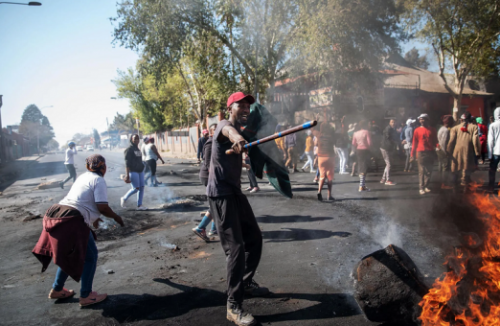
No fewer than 130 Nigerians have so far indicated interest in returning home from South Africa under a voluntary evacuation programme initiated by the Federal Government, following renewed anti-foreigner protests in the country.
Minister of Foreign Affairs, Bianca Odumegwu-Ojukwu, disclosed this in a situation report made public via her X handle on Sunday, noting that the move forms part of intensified efforts to safeguard Nigerians abroad.
She explained that the evacuation plan is one of several diplomatic and security measures being coordinated with Nigeria’s missions in South Africa, in line with directives from President Bola Tinubu.
According to the minister, the President has ordered continuous monitoring of developments, with a firm directive that the safety of Nigerians remains paramount.
“The President has reiterated that the priority at this time remains the safety of our citizens,” she stated.
Odumegwu-Ojukwu further revealed that arrangements were ongoing to collate details of Nigerians willing to return under the voluntary repatriation programme, adding that the number of registrants is expected to rise.
Meanwhile, Nigeria has summoned South Africa’s Acting High Commissioner over the recent unrest, even as diplomatic engagements continue with authorities in Pretoria.
The latest development comes amid renewed anti-immigrant demonstrations in major cities, including Pretoria and Johannesburg, sparking concerns over the safety of foreign nationals, particularly Nigerians.
“There is heightened anxiety over the series of anti-foreigner protests, also targeted at Nigerians in select cities in the Republic of South Africa in recent weeks,” the minister noted.
While acknowledging that South African authorities, including President Cyril Ramaphosa, have condemned the violence, she said disturbing images circulating across social and mainstream media have drawn widespread international condemnation.
She, however, clarified that protests held between April 27 and 29, 2026, were largely peaceful, though marked by a heavy security presence.
“The protests witnessed a largely peaceful procession, under the presence of heavily armed police who occasionally deployed teargas to deter breakdown of law and order.
“There is no recorded killing of any Nigerian or destruction of Nigerian-owned properties during this particular protest,” she added.
Despite this, the minister confirmed two separate fatalities involving Nigerians, both allegedly linked to encounters with security operatives.
She disclosed that Amamiro Chidiebere Emmanuel died on April 25 after sustaining injuries from an alleged assault by personnel of the South African National Defence Force in Port Elizabeth.
Similarly, Nnaemeka Matthew Andrew reportedly died following an encounter with members of the Tshwane Metro Police, with his body later found at the Pretoria Central Mortuary on April 20.
Describing the incidents as “utterly condemnable and unacceptable,” Odumegwu-Ojukwu said Nigerian authorities were closely tracking investigations and pressing for justice.
She further warned of another wave of protests expected between May 4 and 8, prompting heightened diplomatic and security coordination between both countries.
The minister stressed that Nigerian missions in South Africa are working closely with local authorities to ensure the protection of citizens, while evacuation logistics continue.
Recalling Nigeria’s historical role in the anti-apartheid struggle, she urged South Africa to uphold the long-standing spirit of solidarity.
“Nigeria is a frontline state which made great sacrifices towards the liberation struggles of South Africa. Nigerian lives and businesses in SA must not continue to be put at risk,” she said.
Odumegwu-Ojukwu also observed that xenophobic tensions in South Africa often resurface periodically, particularly around election cycles, with anti-foreigner sentiments sometimes exploited for political advantage.
She added that both countries had recently signed a memorandum of understanding on early warning mechanisms aimed at safeguarding citizens, especially during periods of heightened tension.
