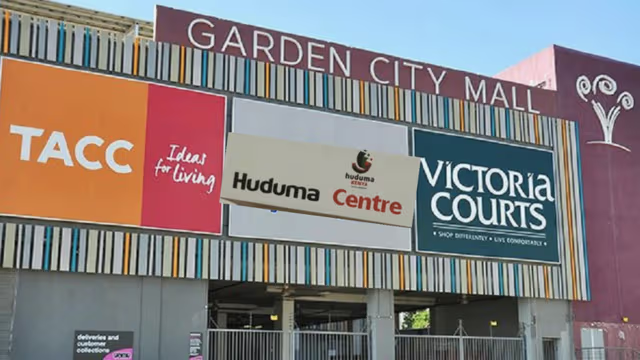
A legal battle over advertising rights at the popular Garden City Mall ended in a surprising twist, leaving the marketing company that once managed the mall’s commercial activities owing money instead of collecting damages.
JohnGray Communication Ltd, the marketing firm hired to handle signage, events, and other commercial activities at Garden City Mall, had claimed it was unfairly forced out of the mall in 2016 and demanded KSh 76.3 million in lost revenue. The firm said it suffered financial losses due to the abrupt termination, including payroll expenses, capital expenditure, lost revenue from corporate clients, and cancelled activations.
The dispute went to the High Court, where Justice Aleem Visram ruled that while GC Retail Ltd, the company owning Garden City Mall, breached its contract with JohnGray by ending the partnership abruptly, JohnGray failed to provide evidence to support its massive claim.
“Having considered the pleadings, evidence and submissions, the Defendant’s (GC Retail Ltd.) Counterclaim is allowed to the extent of KSh 3,257,283.12, being the substantiated sum proved through the Plaintiff’s (JohnGray) own invoices and bank records,” Justice Visram stated.
The court reviewed the history of the relationship, which began even before the parties signed a formal memorandum in May 2015. Emails and internal communications revealed that JohnGray had developed pricing models, mapped advertising space, and projected revenue months before the formal agreement, largely under guidance from GC Retail’s management. The court found that the parties had an implied arrangement based on their conduct, not just the written memorandum.
The central issue was whether GC Retail followed the agreed procedures when terminating the contract in March 2016. Under the termination clause, the mall operator was required to issue a 14-day notice tied to specific contractual triggers. Instead, JohnGray staff were instructed to leave the premises immediately, and management announced that commercialisation would be handled internally, without explanation or remedy period. Justice Visram ruled that this action constituted a breach of contract.
However, the claim for KSh 76.3 million collapsed under scrutiny. JohnGray relied on internal schedules, spreadsheets, and proforma invoices, but failed to provide bank statements, confirmed receipts, or signed client contracts. The court also noted that the firm had received payments from clients like Samsung, undermining attempts to claim the same revenue again.
JohnGray’s additional claim of KSh 20 million for reputational damage also failed. The court found no evidence linking the mall’s actions to measurable harm to the marketing firm’s market standing. Moreover, JohnGray had been allowed to complete pending client contracts under a previous consent order, weakening its argument that the termination caused irreparable damage.
GC Retail’s counterclaim, initially valued at nearly KSh 17 million, suffered the same fate. Most of the amounts were based on JohnGray’s internal projections rather than verifiable transactions. Only KSh 3.26 million could be traced to invoices and bank records, which the court allowed.
In the end, the courtroom battle produced an ironic result: JohnGray successfully proved that GC Retail breached the contract, yet the firm emerged owing the mall operator over KSh 3 million.
Legal experts say the case highlights the importance of proper documentation, including bank statements, signed contracts, and receipts, when claiming damages in commercial disputes. It also underscores that proving a breach of contract does not automatically guarantee recovery of large sums without credible evidence.
The case has since become a reference point in commercial law circles for businesses handling contracts in Nigeria and East Africa, especially in the areas of advertising management, mall operations, and dispute resolution.
