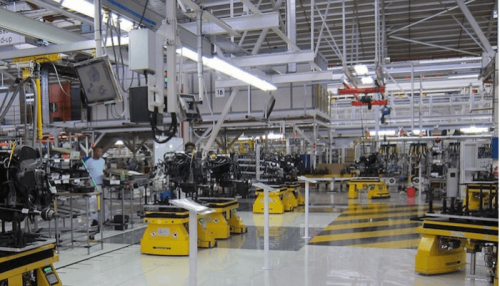
Lagos State has unveiled a new industrial policy aimed at transforming the state into Africa’s leading manufacturing hub, with government officials and private sector stakeholders describing the initiative as a major step toward boosting competitiveness and attracting large-scale investment.
The 2025–2030 industrial policy, launched by Governor Babajide Sanwo-Olu, prioritises regulatory reform, access to finance, stable power supply and industrial cluster development as part of efforts to position Lagos as a strategic gateway under the African Continental Free Trade Area.
Speaking at the launch, Sanwo-Olu, represented by the Secretary to the State Government, Abimbola Salu-Hundeyin, said the policy provides a clear roadmap to reimagine, rebuild and reposition Lagos’ industrial sector for the future.
He said the policy would serve as an implementation engine that localises national ambitions, accelerates industrial productivity and strengthens Lagos’ position as a strategic gateway for Nigeria’s industrial expansion and global competitiveness.
“This policy positions Lagos to emerge as a leading manufacturing hub in Africa,” the governor stated.
Sanwo-Olu stressed the need for Lagos to adapt to rapidly changing global supply chains and technological advancements, noting that the state remains committed to regulatory reform and ease of doing business.
According to him, government is working to ensure that businesses operate in a transparent, predictable and efficient environment.
He added that Lagos is strengthening access to finance and investment promotion by collaborating with financial institutions and development partners to de-risk investments and unlock capital for industrial growth.
The governor further said the state is investing in skills development and workforce readiness to equip residents with competencies required for modern manufacturing.
He explained that the policy aligns with the broader development vision of the state, including the STEAMS Plus agenda and the Lagos State Development Plan 2052.
Key focus areas of the document include regulatory reform, access to finance, skills development, innovation and sustainability.
With Nigeria’s industrial sector facing persistent structural challenges, Sanwo-Olu emphasised the urgency of stronger collaboration between government and industry players to achieve sustainable growth.
Also speaking, Commissioner for Commerce, Cooperative, Trade and Investment, Folashade Ambrose-Medebem, said the policy was the product of months of stakeholder consultations, data-driven analysis and alignment with global best practices.
She noted that the framework provides a roadmap for economic diversification, reduced import dependence and increased value addition across critical sectors of the state economy.
Ambrose-Medebem described the policy as the most ambitious industrial agenda conceived by the Lagos State Government in recent years.
She added that Micro, Small and Medium Enterprises, MSMEs, would play a central role in achieving the policy’s objectives.
“The most consequential commitment in this policy is the one where we have a need for small and medium-sized enterprises,” she said.
According to her, the document also outlines timelines for addressing constraints to industrial growth, including infrastructure deficits, regulatory bottlenecks and supply chain disruptions.
Minister of State for Industry, Trade and Investment, John Enoh, described the policy as a strategic signal that Nigeria’s industrialisation would only be achieved through coordinated action between the federal and sub-national governments.
He said the Lagos policy aligns strongly with the national industrial policy in its emphasis on infrastructure, business competitiveness, MSME growth, skills development, innovation and export readiness.
“It is essential because industrialisation in Nigeria will only succeed when federal vision and strategic plan execution move in lockstep,” he said.
Meanwhile, the organised private sector welcomed the initiative but stressed the importance of implementation.
Director-General of the Manufacturers Association of Nigeria, Segun Ajayi-Kadir, said the country had lacked a comprehensive national industrial policy for decades and noted that Lagos’ version could bring certainty to businesses and reduce regulatory bottlenecks.
He added that manufacturers expect the policy to be practicalised to improve cluster management, power access, port efficiency and economies of scale.
Also speaking, Ayotunde Coker, representing the Lagos Chamber of Commerce and Industry, said Lagos is already Africa’s digital infrastructure hub but requires the right physical infrastructure to unlock its full industrial and innovation potential.
