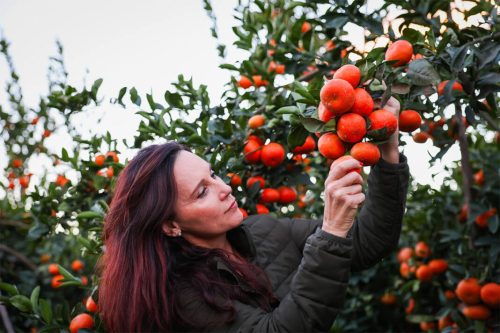
Starting a new business is most often done closer to home. Stephanie De Wit did it the other way around. She started her fruit export company, Agri Bianco, in Morocco. Six years later she has come full circle by opening a South African office, and shares the lessons and experiences locally that shaped her to start a new venture in a foreign country and culture.
Stephanie De Wit ended up in Marrakesh, Morocco purely by chance on a business visit for a previous employer. A Moroccan company contacted her afterwards to join them. When this company was sold, she was “not ready to leave” and started her own export company in 2020.
“My move to Morocco was unexpected, but once I arrived, I saw enormous potential. They have strong growing regions, a favourable geographic position for Europe, and ambitious producers. But I also saw a gap – a need for structured programs, brand positioning, and a disciplined export approach, aligned with European retail expectations. Agri Bianco became the vehicle to build structured, year-round supply programs across citrus and other categories,” recounts De Wit.
Agri Bianco supplies citrus, blueberries, avocadoes, watermelons, pomegranates, watermelons, and peppers to world markets from Morocco. Her business quickly expanded, with exports sent worldwide to more than 15 countries. Agri Bianco is close to hitting the million-carton mark on citrus, with 800 000 boxes of 15kg currently exported.
Ladismith is where it all started
De Wit hails from Ladismith in the Western Cape. She credits her farming upbringing and early career schooling across the citrus value chain in South Africa, that now enables her to tackle the challenges in faraway Morocco.
“Growing up with a father who farmed shaped me deeply. Farming teaches humility. Nature doesn’t negotiate. You learn patience, risk management, and the importance of long-term thinking.”
“One of the most powerful influences on my leadership mindset has been the resilience of South African growers. Working alongside producers supplying exporters like MMG Citrus, I saw firsthand how they navigated rising input costs, currency volatility, water challenges, and logistical bottlenecks. Yet they still delivered export-quality fruit season after season,” adds De Wit.
Overcoming cultural and business differences
De Wit had to make a big cultural adjustment, given that South Africa and Morocco are completely different.
“The biggest adjustment was cultural. Morocco is relationship-driven and trust-based. Decisions often move through people before they move through systems. In South Africa, processes dominate, but in Morocco, relationships come first. Understanding and respecting that dynamic was critical.”
South African fruit export learnings key
De Wit says her 17 years of both South African and international experience across the UK, Spain and Australia turned out to be the perfect preparation needed to start her own venture.
“Operationally, there were differences in packhouse structures, grower integration, and commercial tempo. I had to listen more than I spoke in the beginning. Adaptation came from respect. I didn’t try to import a South African system, but I drew on the fundamentals.”
“My South African training gave me a strong structural backbone. The industry there is highly export-focused, data-driven, and disciplined, and that mindset has given me a competitive edge in Morocco,” she explains.
Women‑led leadership in a male‑dominated sector
Morocco is a very male-dominated society, so De Wit had to break several barriers to gain trust.
“In a traditionally male-dominated sector, you quickly learn that credibility is earned through competence, consistency, and composure. It’s a journey. Not always an easy one, but when you love what you do it’s worth it. And then resilience is key,” says De Wit.
Building the Lady M brand
She built the Lady M brand, which is distinctly Moroccan, yet influenced by her South African roots.
“The creation of Lady M came from a desire to move beyond simply exporting fruit, and instead build a brand that represents consistency, quality, and identity. What makes Lady M distinctly Moroccan is its origin. The fruit, the growers, and the Moroccan roots where our journey started. When we had to decide on a name, we said Morocco is like a lady, not always easy, but from royal blood coming from the Kingdom of Morocco.”
“At the same time, my experience in South Africa’s structured export environment strongly influenced how the brand was built. The focus on quality, consistency, and long-term customer programs reflects that background. Lady M is a fusion of Moroccan origin and character, combined with the disciplined export mindset I developed in South Africa,” says De Wit proudly.
Future expansion plans for Lady M
‘Returning’ home by opening an office in Cape Town, South Africa is part of hers, as well as the company’s growth.
“We aim to continue strengthening Lady M in citrus, expand structured programs, and further integrate supply between hemispheres. Then there will be branching out the brand to other categories or commodities,” concludes De Wit.
