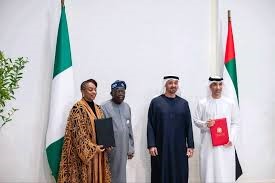
Nigeria has signed a Comprehensive Economic Partnership Agreement (CEPA) with the United Arab Emirates (UAE), a move the Federal Government has described as a major boost to trade relations and economic diversification.
The agreement was signed in Abu Dhabi on January 13, 2026, according to a statement issued by the Minister of Industry, Trade and Investment, Dr. Jumoke Oduwole.
Oduwole said the pact would significantly deepen trade and investment ties between both countries through the elimination of thousands of tariffs and the expansion of opportunities in goods, services and professional exchanges.
She noted that the agreement prioritises improved market access for Nigerian products and services, supports quality investment inflows and aligns with President Bola Ahmed Tinubu’s Renewed Hope Agenda.
Under the deal, the UAE will immediately remove tariffs on more than 7,000 Nigerian products, including fish and seafood, oil seeds, cereals, cotton, pharmaceuticals and chemicals. Tariffs on Nigerian machinery, vehicles, electrical equipment, apparel and furniture will also be phased out within the next three to five years.
“This gives Nigerian industrial exports a clear and competitive route into one of the world’s most dynamic trading hubs,” Oduwole said.
She added that Nigerian businesses will now be able to establish companies, branches and subsidiaries in the UAE, while business visitors can stay for up to 90 days within a 12-month period. Corporate transferees, including managers and specialists, will be eligible for renewable three-year relocation permits.
According to the minister, the agreement removes longstanding barriers to foreign direct investment and provides clarity for UAE investors looking to invest in Nigeria’s productive sectors.
On Nigeria’s part, tariffs will be eliminated on about 6,000 imported products, mainly industrial inputs, capital goods and machinery needed to strengthen local production. About 60 per cent of these tariff cuts will take effect immediately, while the remainder will be phased out over five years. She stressed that Nigeria’s Import Prohibition List remains unchanged.
The CEPA also covers trade in services across 10 sectors and 99 service areas, including business, communications, transport, finance, construction, health, environment, sports and tourism.
Oduwole described the agreement as a strategic tool for economic transformation, noting that it positions Nigeria as a gateway for investors seeking access to the African Continental Free Trade Area (AfCFTA) market of over 1.4 billion people.
She disclosed that UAE institutional investors, including First Abu Dhabi Bank, have already shown strong interest in major Nigerian projects such as the Lagos–Calabar Coastal Road, describing it as a vote of confidence in Nigeria’s reform agenda.
Implementation of the agreement will be led by the Federal Ministry of Industry, Trade and Investment, in collaboration with agencies such as the Nigeria Customs Service, Nigerian Export Promotion Council, Nigerian Investment Promotion Commission and the Standards Organisation of Nigeria.
The minister commended both Nigerian and UAE negotiation teams for their roles in finalising the agreement and urged Nigerian entrepreneurs and manufacturers to take advantage of the expanded market access.
“This agreement was negotiated for the Nigerian private sector. Nigerian businesses now have open access to the UAE, the Middle East and beyond,” she said.
