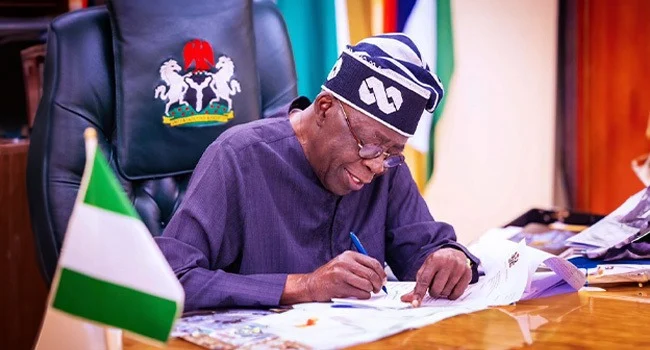
President Bola Ahmed Tinubu has appointed Dr Mulisiu Oseni as the Chairman of the Nigerian Electricity Regulatory Commission following the confirmation of members of the commission’s board by the Senate. The appointment comes months after controversy surrounded the leadership of the power sector regulator and signals a formal resolution of the succession process at the commission.
Oseni’s appointment shows that the President has dropped Abdullahi Ramat, whose name was earlier forwarded to the Senate for confirmation as NERC chairman in August. Ramat, a former Chairman of Ungogo Local Government Area in Kano State, was nominated by President Tinubu shortly after the exit of the immediate past chairman of the commission, Mr Sanusi Garba. The nomination was announced in a statement issued on August 7 by the Special Adviser to the President on Information and Strategy, Mr Bayo Onanuga.
Ramat’s nomination, however, quickly became controversial. Despite not yet being confirmed by the National Assembly, the 39-year-old nominee reportedly stormed the Abuja headquarters of the Nigerian Electricity Regulatory Commission on August 8 to assume office. He arrived at the commission accompanied by political associates and security personnel, including an individual seen in a military uniform in widely circulated videos. The development raised concerns within the power sector and among key stakeholders over due process and the independence of the regulator.
At the NERC office, Ramat was received by Dr Mulisiu Oseni, who was then the Vice Chairman of the commission, during what was described as a handover ceremony. However, following widespread public criticism and concerns raised by industry operators, civil society groups, and members of the public, Ramat later left the premises without formally taking over the leadership of the commission.
In the weeks that followed, the Senate Committee on Power declined to confirm Ramat’s nomination. According to reports, the committee cited several petitions and complaints submitted against the nominee as the basis for its decision. The delay and eventual refusal to confirm his appointment led to heightened political tension, particularly in Kano State, where some of his supporters accused the Senate of acting in bad faith.
Some loyalists of Ramat alleged that members of the Senate had been paid as much as $10 million to block his confirmation. The allegation sparked further controversy and protests. A Kano-based civil advocacy group, Grassroots Initiative Concept, staged a protest at the National Assembly, calling on lawmakers to urgently confirm Ramat’s appointment as NERC chairman.
However, the Chairman of the Senate Committee on Media and Public Affairs, Senator Yemi Adaramodu, dismissed the allegation of bribery as false and unfounded. According to him, the Senate’s decision to suspend and eventually halt Ramat’s screening was based solely on what he described as “a barrage of public and private complaints” against the nomination. He maintained that the Senate acted within its constitutional responsibilities and followed due legislative process.
Meanwhile, in a statement issued on Thursday, Bayo Onanuga announced the appointment of Dr Mulisiu Oseni as the substantive Chairman of the Nigerian Electricity Regulatory Commission. Oseni had been serving as Acting Chairman of the commission following the exit of the former chairman in August.
According to the statement, Oseni’s appointment as NERC chairman took effect from December 1, 2025, and will last until the completion of his 10-year tenure at the commission, in line with the provisions of the Electricity Act, 2023. The Act provides a clear framework for appointments, tenure, and succession within the electricity sector regulator.
“His appointment as chairman took effect from 1 December 2025 and shall subsist until the completion of his 10-year tenure at the commission, in accordance with the provisions of the Electricity Act, 2023,” the statement said.
Oseni joined the Nigerian Electricity Regulatory Commission as a commissioner in January 2017 and has spent several years within the regulatory system overseeing key aspects of the electricity market. His elevation to chairman is seen by some industry watchers as a move aimed at ensuring continuity and institutional stability within the commission.
President Tinubu also approved the appointment of Dr Yusuf Ali as Vice Chairman of the commission. Ali was first appointed as a commissioner in February 2022 and assumed his new role as vice chairman with effect from December 1, 2025. According to the presidency, his designation will remain in effect until the completion of his first term.
Other members of the reconstituted NERC Board include Mr Nathan Shatti and Mr Dafe Akpeneye, both of whom are serving second terms after their initial appointments in January 2017. Mrs Aisha Mahmud is also serving a second term, having first been appointed to the commission in December 2020.
Dr Chidi Ike, who was first appointed in February 2022, continues his first term as a commissioner on the board. In addition, Dr Fouad Animashaun joins the commission for his first term, effective from December 2025. According to the presidency, Animashaun is an energy economist with extensive experience in Nigeria’s power sector and most recently served as Executive Commissioner and Chief Executive Officer of the Lagos State Electricity Regulatory Commission.
President Tinubu has charged the newly reconstituted board of the Nigerian Electricity Regulatory Commission to deepen and consolidate the ongoing transformation of Nigeria’s power sector. He urged members of the board to align strictly with the provisions and objectives of the Electricity Act, 2023, as the country continues efforts to improve electricity supply, regulation, and market stability.
