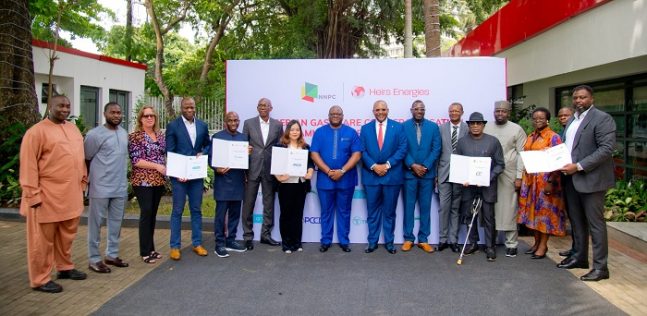
The NNPC/Heirs Energies OML 17 Joint Venture has advanced Nigeria’s gas commercialisation and environmental protection drive with the symbolic signing of Gas Flare Commercialisation Agreements under the Nigerian Gas Flare Commercialisation Programme (NGFCP) and approved Non-NGFCP frameworks.
The ceremony took place in Lagos and marked a major shift from policy approvals to structured commercial execution. The signing allows previously flared gas across Oil Mining Lease 17 (OML 17) to be captured and deployed for productive use, including electricity generation, industrial fuel, Liquefied Petroleum Gas (LPG), and Compressed Natural Gas (CNG). This aligns with Nigeria’s gas development strategy and energy transition goals.
The agreements were signed between Heirs Energies, the operator of the OML 17 Joint Venture, and approved flare gas offtakers. The offtakers include AUT Gas, Twems Energies, Gas & Power Infrastructure Development Limited (GPID), PCCD, and Africa Gas & Transport Company Limited (AGTC). These frameworks are designed to eliminate routine gas flaring while converting what was previously wasted gas into economic and environmental value.
Speaking at the event, the Chief Upstream Investment Officer of NNPC Upstream Investment Management Services (NUIMS), Engineer Seyi Omotowa, who represented NNPC Limited, described the milestone as a practical demonstration of Nigeria’s commitment to gas-led economic development.
He stated that for NNPC Limited and NUIMS, gas flare commercialisation is not just a regulatory obligation but a strategic pathway to increasing energy availability, promoting gas-based industrialisation, and strengthening Nigeria’s standing as a responsible energy producer. According to him, the OML 17 project has become a model by moving from approval stage to real delivery.
He also commended Heirs Energies for its discipline, investment, and operational focus, noting that the Joint Venture is setting new benchmarks in gas development and upstream performance in Nigeria’s oil and gas industry.
The Chief Executive of the Nigerian Upstream Petroleum Regulatory Commission (NUPRC), Engineer Gbenga Komolafe, who was represented at the ceremony by Senior Manager Ojo Ezekiel, also reaffirmed the Commission’s strong support. He described flare gas commercialisation as a key pillar of Nigeria’s decarbonisation strategy under the Petroleum Industry Act (PIA) 2021.
Ezekiel said the signing demonstrated Heirs Energies’ commitment to ending routine gas flaring across OML 17 and fully aligned with the goals of the Gas Flare Commercialisation Programme and Nigeria’s national emission reduction targets.
The Chief Executive Officer of Heirs Energies, Mr. Osa Igiehon, said the agreements reflected the company’s wider gas-led growth strategy and brownfield excellence approach, which focuses on unlocking long-term value from existing assets. He explained that gas remains central to Nigeria’s development journey.
According to him, through disciplined investment, close partnership with regulators, and collaboration with credible gas offtakers, the company is turning wasted resources into value, strengthening domestic energy supply, and promoting responsible operations across OML 17.
The NGFCP and Non-NGFCP flare gas projects build on recent operational improvements by the Joint Venture, including increased gas supply to the domestic market through brownfield field interventions and infrastructure optimisation. The JV has also continued to strengthen its relationship with host communities through healthcare programmes, education support, and skills development initiatives across its operational areas.
With the symbolic signing now completed, the flare gas offtakers are expected to move into full-scale project implementation. They will work closely with the Joint Venture, regulators, and host communities to deliver commercial, environmental, and social benefits.
The OML 17 NGFCP initiative strengthens Nigeria’s ambition to build a gas-led economy. It is expected to support domestic power generation, industrial expansion, cleaner cooking fuel adoption through LPG and CNG, and responsible resource development, while helping Nigeria progress toward its long-term energy transition and climate commitments.
