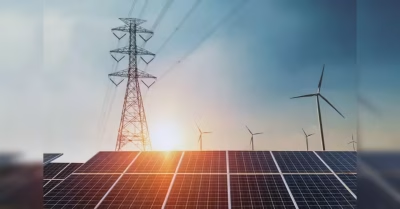
As countries accelerate the shift to cleaner energy, experts warn that widening gaps in power infrastructure could undermine energy security, industrial growth and affordability.
While the global energy transition was initially driven by climate goals, it is now equally shaped by concerns around reliable electricity supply, reindustrialization and rising energy costs. With more sectors being electrified, massive investments are required not only in renewable generation but also in grids and system flexibility to support them.
Renewable energy deployment has expanded rapidly in recent years. Solar and wind now account for more than 90 percent of new global electricity capacity, while clean energy provides about 40 percent of global power generation. However, analysts say ageing grids designed for a different era are struggling to keep pace with rising demand and the complexity of renewable energy systems.
Recent blackouts and grid failures across Europe and parts of Asia have exposed the fragility of existing infrastructure. In Europe, an energy shock triggered by the Ukraine war accelerated renewable adoption, raising its share of electricity generation to nearly 50 percent. Yet grid congestion and ageing transmission lines are now slowing further progress and increasing system risks.
Asia faces even greater pressure. The region accounts for roughly 60 percent of global emissions and population, making its energy infrastructure choices critical. China has emerged as a global leader by matching clean energy expansion with large-scale grid investments. In 2024 alone, it invested over $600 billion in clean energy and continues to roll out ultra high voltage transmission lines that move renewable power across long distances with minimal losses.
By contrast, Europe and other advanced economies are still lagging behind. Although grid investment has increased, it remains below the level needed to support renewable growth. The International Energy Agency estimates that global grid capacity must at least double within the next 15 years. Without this, up to 1,500 gigawatts of renewable projects could be delayed due to grid connection constraints.
Experts warn that weak grid infrastructure drives up electricity prices, slows industrial development and erodes public trust. Inadequate investment could also force countries to rely longer on fossil fuel imports, undermining climate targets and energy independence.
To close the gap, analysts say governments must prioritize early and coordinated investment in power infrastructure, strengthen public private partnerships and reform regulations to attract private capital. Public engagement and affordability, they add, will be crucial to sustaining support for the energy transition.
Without urgent action, experts caution that clean energy ambitions may outpace the infrastructure needed to sustain them, leaving economies vulnerable to power shortages, higher costs and stalled growth.
