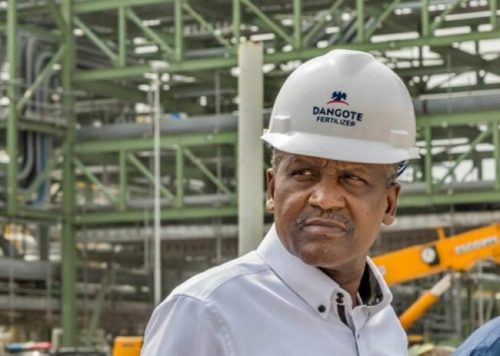
The Chief Executive Officer of the National Petroleum Authority, Godwin Edudzi Tameklo, has said that the operations of the Dangote Refinery in Nigeria are providing a significant buffer for the West African sub-region amid rising global crude oil market tensions.
Tameklo noted that the refinery, owned by Africa’s richest man, Aliko Dangote, has altered the energy supply dynamics within the region through its large-scale production capacity.
According to him, the refinery’s production of about 650,000 barrels per day is substantial enough to strengthen supply within the region and create room for exports.
“The presence of Dangote has changed the dynamics greatly because he is also doing significant production in Nigeria. The production he is doing, which is about 650,000 barrels every day, is quite significant and gives him the capacity to export a large portion,” Tameklo said.
He added that the refinery serves as an important buffer for the West African sub-region at a time when global oil markets are experiencing uncertainty.
Tameklo further disclosed that about 80 per cent of the crude oil products imported into Ghana come from the European market, while the remaining 20 per cent are sourced from the Arabian region.
He explained that the ongoing geopolitical tensions in the Middle East could affect supply chains, particularly for refineries in Europe that supply Ghana and other countries.
Speaking on a current affairs programme on TV3, Tameklo assured Ghanaians that authorities are closely monitoring developments in the global energy market.
“We are not leaving anything to chance. We have a proactive sector minister, strong national security coordination and leadership from the presidency to ensure we manage the situation properly,” he said.
According to him, the government has intensified engagement with international partners while closely analysing supply trends in Europe, particularly in key trading hubs such as Rotterdam.
“We are constantly studying the data and the supply chain dynamics in Europe. Once we fully understand the situation, we will determine how best to provide a buffer for the remaining imports coming from the Arabian region,” he added.
Meanwhile, global oil prices surged past $100 per barrel on Monday following escalating tensions in the Middle East after a series of military confrontations that have unsettled global energy markets.
The crisis intensified after the United States and Israel reportedly launched a major military campaign known as Operation Epic Fury against Iran, which allegedly led to the killing of Iran’s Supreme Leader, Ali Khamenei, alongside several senior government officials.
Iran responded with missile strikes targeting Israel and several Gulf countries, raising fears of a wider regional conflict that could disrupt global energy supplies.
Energy analysts warn that the crisis has placed the global oil market on high alert, particularly due to threats to shipping routes through the Strait of Hormuz, through which nearly one-fifth of the world’s oil and liquefied natural gas supplies pass.
Stephen Innes of SPI Asset Management described the waterway as a critical artery for global energy trade.
“Roughly one-fifth of global oil and LNG flows through the Strait of Hormuz. This is not an obscure canal; it is the aorta of the global energy system,” he said.
The escalating tensions have already begun to affect key energy infrastructure. Operations at Saudi Arabia’s largest refinery in Ras Tanura were reportedly halted after a drone attack, while QatarEnergy temporarily suspended liquefied natural gas production.
Maritime authorities have also reported several attacks on vessels operating within the Gulf region.
The conflict is also beginning to disrupt global shipping routes. Danish shipping giant Maersk has announced plans to divert vessels away from the Suez Canal, opting instead to route them around the Cape of Good Hope, a move expected to increase delivery times and freight costs globally.
Amid the uncertainty, safe-haven assets have surged, with gold prices climbing to record highs of about $5,426 per ounce. Major African gold producers such as Ghana and South Africa are expected to benefit from the price surge.
However, economists warn that sustained increases in energy prices could fuel global inflation, potentially pushing up the cost of transportation, food and industrial goods.
Market volatility has also increased, with the CBOE Volatility Index, commonly referred to as the market’s “fear gauge”, rising sharply as investors react to the uncertainty.
Analysts say that while commodity-exporting African economies may benefit from higher oil and gold prices, consumers could still face rising fuel and living costs if the geopolitical tensions persist.
