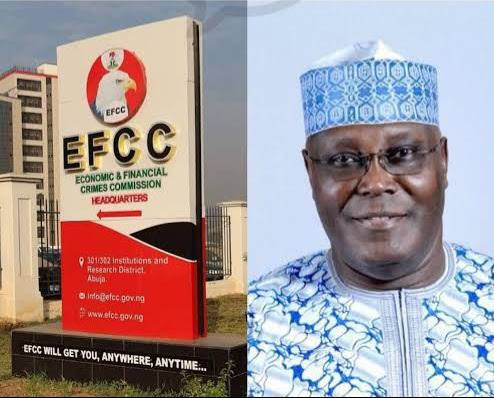
The Economic and Financial Crimes Commission (EFCC) has reopened its investigation into alleged financial crimes involving former Vice-President Atiku Abubakar following a fresh petition by former House of Representatives member Ehiozuwa Agbonayinma.
The petition urges the anti-graft agency to revisit allegations dating back to 2006 and determine whether further investigative or prosecutorial action is warranted.
Agbonayinma said the petition, dated August 27, 2026, was received by the EFCC on September 1. Submitted through his lawyer, Hannibal Uwaifo, it asks the commission to review its September 2006 investigative report on Atiku alongside a report issued by the United States Senate Permanent Subcommittee on Investigations on February 4, 2010.
The former lawmaker subsequently visited the EFCC headquarters in Jabi, Abuja, where he formally adopted the petition and answered questions from investigators.
He maintained that allegations of financial wrongdoing should be addressed regardless of the political influence or social standing of the individuals involved.
“The laws are meant for both the rich and the poor,” Agbonayinma said, urging the commission to ensure that its previous investigative work was not left without appropriate follow-up.
According to the petitioner, the EFCC had previously indicated that Atiku could face prosecution after leaving office as vice-president, when the constitutional immunity attached to the position no longer applied.
Agbonayinma claimed that no prosecution followed the earlier investigation and described the alleged failure to act as a dereliction of duty by the relevant authorities.
He argued that revisiting the reports would allow the commission to clarify the status of its earlier findings and determine whether the allegations justify further action under the law.
The former lawmaker also disclosed that he had petitioned United States President Donald Trump over the matter, indicating his intention to pursue the allegations through channels outside Nigeria.
The petition does not establish that Atiku committed any offence. Any decision on prosecution would depend on the EFCC’s assessment of the evidence and the applicable legal procedures.
The development comes as political activities gather momentum ahead of Nigeria’s 2027 general elections, with Atiku among the prominent opposition figures expected to contest the presidency.
The EFCC’s handling of the petition is likely to draw public attention to questions surrounding the treatment of corruption allegations involving high-profile political figures.
