
South African aviation authorities are reviewing a low-altitude flyover involving two Airlink passenger jets before a rugby match in Cape Town, following concerns about the safety of the maneuver.
The South African Civil Aviation Authority (SACAA) said on Wednesday that it had obtained the aircrafts’ flight data recordings and requested additional information from regional airline Airlink. The authority said it will issue a full report and recommendations after completing its assessment.
“It is therefore critical that we interrogate this past weekend’s events … to determine if there were any safety concerns which warrant a review,” the agency said in a statement.
Airlink Cancels Another Planned Flyover
Airlink has withdrawn plans for another passenger jet flyover at the upcoming rugby match at Johannesburg’s FNB Stadium, according to the SACAA, which oversees aviation safety and security in South Africa.
The Cape Town flyover took place ahead of the Aug. 29 Springboks-All Blacks match at DHL Stadium. The dramatic appearance of the two aircraft was met with loud cheers from an estimated 56,000 spectators, although videos shared online also prompted questions about how close the planes appeared to be to the stadium.
Deandra Peters, a 25-year-old pilot and aviation enthusiast attending her first live rugby match, said the experience inside the stadium was difficult to convey through video.
“You can watch the planes fly over, but you can’t recreate what it felt like to be inside a stadium full of Springbok supporters absolutely losing their minds,” she told The Associated Press. “The atmosphere was electric — the noise, the pride, the emotion. It was a very uniquely South African moment.”
Airlink Defends Safety Measures
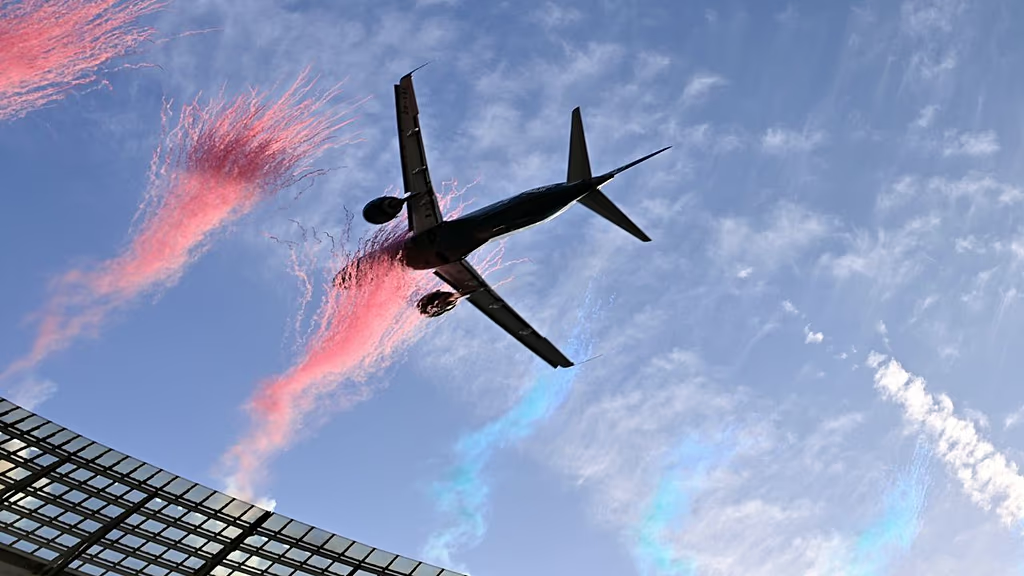
Airlink said the flyover had been carefully planned and rehearsed, stressing that safety remained “the first consideration at every stage of the process.”
The airline said each aircraft involved in the maneuver had three senior captains on board, with the crews having more than 75,000 combined flight hours.
Earlier in the week, Airlink provided data from the aircraft black boxes to the civil aviation authority as part of the review.
While acknowledging the excitement generated by the flyover, the airline also recognized what it called the “valid questions and concerns” raised afterward.
“We never intended to become the news or upstage Rugby’s Greatest Rivalry,” Airlink chief executive de Villiers Engelbrecht said in a statement.
South Africa’s Long Tradition of Rugby Flyovers
According to the SACAA, Airlink had submitted applications for three flyovers. The Cape Town event was the second, following an earlier flyover in Johannesburg on Aug. 22. Both had received approval under the requirements governing special air events.
Airlink later withdrew its application for a flyover planned for Sept. 1 over Johannesburg’s FNB Stadium. The airline said unfavorable weather forecasts meant the formation flight could not be conducted safely, a decision the SACAA confirmed.
Stadium flyovers have long been part of major rugby events in South Africa. The tradition dates back to the 1995 Rugby World Cup final in Johannesburg, when a Boeing 747 flew over Ellis Park before the Springboks played the All Blacks.
However, the Aug. 29 flyover attracted particular international attention because of how low and dramatic the aircraft appeared. Some aviation experts subsequently questioned whether the maneuver left enough room for error, prompting authorities to take a closer look at the event.
