Success does not always resolve the questions that come with getting older, earning more money or gaining influence. For some people, the more conventional markers of progress begin to raise a different set of questions about purpose, freedom, identity and whether the life they have built still reflects what they want.
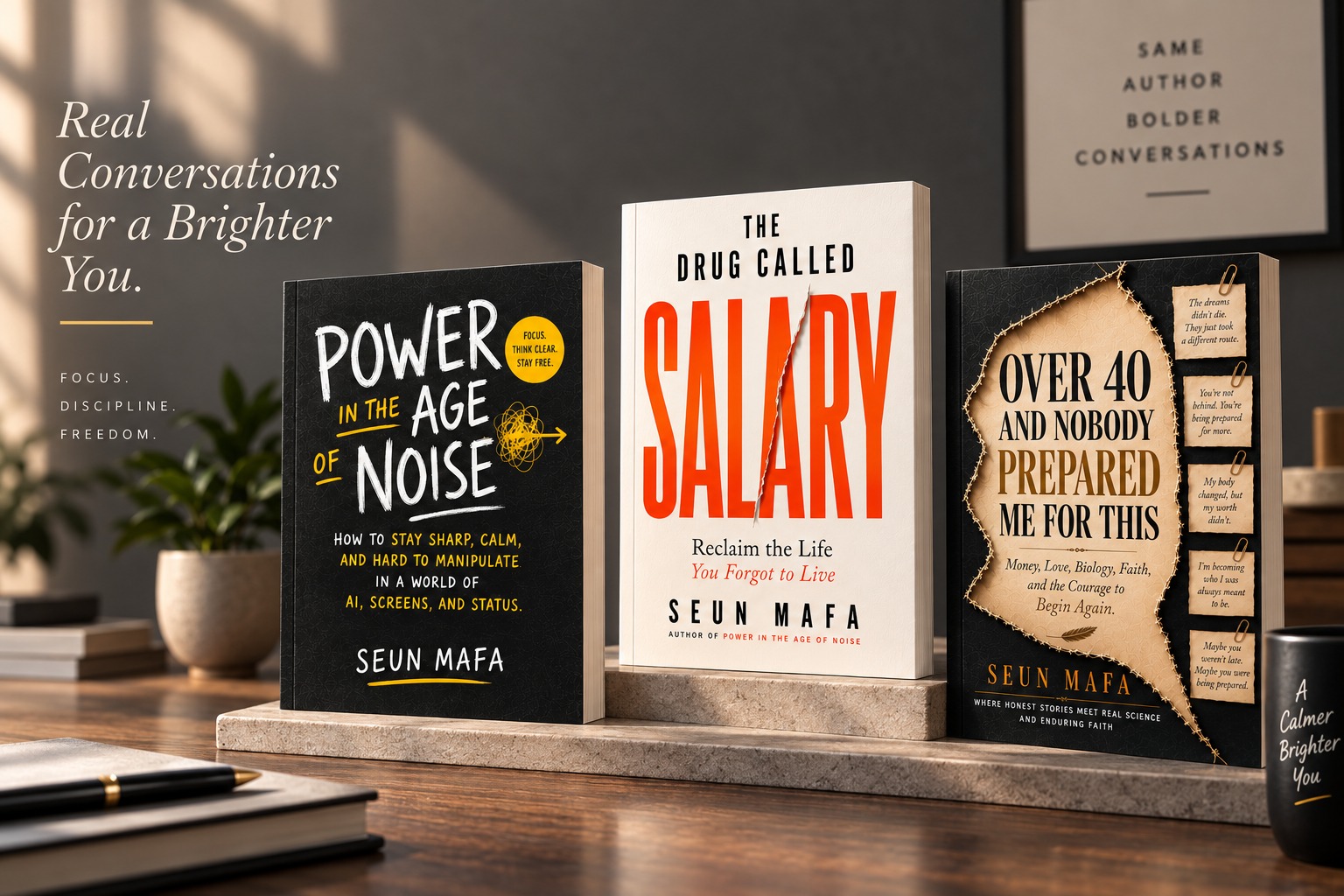
It is this tension that runs through the latest body of work by consultant, author and speaker Seun Mafa, whose three books, Over 40 and Nobody Prepared Me for This, The Drug Called Salary and Power in the Age of Noise, examine different aspects of modern adult life.
The books approach subjects that are often discussed separately but frequently overlap in people’s lives: ageing and expectations, employment and financial security, attention and personal judgment.
In Over 40 and Nobody Prepared Me for This, Mafa examines what happens when reaching a certain stage of life does not bring the clarity many people expect.
For some, turning 40 comes with financial obligations, delayed ambitions, changes in relationships or a growing awareness that time is moving differently. Others find themselves questioning a life they spent years building because it no longer feels as relevant to who they have become.
Rather than presenting midlife as a crisis, the book approaches it as a period of reassessment. Mafa explores money, relationships, biology, faith and reinvention while encouraging readers to take an honest look at where they are and consider what they want the next stage of their lives to look like.
The underlying argument is that an unexpected life is not necessarily an unsuccessful one. There can still be room to make different choices and find meaning in a chapter that did not unfold according to the original plan.
His second book, The Drug Called Salary, turns to the workplace and the relationship many people develop with financial security.
A regular salary provides stability and allows people to meet responsibilities, but Mafa examines how that stability can also make it difficult to consider alternatives, particularly when the work itself has become a source of dissatisfaction.
The book does not present leaving employment as the answer for everyone. Instead, it examines the point at which a dependable income can become so central to a person’s sense of security that the possibility of doing anything else begins to feel too risky.
Mafa’s focus is on restoring choice before circumstances force a decision. For some readers, that could mean developing another source of income, acquiring a new skill or building something independently. For others, it may simply mean taking a more honest look at the relationship between their work, income and the life they want to lead.
The third book, Power in the Age of Noise, moves from work and personal reinvention to the challenge of maintaining independent judgment in an increasingly distracted world.
Artificial intelligence, social media, constant notifications and the pressure to remain visible have changed the way people consume information and interact with one another. The volume of information available to individuals has increased, but so has the competition for their attention.
Mafa examines attention, influence, status and self-command, with particular focus on the ability to think independently in an environment where people are constantly being encouraged to react.
The book considers how urgency can sometimes take the place of reflection and how external expectations can influence decisions that should ordinarily be guided by personal conviction.
For Mafa, maintaining the ability to pause, assess information and make decisions without being driven by every external signal is increasingly important.
Although the three books deal with different subjects, they are connected by a broader concern about how people make decisions about their lives.
Over 40 and Nobody Prepared Me for This looks at the gap between the life people expected to have and the one they eventually find themselves living.
The Drug Called Salary examines the relationship between financial security and personal freedom.
Power in the Age of Noise considers the influence of an increasingly crowded information environment on individual judgment.
Taken together, the books speak to a particular group of readers: people who may appear to be doing well by conventional measures but are privately reconsidering what success means to them.
Mafa’s writing focuses less on offering simple answers than on encouraging readers to ask questions they may have postponed. The books examine the points at which people begin to reassess their choices, whether because of age, work, financial security or the growing influence of technology and public opinion.
The three titles are available individually and as a collection through the official Seun Mafa bookstore.
