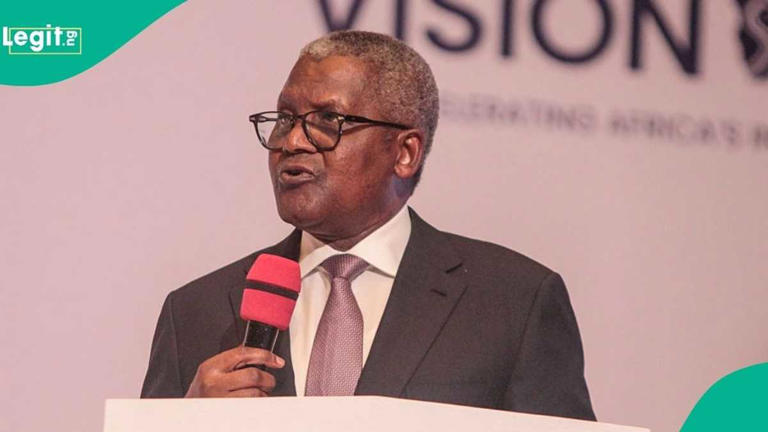
Africa needs reliable electricity, stronger financial institutions and consistent industrial policies to become a global manufacturing powerhouse, Aliko Dangote, president of Dangote Group, has said.
Speaking at the 2026 Financial Times Africa Summit in London, Dangote argued that the continent has the natural resources, population and investment opportunities needed to build a strong manufacturing sector. However, inadequate infrastructure, limited access to long-term financing and weak industrial policies continue to prevent African economies from fully benefiting from these advantages.
He identified electricity supply as one of the most urgent challenges facing the continent, noting that power shortages make it difficult for manufacturers to operate efficiently and for mining companies to process raw materials locally.
“For Africa, what we need the most today is actually power,” Dangote said.
He pointed to the estimated 650 million Africans without access to electricity, arguing that the scale of the deficit is incompatible with the continent’s industrial ambitions.
Power Shortages Restrict Manufacturing Growth
Dangote said unreliable electricity forces African countries to export raw materials rather than process them locally into higher-value products.
The mining sector illustrates the problem, as companies often struggle to establish processing plants near mineral deposits because they cannot secure dependable electricity supplies.
Without sufficient power, manufacturers face higher operating costs, while investors may be discouraged from establishing factories and other industrial facilities.
Expanding electricity infrastructure could therefore help African economies develop local manufacturing, create jobs and retain more of the value generated from their natural resources.
Dangote’s comments reinforce the argument that industrialisation requires coordinated investment in energy, transport and other essential infrastructure rather than relying on natural resource exports alone.
Dangote Calls for Stronger African Financial Institutions
Beyond electricity, Dangote stressed the need for financial institutions capable of providing long-term funding for large industrial projects.
He argued that African businesses need access to financing that matches the scale, cost and extended construction periods associated with major manufacturing investments.
Dangote used the development of the Dangote Petroleum Refinery in Lagos to illustrate the difficulties African investors face when trying to secure conventional project financing.
According to him, obtaining funding through traditional channels proved extremely difficult, forcing the group to finance the refinery from its own balance sheet.
The project also faced significant currency risks during construction. Dangote said the exchange rate moved from approximately ₦136 to the dollar to as high as ₦1,800, while about 90 per cent of the group’s revenue was denominated in naira.
He explained that prolonged financing negotiations can delay projects, increase construction costs and expose investors to changing economic conditions.
Stronger domestic financial institutions, he argued, would help African businesses mobilise the capital required to develop large-scale industrial operations and compete internationally.
$50bn Investment Plan Targets Africa’s Industrial Future
Dangote has outlined a $50 billion investment programme for 2026 to 2030, aimed at expanding industrial activity and demonstrating the potential of large-scale investment across Africa.
The plan is intended not only to grow his business interests but also to encourage other African entrepreneurs and investors to participate in developing the continent’s productive capacity.
Dangote said the broader objective was to establish an industrial ecosystem that creates employment, expands local production and keeps more economic value within African economies.
“The legacy we are trying to set up is how do we industrialise our continent?” he said.
The investment programme reflects his belief that African businesses must take a leading role in developing the continent rather than depending primarily on foreign investors to finance major projects.
However, the success of such investments will depend on the availability of reliable infrastructure, appropriate financing and policies that support long-term industrial development.
Dangote Urges African Governments to Support Local Industry
Dangote also called on African governments to reconsider how they protect emerging industries from competition, particularly from cheap imported products that can undermine domestic manufacturing.
He argued that local producers need policies that allow them to develop and compete with established foreign manufacturers, especially during the early stages of industrial expansion.
At the same time, he supported stronger trade between African countries under the African Continental Free Trade Area (AfCFTA).
His position is that African economies should make it easier to trade with one another while developing a coordinated approach to competing with producers outside the continent.
Such an approach could help expand regional markets, encourage investment in manufacturing and enable businesses to benefit from demand across multiple African countries.
Dangote also questioned why widespread poverty persists despite the continent’s mineral resources, agricultural potential and young population.
He asked, “Why should we remain poor?”
His argument is that Africa’s development challenge is not simply a shortage of resources, but the limited investment and productive capacity needed to transform those resources into goods, businesses and employment.
Africa’s Industrialisation Depends on Investment
Dangote’s proposals highlight the connection between electricity, finance, government policy and manufacturing growth.
Reliable power can lower production costs and make factories more competitive. Stronger financial institutions can provide the long-term capital required for major projects, while consistent industrial policies can give investors greater confidence to commit resources.
For African countries seeking to reduce dependence on imported goods, these factors will be critical to building stronger domestic industries and expanding employment opportunities.
The continent’s challenge is to turn its natural resources and growing population into productive economic activity. Achieving that goal will require sustained investment, stronger institutions and closer cooperation between governments and private businesses.
Dangote’s central argument is that Africa cannot become a major manufacturing hub without first addressing the infrastructure and financing constraints that continue to limit industrial expansion.
