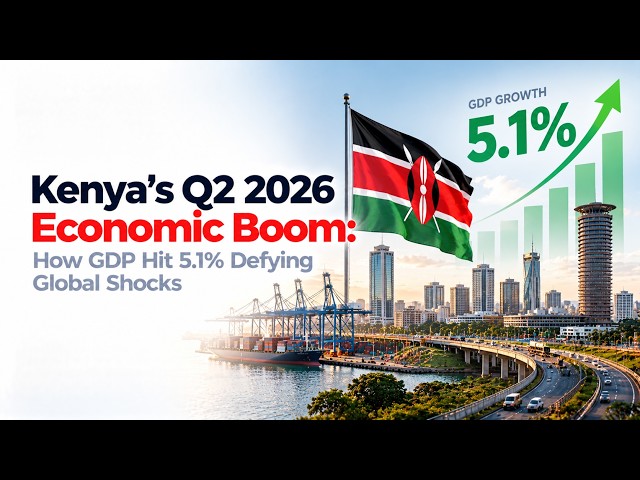
Kenya economy growth picked up in the second quarter of 2026, with output rising 5.1% year on year, up from 4.9% in the same period last year, according to figures reported by CNBC Africa on 19 October.
What happened
Transportation and storage grew by 4.4%, compared with 3.3% in the second quarter of 2025, a sign of stronger activity in the sectors that keep trade, logistics and domestic travel moving. Accommodation and food services also performed well. Electricity, information and communication technology, financial services and construction recorded notable growth too, which means the expansion was spread across services and infrastructure-linked industries rather than resting on a single sector.
Why it matters
The figures give policymakers and investors a modestly encouraging signal. Business Daily reported that the economy grew 5.3% in the first three months of 2026, so growth has held above 5% through the first half of the year. That sits within the 4.9% to 5.2% range projected for 2026 at the Kenya Private Sector Alliance’s Economic Outlook Forum in February. Speakers at that forum pointed to a steadier shilling and slowing inflation as foundations for recovery, and said the path to 6% growth remained a journey.
Growth of 5.1% is also above the 4.5% that the International Monetary Fund projects for sub-Saharan Africa this year. The Fund warned in its October outlook that oil-importing economies are the most exposed to higher energy and food prices. In dollar terms, the IMF’s data put Kenya’s 2026 economy at about $151.2 billion, slightly behind Angola’s estimated $157.3 billion, according to the Rio Times.
The pressure points
Costs remain a concern for households and firms. Business Radar reported that motorists were bracing for a fuel price review on 14 October as an 8% VAT relief ran out, and Radarr has reported that Kenya raised petrol prices by KSh12.93 in the latest review.
What to watch
Three questions matter from here. First, whether Kenya can hold growth near 5% in the second half of the year. Second, whether it can move closer to the 6% that business groups see as the next milestone. Third, how fuel prices and borrowing costs affect consumers and companies as the year ends. Investor appetite for Kenyan businesses, including cross-border banking expansion, will be another signal to follow.
Related on Radarr:
- Kenya Raises Petrol by KSh12.93 as Import Costs Climb
- Kenyan Court Lifts Order on Dangote’s $16bn Lamu Refinery
- Zenith Bank Expands Kenya Operations After Paramount Bank Acquisition
Sources: CNBC Africa via africa.com; The Star; Rio Times; Semafor Africa; Business Radar.
