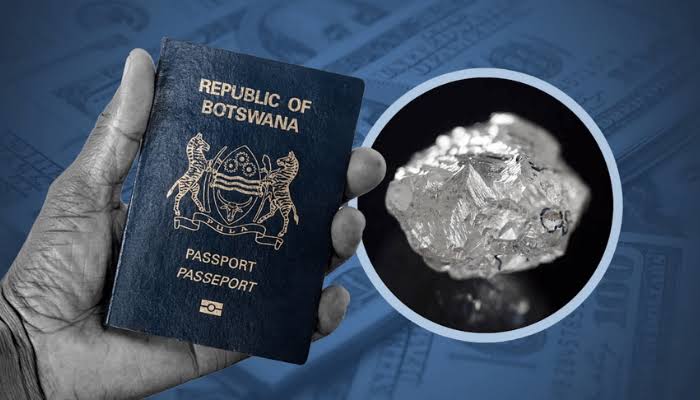
GABORONE, November 26 (Radarr Africa) – The International Monetary Fund (IMF) has cut its 2026 growth forecast for Botswana to 3 per cent from 4.4 per cent, citing persistent weakness in global diamond demand, as the government says it spends about P100 billion a year against revenue of about P80 billion.
The forecast follows the IMF’s latest Article IV consultation. A team led by Faisal Ahmed visited Gaborone from November 9 to 23 and held talks with government officials. The Fund expects the economy to return to growth in 2026 after two consecutive years of contraction, but its forecast falls short of the government’s own projection of 3.8 per cent.
In a statement at the end of the mission, Ahmed said economic activity rebounded in early 2026, supported by mining, but that the recovery remains fragile. “Botswana’s medium-term outlook remains challenging amid structural vulnerabilities and weaker buffers,” he said.
The IMF attributed the downgrade to weak global diamond demand and growing competition from lab-grown diamonds, which have undermined earnings from one of Botswana’s major sources of export revenue and government income. It said growth outside mining is expected to recover only gradually without sustained structural reforms, and that unemployment, especially among young people, remains high.
Inflation was 7.6 per cent in October, largely driven by higher fuel prices, according to the mission statement.
The contraction has been sharp. The economy shrank 2.8 per cent in 2024 and a further 0.7 per cent in 2025, according to analysis by Peter Fabricius for the Institute for Security Studies. Diamonds have historically accounted for 70 per cent or more of exports, about a third of government revenue and about a quarter of gross domestic product.
Fabricius wrote that natural diamonds have lost their sparkle since 2023 as global prices plummet, driven by cheaper lab-grown alternatives and depressed demand in China.
Vice President Ndaba Gaolathe, who is also the finance minister, said the fiscal challenges are largely due to the decline in diamond revenue and can only be addressed through “judicious fiscal management”, new approaches and intensified economic diversification. He spoke at a budget consultation kgotla meeting in Letlhakeng.
Gaolathe said annual expenditure is about P100 billion and annual revenue about P80 billion. The gap forces the government to borrow from the African Development Bank, the World Bank and the OPEC Fund for International Development.
He expressed optimism about the Botswana Economic Transformation Programme, which helps business owners get funding, skills, partners and markets. He said the government is enhancing resources for vocational schools, easing business licensing bottlenecks to attract investors and creating jobs, and will build infrastructure at reasonable cost, with feasibility studies before projects start.
Gaolathe said mineral processing will soon be done locally, that the government is seeking investment partners and that discussions with the government of Zambia on this have started.
President Duma Boko announced this month that Botswana would double its stake in De Beers to 30 per cent. The country already has a 50-50 joint venture with the diamond giant and a 15 per cent stake in De Beers itself. Fabricius called the move counterintuitive and said: “Boko’s announcement seems to have alarmed most observers.”
At the Letlhakeng meeting, Kgosi Itsoseng Gaoonwe said the Department of Tribal Administration lacks transport and asked for a bigger budget. Kebafilwe Moselele, chairperson of the Letlhakeng Village Development Committee, asked for a fully equipped regional hospital and another junior school to ease overcrowding at Mphuthe Junior Secondary School.
