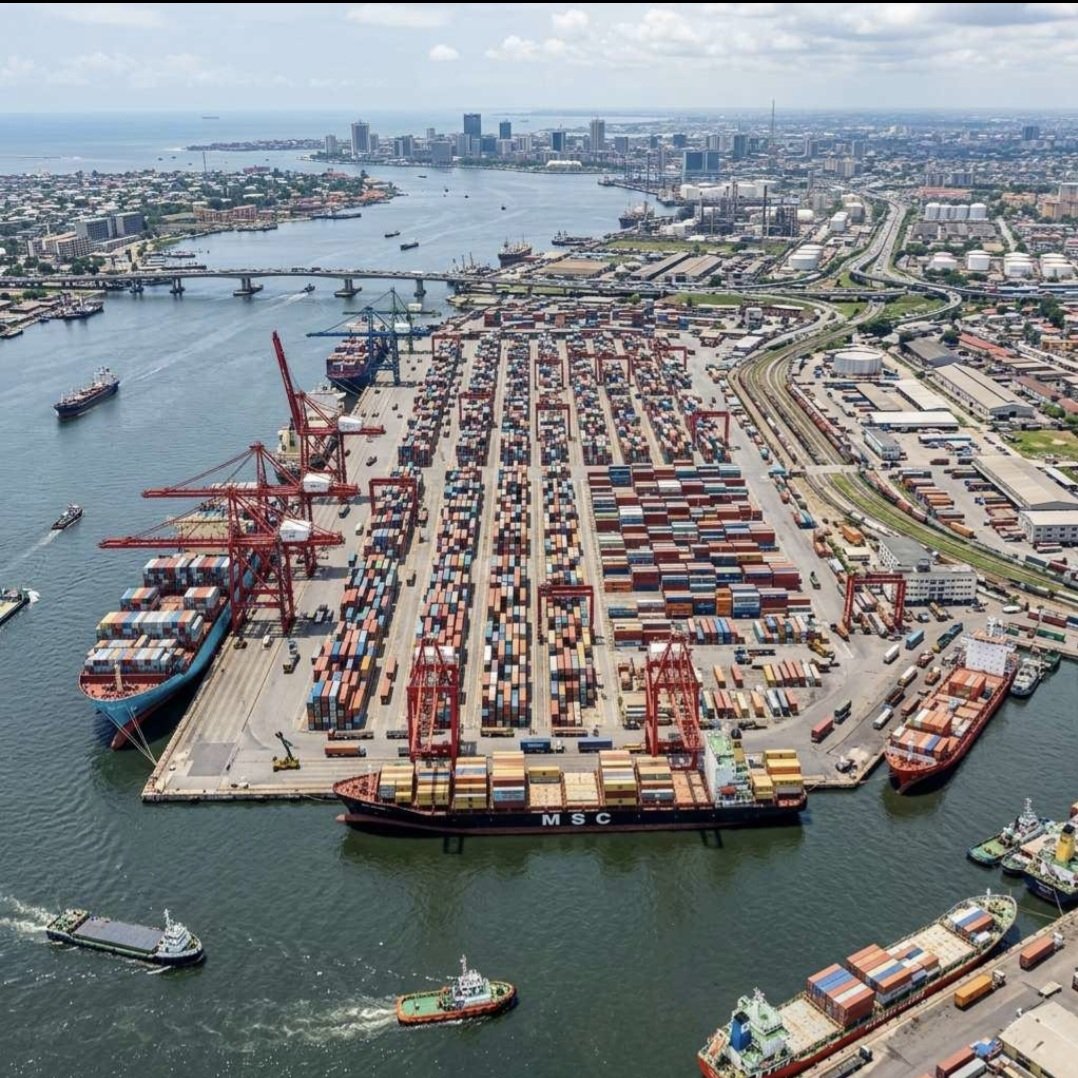
LAGOS, November 26 (Radarr Africa) – The Federal Government on Wednesday broke ground on the reconstruction of the Apapa and Tin Can Island ports in Lagos, eight months after signing a £746 million (N1.45 trillion) financing deal backed by the United Kingdom and after missing two announced start dates.
Adegboyega Oyetola, Minister of Marine and Blue Economy, led the ceremony at Tin Can Island and said the work will create at least 20,000 direct and indirect jobs. His ministry says inefficiency at Nigerian ports costs the economy as much as $4 billion a year.
The project covers quay walls and berths, dredging and navigation channels, access facilities, cargo-handling equipment and operational systems, the ministry said. It includes structural works at Tin Can to support ship-to-shore gantry cranes. Documents from the contractor, ITB Nigeria, put the project cost at $901.86 million.
The loan is guaranteed by UK Export Finance and was arranged by Citigroup. At least £236 million in supplier contracts will go to British firms, including a £70 million order for 120,000 tonnes of steel from British Steel.
Finance minister Taiwo Oyedele described the deal as Nigeria’s largest sovereign export credit transaction since 2009. He said it is also the first project in Nigeria for Poland’s export credit agency, KUKE. Poland’s deputy foreign minister, Marcin Bosacki, and the British deputy high commissioner in Lagos, Jonny Baxter, attended the ceremony.
The two ports handle more than 68 per cent of Nigeria’s container trade, according to the National Bureau of Statistics. Nigerian Ports Authority (NPA) data show Apapa cargo throughput fell 5 per cent to 535,000 tonnes in the six months to June, with 18 fewer vessel calls than a year earlier. At Tin Can, vessel calls fell 3.4 per cent to 488, and vessel turnaround time rose to 5.1 days from 4.4 days.
Oyetola said cargo dwell time at Nigerian ports ranges from 10 to 18 days, against three to five days at leading international ports. Customs agents estimate demurrage at N63,000 per container a day, which means 10 extra days on 10 containers costs N6.3 million. “The cost of inaction is far greater than the cost of modernisation,” he said.
The minister said trade has outgrown the ports. Tin Can was commissioned in 1977, when Nigeria had about 67.2 million people, $17 billion in annual trade and 8.11 million tonnes of throughput. Today the population is about 240 million, according to the International Monetary Fund, merchandise trade is above $100 billion, according to the statistics bureau, and throughput is 129.3 million tonnes, according to the NPA, nearly 16 times the 1977 level.
Nigerian ports have been absent from the Lloyd’s List One Hundred Ports ranking for 10 straight years. The NPA reported 2.1 million twenty-foot equivalent units (TEUs) across all Nigerian seaports in 2025. Tanger Med in Morocco, the top African port in the 2026 ranking, handled about 11.1 million TEUs.
To keep cargo moving during construction, Oyetola approved an inter-ministerial committee made up of his ministry, the NPA and the Nigerian Ports Economic Regulatory Agency. It will draft a business continuity and cargo flow plan covering phased construction, vessel scheduling, cargo evacuation, truck traffic and the use of alternative ports and transport modes.
Abubakar Dantsoho, managing director of the NPA, pledged to deliver to approved designs and contractual timelines while keeping the ports operating. He has previously said the project should take 48 months, which implies completion around the end of 2030.
The start has been delayed more than once. Bolaji Akinola, Oyetola’s adviser, said in April that construction would begin in the second quarter, and in July Dantsoho said contractors would mobilise in the third quarter. Neither happened.
The ministry says the Lagos work is part of a wider programme that includes approved modernisation of the Onne, Rivers, Delta and Calabar ports.
