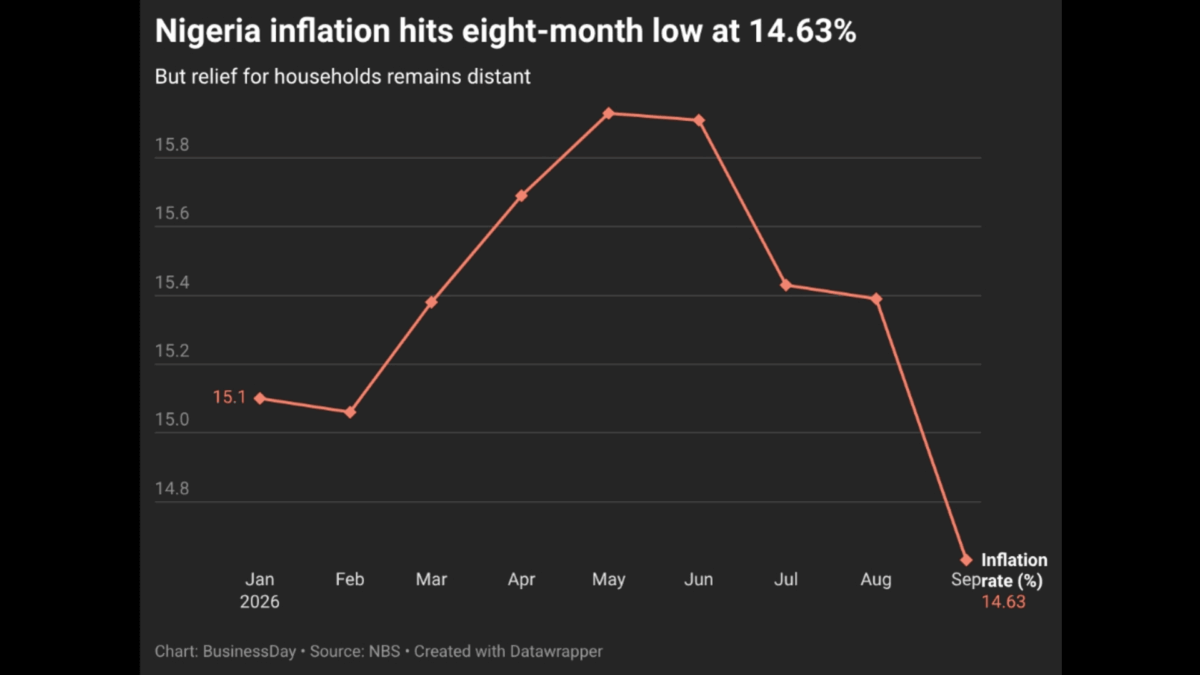
Nigeria’s headline inflation rate declined to 14.63 per cent in September 2026 from 15.39 per cent in August, as falling food prices slowed the overall increase in consumer prices. However, rising monthly core inflation suggests that price pressures remain uneven across the economy.
The National Bureau of Statistics (NBS) reported the latest figures on Thursday, October 15, showing that annual headline inflation fell by 0.76 percentage points. The rate was also significantly lower than the 20.98 per cent recorded in September 2025.
On a month-on-month basis, headline inflation slowed to 0.06 per cent in September from 0.71 per cent in August, indicating that average consumer prices increased only marginally during the month.
However, a lower inflation rate does not mean that prices have returned to previous levels. It means that prices are rising more slowly, while the overall cost of goods and services remains elevated.
Food prices drive inflation slowdown
Food prices provided the strongest relief in September, with annual food inflation standing at 19.59 per cent, compared with 20.16 per cent in September 2025.
On a month-on-month basis, food inflation fell to -1.55 per cent from 1.02 per cent in August, indicating that the food-price index declined during the month.
The NBS attributed the reduction to lower prices for several food items, including local short-grain rice, guinea corn flour, eggs, fresh onions, palm oil, Irish potatoes, okra, tomatoes and plantain.
The decline could offer some relief to households, particularly lower-income Nigerians who spend a significant share of their earnings on food.
However, sustaining the improvement may prove difficult because food prices remain sensitive to seasonal harvests, insecurity in farming communities, transportation expenses, storage limitations and distribution costs.
Average annual food inflation for the 12 months ending September stood at 15.72 per cent, down from 28.37 per cent a year earlier. While this indicates a substantial slowdown in food-price increases, it does not mean households have returned to the prices they faced before the inflation surge.
Core inflation raises concerns
Despite the decline in headline inflation, core inflation showed a different trend on a monthly basis.
Core inflation, which excludes farm produce and energy prices, stood at 12.95 per cent year-on-year in September, down from 22.11 per cent in September 2025.
However, its month-on-month rate increased to 1.11 per cent in September from -0.06 per cent in August, indicating renewed price increases across items in the core basket.
The figures suggest that lower food prices helped reduce headline inflation even as prices in other categories continued to rise. The monthly increase in core inflation therefore cautions against interpreting the latest headline figure as evidence that inflationary pressures have been fully contained.
Urban and rural inflation diverge
The NBS data also showed different inflation trends across urban and rural areas.
Urban inflation stood at 15.64 per cent year-on-year in September, compared with 12.46 per cent in rural areas.
On a month-on-month basis, urban inflation accelerated to 0.53 per cent from 0.28 per cent in August. Rural inflation, however, fell to -0.89 per cent from 1.79 per cent in the previous month.
The divergence shows that the national inflation rate does not fully reflect the different price pressures facing households across the country.
While rural consumers experienced a decline in the overall price index during September, prices continued to rise in urban areas, where transport, housing and other expenses can place additional pressure on household budgets.
What the latest figures mean for the economy
The September report provides evidence of continued progress in reducing annual inflation, particularly through lower food prices. However, the increase in monthly core inflation suggests that underlying price pressures require continued attention.
For policymakers, the figures highlight the need to sustain price stability while addressing structural factors that keep the cost of living high, including transportation, food distribution and supply constraints.
For households, the more immediate concern is whether the decline in food prices will continue and whether the cost of essential goods and services will become more manageable relative to incomes.
The latest figures represent progress in slowing inflation, but sustained relief will depend on whether the downward trend continues across food and non-food categories in the coming months.
