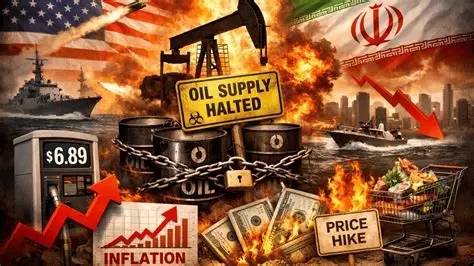
Oil prices climbed above $100 a barrel on Wednesday for the first time since July as renewed fighting between the United States and Iran, along with continuing Houthi attacks in Saudi Arabia, raised fresh concerns about global energy supplies.
Brent crude, the international benchmark, rose past the $100 mark before slipping back to around $99.90 a barrel. However, analysts warn that any further escalation in the Middle East could push prices higher.
The latest increase follows a series of retaliatory attacks between Washington and Tehran. The United States struck five Iranian oil tankers after Iran targeted one of its warships.
Brent crude has not reached this level since late July, when a ceasefire between Iran and the US collapsed.
The Iran-backed Houthi movement in Yemen has also intensified attacks, targeting oil facilities in Saudi Arabia on Tuesday and continuing attacks on tankers travelling through the Red Sea.
Oil Market Under Pressure
The latest escalation comes more than six months after the conflict began on February 28, when the US and Israel launched attacks on Iran.
Oil prices have fluctuated sharply since the conflict started, with wider instability across the region adding further pressure to the energy market.
Before the war began, Brent crude was trading at around $70 a barrel.
The conflict has also effectively disrupted traffic through the Strait of Hormuz, a crucial shipping route that carries about 20% of the world’s oil and liquefied natural gas supplies.
The disruption has contributed to sharp increases in petrol prices in several countries, putting additional pressure on motorists and consumers.
US Strikes Iranian Oil Tankers
The US military said its latest strikes targeted five Iranian oil tankers.
Four of the vessels, which were linked to Iran’s Islamic Revolutionary Guard Corps (IRGC), were hit in the Gulf of Oman, while another was targeted near Kharg Island.
Iran responded by launching missiles at a US base in Jordan, most of which were intercepted. Tehran also claimed to have attacked two US vessels and eight oil tankers in the Strait of Hormuz.
The US military said the Iranian attack on its warship was “successfully evaded” and confirmed that no American troops were injured.
Washington said the five Iranian tankers were “part of a multi-billion-dollar shadow network that funds the IRGC and its regional proxies”.
One of the vessels targeted by the US, the M/T Riesco, later sank in the Gulf of Oman, according to US Central Command (Centcom).
Kharg Island is particularly important to Iran’s oil industry because it hosts the country’s main oil export terminal. About 90% of Iran’s crude oil passes through the island after being transported from the mainland through pipelines.
Houthi Attacks Add to Energy Concerns
The latest developments also involve escalating tensions between Yemen’s Iran-backed Houthis and Saudi Arabia.
The two sides have exchanged attacks since July after an informal ceasefire broke down.
On Monday, the Houthis accused Saudi Arabia of bombing a prison in al-Hazm, killing 11 people.
Saudi authorities said on Tuesday that Houthi attacks had targeted civilian and economic sites in Abha, Khamis Mushait, Jazan and Najran.
Saudi authorities later said the latest drone and missile attack on energy facilities and civilian infrastructure injured 73 people.
The attacks reportedly caused fires at oil facilities and other installations, temporarily disrupting operations, according to Saudi Arabia’s military and energy ministry.
Rubio Warns of More Retaliatory Strikes
US Secretary of State Marco Rubio described the latest exchange of attacks between Washington and Tehran as “pretty straightforward”.
“Iran continues to try to hit US naval ships. And, for every time they do that or try to do that, they’re going to lose tankers. And I think you’ll see that again today,” Rubio told reporters during a visit to Colombia.
The US strikes came hours after Iran’s Navy claimed to have seized an uncrewed US submarine in the Strait of Hormuz.
However, US Navy Capt Tim Hawkins, a Centcom spokesperson, said the vessel was an underwater drone that had malfunctioned more than a day earlier.
He said the drone was being used to survey regional waters “in support of ongoing operations”.
Hawkins described it as “an older model that neither collected sensitive data nor carried any classified sonar or radar equipment”, adding that US military operations in regional waters were continuing.
With tensions rising across several key energy-producing and shipping areas in the Middle East, the oil market remains highly sensitive to further attacks, particularly around the Strait of Hormuz and major regional oil infrastructure.
