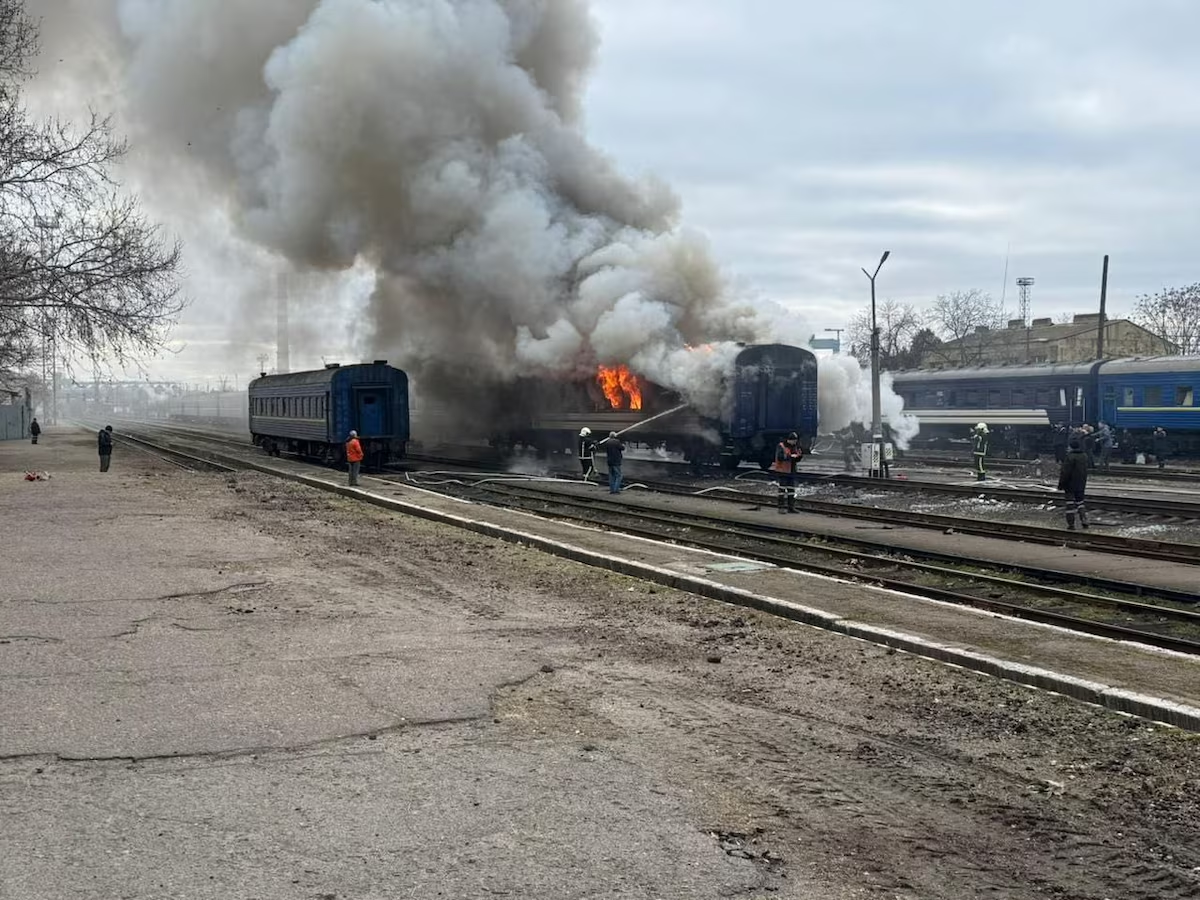
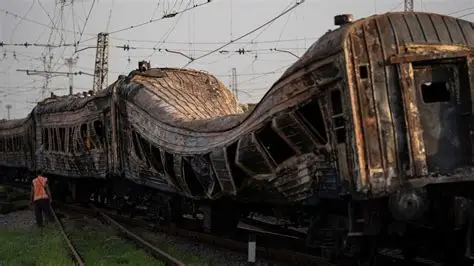
A Russian drone struck a train near Ukraine’s border with Poland shortly after former British Prime Minister Boris Johnson and senior European security officials had passed through the area.
No casualties were reported following the strike at Yahodyn, which hit the train’s engine. Ukrainian authorities said all passengers had been evacuated.
Johnson and other European national security advisers, including the UK’s Jonathan Powell, had travelled along the same railway line on a different train while returning from a conference in Kyiv.
Russia said it had targeted “railway infrastructure” in western Ukraine. However, Ukraine’s state railway operator Ukrzaliznytsia said that “quite possibly, the target of this drone could have been the diplomatic train”.
Former CIA chief David Petraeus, who was travelling on another train at Yahodyn station when the strike occurred, described the incident as “terrifying”.
In an interview with the New York Times, Petraeus said: “This is the act of a truly barbaric leader trying to terrorize Ukrainian civilians.”
In a statement, Ukrzaliznytsia said the diplomatic train “had left the station earlier than expected because of the timetable change… due to constant threats of Russian strikes”.
The railway operator added that passengers on the train that was struck had been ordered to evacuate “just 15 minutes” before the Russian jet-propelled drone hit.
Ukrainian and Polish authorities both said the drone struck approximately 2km (1.2 miles) from the Polish border.
Former Swedish Prime Minister Carl Bildt, who also attended the Kyiv conference, told the BBC that passengers on his train were instructed to prepare for evacuation before eventually being cleared to continue their journey.
“On the train I was on we received order to prepare evacuation after it had stopped. But after a number of minutes we were informed that it was clear and we could proceed,” he said.
The train subsequently arrived safely at Poland’s border station in Dorohusk.
Some reports have claimed that Bildt travelled on the same train as Johnson, although the former British prime minister has not confirmed details of his journey.
Johnson wrote on X: “I don’t know what warped logic drove Putin to blow up a stationary Ukrainian locomotive on the Polish border this morning.
He described the incident as “the kind of random and senseless attack Ukrainians are enduring every day – even on civilian railways” and called on Kyiv’s allies to urgently provide Ukrainians “the air defences they need”.
Ukraine has repeatedly appealed to its allies, particularly the United States, for additional interceptors to help defend against daily Russian attacks. Kyiv says the attacks increasingly involve fast-moving ballistic missiles and jet-propelled drones.
Johnson, who was pictured in Lviv in September 2026, had been travelling alongside senior European security officials after attending the Yalta European Strategy (YES) conference in Kyiv.
Ukrainian Foreign Minister Andrii Sybiha condemned what he called “barbaric strikes” at Yahodyn, saying they amounted to “[Russian President Vladimir] Putin’s terror ‘knocking’ directly on the doors of the EU and Nato”.
Sybiha again called for tougher sanctions against Moscow.
“Putin needs to understand that his barbarism will be met with decisive action that increases the cost of war for him to an unacceptable level. This is the only way to stop him,” he said.
In Poland, Prime Minister Donald Tusk convened an emergency meeting to discuss the incident and its implications.
“The escalation of the actions from the Russian side is becoming a reality, and they are getting closer and closer to our border.”
Meanwhile, EU foreign policy chief Kaja Kallas accused Russia of attempting to intimidate Western countries through the attack.
“I think we should act the opposite. We should show that we are there for Ukraine and we are not scared,” she told reporters in Finland during a summit focused
