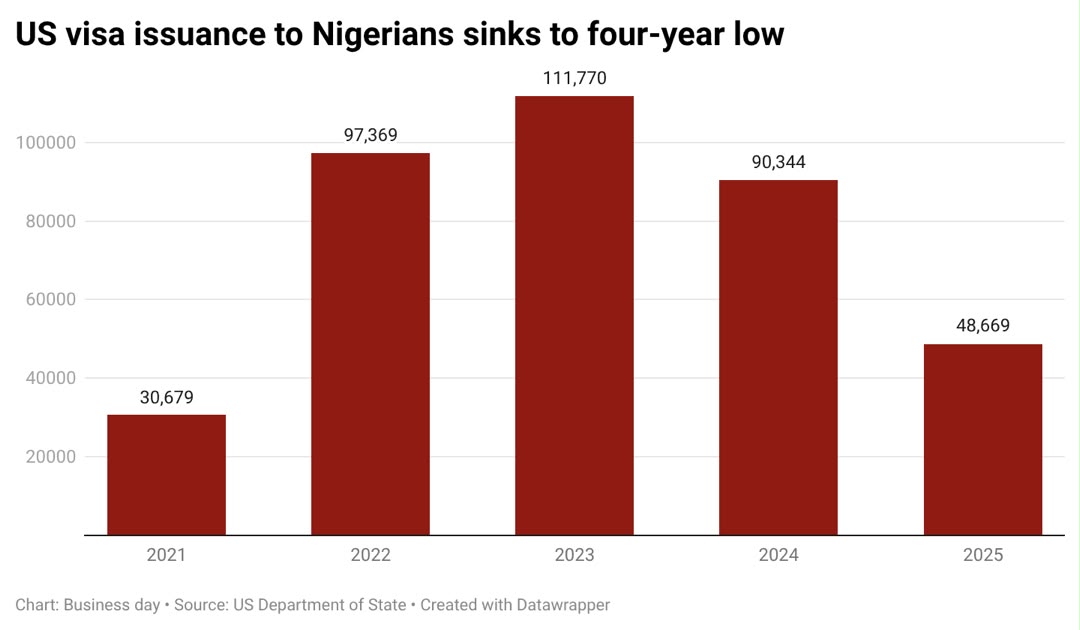
The number of US non-immigrant visas issued to Nigerians dropped to a four-year low in 2025, as tighter immigration and consular policies continued to affect travel, study and business plans.
Data from the US Department of State shows that 48,669 non-immigrant visas were issued to Nigerians in 2025, down 50.2 percent from the 97,369 issued in 2022.
The figures, covering more than 40 categories of non-immigrant visas, show that issuance initially rose by 14.8 percent between 2022 and 2023 before falling by 26.3 percent between 2023 and 2024. It declined by another 19.2 percent between 2024 and 2025.
Joanna Leblanc, a Washington DC-based adjunct professor of American foreign policy, said security and intelligence-sharing concerns were among the reasons cited by the US administration for imposing partial travel restrictions on Nigeria and other African countries.
“If you look at the proclamation, it specifically states that one of the reasons why Nigeria is on this list is because of lack of intelligence sharing. They cited security concerns and vetting difficulties,” she said.
Leblanc added that the restrictions form part of the administration’s broader ‘America First’ approach to immigration reform.
The decline was also accompanied by a sharp increase in the total amount Nigerians spent on visa approvals. Spending rose from N6.59 billion in 2022 to N13.8 billion in 2025, representing a 110.8 percent increase, despite the decline in the number of visas issued.
Visa Issuance Fell Sharply in 2025
Visa approvals recorded a particularly steep decline throughout 2025. Between January and September, monthly issuance dropped from a high of 7,386 in March to 1,422 by September.
In July 2025, the US announced that most non-immigrant and non-diplomatic visas issued to Nigerians would be limited to single-entry permits valid for three months. The change reduced the longer-term, multiple-entry options previously available to many travellers.
Further changes followed in 2026, including the consolidation of some visa services in Lagos after the US Embassy in Abuja reduced its operations.
Travel operator Uloma Okoro said the changes could discourage Nigerians who are already uncertain about travelling to the US.
“The closure of the US embassy in Abuja may further discourage visa applicants, especially given the existing executive orders which have placed visa restrictions on some African countries. Interest in the United States is gradually declining in Nigeria and the closure may further worsen the situation,” she said.
She added that some Nigerians were already considering alternative destinations.
“Nigerians have begun to look at Morocco, Greece, the UK and other African countries as travel destinations. For studies, the interest has been more around the UK, Canada, Australia and New Zealand,” she added.
Sóókó Deji-Ajomale McWord, publisher of Globalafri Diplomat Magazine, said the concentration of consular services could increase existing appointment delays.
“Even when the two missions were providing consular services, getting an appointment could take several months or more than a year. If those services are consolidated into fewer centres, it is going to be chaotic,” he said.
He noted that some applicants had previously struggled to secure appointments until the following year because available slots were already filled.
“If what two centres are currently handling is eventually managed by one location, demand will naturally overwhelm capacity,” he added.
McWord, however, said increased use of digital processing could help reduce some of the pressure by limiting the need for physical visits.
Different Views on the Policy Changes
While some observers have linked the changes to a tougher US immigration approach towards Africa, others have attributed them to wider foreign-policy and resource-management considerations.
Public affairs analyst Fortune Abang said reductions in embassy and visa-processing operations should not automatically be interpreted as an anti-African policy.
“The reduction of embassies or visa stations across Africa is not necessarily about excluding African countries. It is largely a strategic and economic decision aimed at reducing operational costs and managing diplomatic resources more efficiently,” he said.
Abang nevertheless acknowledged that the changes could create additional difficulties for African travellers who lose direct access to visa-processing centres.
Errol Morkoc, a senior Republican spokesperson, said the US was increasingly prioritising highly skilled migrants rather than traditional labour-based immigration.
“A new world order has emerged. The need for large-scale economic migration to work in factories, as was the case during the first and second industrial revolutions, no longer matters,” he said.
He added:
“The United States’ entire advantage is brain-draining the very top 0.1 percent of people from all these countries. No longer do we need people to come and work in factories. We need people to come and innovate at the very highest level because jobs are going down and the economy is changing. The fifth industrial revolution is upon us and we need to prepare for it adequately.”
Morkoc also connected the administration’s immigration policies to changes in the labour market caused by artificial intelligence and automation.
On asylum restrictions, he argued that some applicants were using humanitarian routes for economic migration.
“They are trying to have backdoor access to economic migration. That’s not asylum. Right now, we don’t have a functional immigration system. It is completely broken. That is why President Trump is putting a hard moratorium on new asylum seekers because you cannot seek asylum for economic benefits. That isn’t asylum; it is economic migration,” he said.
The combination of tighter visa rules, reduced processing capacity and changing immigration policies has created additional uncertainty for Nigerians travelling to the US for tourism, education, business and migration. (Businessday NG)
