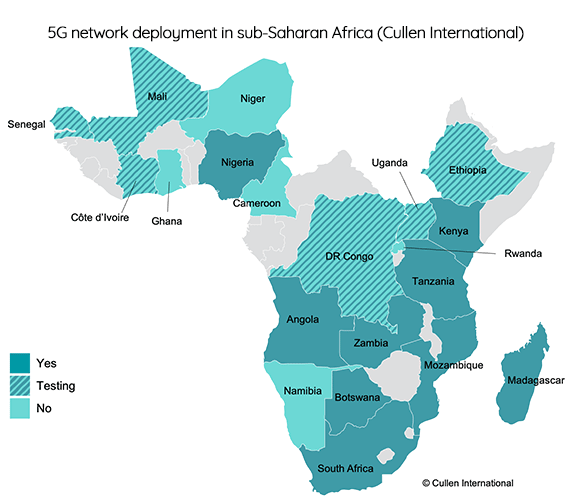
Africa’s 5G market remains relatively small in terms of subscribers, but the technology is already having a much larger impact on the continent’s data economy as 5G users consume significantly more internet traffic than users on older networks.
Data from Kenya’s Communications Authority shows that 5G accounted for 2.10 million of the country’s 64.26 million mobile data connections as of June 2026. That represents about 3.27 percent of total connections.
Despite its small subscriber base, 5G generated 135.38 million gigabytes of data traffic in the second quarter of 2026, compared with 43.86 million GB during the same period in 2025. That amounts to a 208 percent year-on-year increase.
By comparison, 4G had 48.31 million connections, representing about 75 percent of Kenya’s mobile data market.
The difference becomes even clearer when average usage is considered. A Kenyan 5G subscriber consumed about 64.4 GB of data per month, compared with 15.8 GB for a 4G user and 8.3 GB for a 3G user.
This means the average 5G subscriber used more than four times the amount of data consumed by a 4G subscriber.
The figures suggest that measuring 5G’s impact simply by counting subscribers may not tell the full story. Although adoption is still limited, users on the faster network are generating considerably more traffic, creating new demands for network capacity, infrastructure investment and data services.
Why 5G users consume more data
One of the major drivers of increased usage is speed.
Faster connections allow users to download large files more quickly, stream higher-quality videos with fewer interruptions and make greater use of cloud-based services.
Applications can also respond to faster networks by delivering larger files and higher-quality content. Video platforms can provide higher-resolution streams, while social media services can load larger media files.
As a result, users may consume significantly more data without necessarily spending more time online.
Early 5G adopters also tend to include heavy data users, businesses and enterprise customers using smartphones, routers and fixed wireless access devices.
Services such as high-resolution video streaming, cloud gaming, large file transfers and cloud computing can generate considerably more traffic than traditional web browsing.
For telecom operators, this creates a potential revenue opportunity because customers consuming more data may require larger or more frequent data packages.
As more people move to 5G, network value could therefore grow faster than the technology’s share of total subscribers.
Nigeria’s growing appetite for data
Nigeria provides another indication of how quickly demand for mobile data is increasing.
As of July 2026, 5G represented 4.74 percent of Nigeria’s 195.1 million telecom subscribers, according to industry data.
Although this remains a relatively small portion of the country’s subscriber base, overall internet data consumption has continued to rise.
Nigerians consumed approximately 1.38 million terabytes of data in January 2026, compared with one million terabytes in January 2025.
Monthly consumption increased further to about 1.67 million terabytes in July, the highest level recorded during the period. Industry expectations suggest monthly usage could exceed two million terabytes before the end of the year.
The Nigerian Communications Commission does not provide equivalent monthly figures showing exactly how much of this traffic comes from 3G, 4G or 5G. As a result, the precise contribution of 5G to the increase cannot be determined.
However, the growth has occurred alongside continued expansion of 5G networks and greater availability of compatible devices.
Telecom operators are responding by increasing investment in their networks.
MTN Nigeria spent N620.5 billion on capital expenditure during the first half of 2026, while Airtel reported spending of $211 million, equivalent to approximately N287.6 billion, on 4G and 5G tower deployment and related investments.
MTN Nigeria’s proposed acquisition of Mafab Communications’ 5G spectrum could also provide additional network capacity. The proposed deal involves Mafab’s holdings in the 2.1 GHz and 3.5 GHz bands.
The investments highlight a wider issue facing African telecom operators: network capacity may need to expand substantially even before 5G becomes a mainstream technology.
Africa’s 5G challenge
5G deployment is increasing across Africa, but adoption remains uneven from one market to another.
Countries such as Ghana are moving forward with 5G spectrum licensing, while other markets continue to face challenges involving spectrum availability, infrastructure and financing.
The obstacles go beyond spectrum.
Limited coverage, inadequate investment, vandalism, network disruptions and the high cost of 5G-enabled devices continue to restrict adoption in parts of the continent.
This creates an unusual situation. A significant portion of the population still cannot easily access 5G, yet the relatively small group that can use it is already consuming data at much higher levels.
Consequently, 5G can have a small subscriber footprint while generating a much larger impact on overall network traffic.
This is important for infrastructure planning because operators cannot estimate future capacity needs solely by calculating how many customers will migrate to 5G.
They also have to account for how much additional traffic each user is likely to generate.
If the Kenyan experience is repeated elsewhere, the addition of millions of 5G users could lead to a disproportionately large increase in data traffic as consumers begin using more bandwidth-intensive services.
The focus is shifting from access to capacity
Africa’s earlier mobile internet expansion was largely about connecting more people to the internet.
The emerging 5G phase is increasingly about how much data people can consume once they are connected.
That shift has implications for telecom operators, investors and infrastructure providers.
Higher data consumption means greater demand for radio network capacity, fibre backhaul, data centres and international connectivity. It also increases the need for reliable electricity and denser network infrastructure in areas experiencing heavy traffic.
The commercial impact of 5G could therefore extend beyond selling 5G subscriptions.
Telecom operators could benefit from higher data usage, while businesses involved in cloud services, data centres, fibre networks and other digital infrastructure could experience increased demand as applications become more data-intensive.
However, expanding access without expanding supporting infrastructure could create new problems.
If subscriber numbers grow faster than radio capacity, fibre backhaul and other network resources, congestion could increase and affect users’ experience.
Kenya’s figures offer an early indication of this challenge. A technology used by only 3.27 percent of mobile data connections generated 135.38 million GB of traffic in one quarter, with usage more than tripling compared with the same period a year earlier.
The bigger 5G story in Africa may therefore not be how quickly the technology becomes the dominant mobile network.
Instead, it may be how quickly a relatively small group of high-speed users changes the volume of data being consumed and, in turn, the infrastructure and economics of the continent’s digital market.
As coverage expands, the industry’s focus is increasingly moving from asking how many people will adopt 5G to understanding how much data each new 5G user will generate.
Read also on Radarr: IT Trends Driving Exponential Business Growth in 2024 | Talkio Mobile Opens Ntinda Service Centre
