By Radarr Africa Business Desk
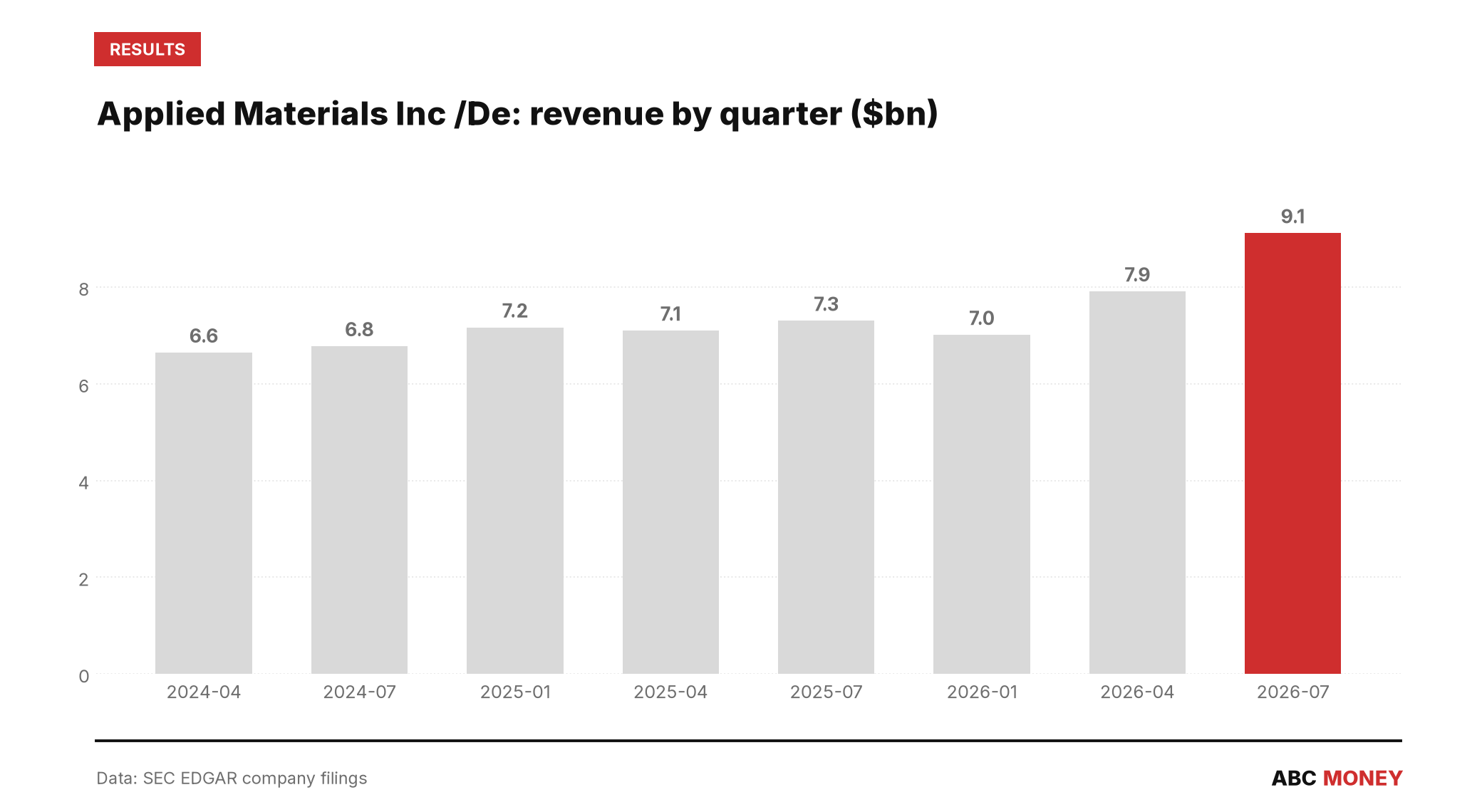
SANTA CLARA, California, November 14 (Radarr Africa) – Applied Materials reported record fourth-quarter revenue of $10.41 billion, up 53% from a year earlier, and forecast further growth as artificial intelligence continues to drive demand for chipmaking equipment.
The company announced the results on 12 November for the quarter and fiscal year ended 25 October 2026. Non-GAAP earnings per share reached a record $4.16, up 92%, while GAAP earnings per share were $3.40, up 43%.
Gross margin was 50.4% on a GAAP basis and 50.6% on a non-GAAP basis. GAAP operating income was $3.66 billion, or 35.1% of revenue, and non-GAAP operating income was $3.68 billion, or 35.3%. Non-GAAP free cash flow was $2.6 billion, up 28%.
Chief executive Gary Dickerson said “AI continues to fuel strong incremental demand for semiconductors”. He said the company is “on track to grow our Semiconductor Systems business more than 40 percent in our calendar 2026”.
Chief financial officer Brice Hill cited “record quarterly free cash flow of $2.6 billion” and said the company distributed over $2.4 billion to shareholders in the quarter. The company returned $2.42 billion in total, made up of $2.00 billion in share repurchases and $421 million in dividends.
For the first quarter of fiscal 2027, Applied guided revenue of $11.1 billion, plus or minus $500 million, and non-GAAP diluted earnings per share of $4.35, plus or minus $0.20.
By segment, Semiconductor Systems generated revenue of $7.996 billion in the quarter, with a gross margin of 55.0% and an operating margin of 38.8%. Applied Global Services, the company’s aftermarket and services arm, posted revenue of $1.896 billion, a gross margin of 35.1% and an operating margin of 30.5%.
For the full fiscal year, revenue was a record $34.45 billion, up 21%. Gross margin was 50.0% on a GAAP basis and 50.1% non-GAAP. GAAP operating income was $11.09 billion, or 32.2% of revenue, and non-GAAP operating income was $11.42 billion, or 33.1%. Full-year GAAP earnings per share were $12.62, up 46%, and non-GAAP earnings per share were $12.89, up 37%.
Operating cash flow for the year was a record $8.87 billion and non-GAAP free cash flow was $6.2 billion, up 9%. Shareholder returns for the year totalled $4.75 billion, comprising $3.18 billion in buybacks and $1.57 billion in dividends.
The gap between GAAP and non-GAAP profit in the fourth quarter was largely due to an unrealised loss of about $0.68 per share on strategic investments. GAAP net income was $2.718 billion, against non-GAAP net income of $3.321 billion. The GAAP effective tax rate was 11.7% and the non-GAAP rate was 11.0%.
Applied ended the year with cash and cash equivalents of $7.239 billion, short-term investments of $2.100 billion and long-term investments of $4.756 billion, a combined total of about $14.1 billion, up from about $12.9 billion a year earlier. Total debt was about $6.53 billion, little changed from about $6.56 billion.
Total assets rose to $45.4 billion from $36.3 billion, and stockholders’ equity increased to $26.1 billion from $20.4 billion. Accounts receivable climbed to $8.998 billion from $5.185 billion and inventories rose to $6.889 billion from $5.915 billion. Regular full-time employees numbered 41,500, up from 36,500 a year earlier.
During the quarter Applied opened its EPIC Center in Silicon Valley and added four partners, Intel, KIOXIA, Besi and UCLA Samueli, bringing the total to 15. It also launched the VeritySEM 20 metrology system.
On 26 October the company announced it had entered an accelerated share purchase agreement to raise its holding in Dutch packaging-equipment maker BE Semiconductor Industries (Besi) to about 20% of outstanding shares, adding to a stake it first took in April 2025. Delivery of the shares depends on the expiry or termination of the United States Hart-Scott-Rodino Act waiting period.
Applied said it regards the investment as long term, has no current plan to exceed about 20% and does not intend to seek a board seat at Besi. Prabu Raja, president of Applied’s Semiconductor Products Group, said hybrid bonding and next-generation interconnects are “increasingly critical enablers of energy-efficient AI compute performance”.
The companies have collaborated since 2020, and their work has extended beyond hybrid bonding into new interconnect architectures, including three-dimensional chip scaling, logic and memory integration, and thermo-compression bonding.
