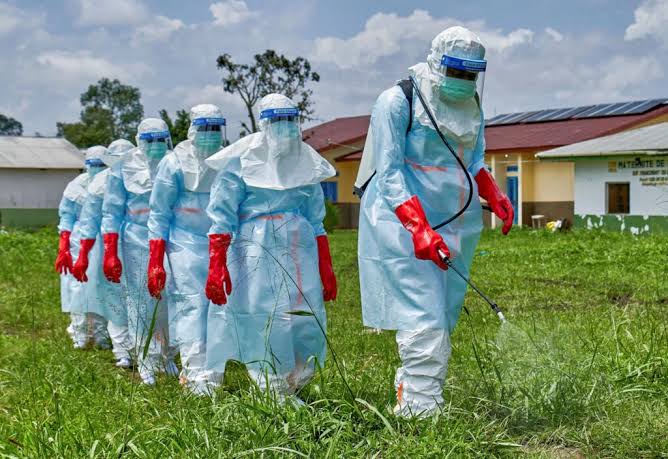
Nigeria’s confirmed Ebola case has raised concerns about international travel, airport health screening and the potential disruption of passenger movement as authorities strengthen measures to contain the virus.
The confirmation of an imported case in the Federal Capital Territory (FCT) has prompted renewed health surveillance at airports, the reintroduction of digital health declaration forms and contact-tracing efforts. However, gaps in screening procedures have raised questions about Nigeria’s readiness to manage the public health threat while keeping its airports operating efficiently.
A visit to Murtala Muhammed International Airport (MMIA) in Lagos revealed that officials had resumed temperature checks for arriving international passengers using handheld infrared thermometers. Travellers were also required to complete digital health declarations covering their travel history and possible exposure to the virus.
However, the measures were reportedly introduced only after the latest case was confirmed, while automated thermal scanning equipment was not available at major terminals. Domestic airport terminals also lacked comparable screening procedures.
Airport Screening Gaps Raise Concerns
The uneven implementation of health checks has raised concerns among passengers and aviation stakeholders about the effectiveness of Nigeria’s airport surveillance system.
At Lagos domestic terminals, passengers continued moving through departure and arrival areas without routine temperature checks or travel-history screening.
Eno Bassey, a passenger preparing to travel to Uyo, expressed concern about the absence of visible screening measures, saying it was “business as usual”.
The lack of consistent screening has raised questions about whether authorities can identify potentially infected travellers early enough to reduce the risk of further transmission.
Public health and aviation experts have called for improved screening equipment, coordinated procedures and digital systems that can process passengers efficiently without creating long queues or delaying flights.
They have also highlighted the need to strengthen surveillance beyond international arrival halls, particularly where passengers move between domestic and international routes.
Travel Agencies Warn of Possible Delays
Travel industry stakeholders say the renewed screening measures could affect passenger processing times, particularly if airports rely heavily on manual checks.
Susan Akporaiye, former president of the National Association of Nigeria Travel Agencies (NANTA) and managing director of Topaz Travels and Tours, said Nigeria’s enforcement of health screening had varied depending on developments in affected countries.
She explained that screening measures were strengthened when Uganda was reporting cases but became less consistent after authorities indicated that the outbreak was under control in the affected area.
With a case now confirmed in Nigeria, Akporaiye advised passengers to arrive at airports early to allow sufficient time for additional procedures.
She cautioned that screening could cause travellers to miss flights if passengers did not account for possible delays.
The situation presents a challenge for airlines and airport operators, which must balance public health requirements with efficient passenger handling and adherence to flight schedules.
Who Is Responsible for Airport Health Checks?
The renewed Ebola alert has also drawn attention to the responsibilities of agencies involved in airport security and public health surveillance.
John Ojikutu, an aviation security expert and chief executive of Centurion Aviation Security and Safety Consult, said primary responsibility for airport biosecurity screening rests with the Federal Ministry of Health’s Port Health Services rather than the Federal Airports Authority of Nigeria (FAAN).
He argued that Port Health officials should be positioned at international arrival points in the same way as other agencies responsible for border control and security.
Ojikutu called on the relevant authorities to explain why screening procedures were not consistently visible before the latest case was confirmed and to clarify their plans for maintaining surveillance.
The concerns highlight the importance of clear responsibilities and coordination among health authorities, airport operators, immigration officials and aviation regulators.
Without effective coordination, screening measures may be inconsistently applied, weakening efforts to identify potential cases while adding uncertainty for travellers.
FAAN Places Airports on Heightened Alert
FAAN has confirmed that airports across the country have been placed on heightened alert following the confirmed Ebola case.
The authority said it was working with the Nigeria Centre for Disease Control and Prevention (NCDC), Port Health Services, the Nigerian Civil Aviation Authority (NCAA) and other relevant agencies to support containment efforts.
In a statement issued by its Director of Public Affairs and Consumer Protection, Henry Agbebire, FAAN said it would continue coordinating airport operations with public health authorities and implement additional measures where necessary.
The authority also urged passengers, airlines, airport workers and other users to remain calm, follow official health instructions and avoid circulating unverified information.
The response is intended to strengthen surveillance while maintaining the safe operation of airports and protecting passengers and airport personnel.
Ebola Alert Forces Changes to Business Events
The public health alert has also begun affecting business activities and events involving large gatherings.
Nigerian National Petroleum Company Limited (NNPC) postponed its two-day Contractors and Partners Chief Executive Officers’ Health, Safety and Environment Conference, which had been scheduled for October 21 and 22 in Abuja.
The company said the decision was taken “as a precaution” following confirmation of the Ebola case in the capital. It did not announce a replacement date, stating that further information would be provided later.
NNPC also expressed appreciation to its contractors, partners, speakers and participants for their understanding, adding that the wellbeing of attendees remained a priority.
The postponement illustrates how uncertainty surrounding a public health incident can affect conferences and other business gatherings, even before a wider disruption to travel is established.
If concerns persist, organisers may face pressure to postpone events or introduce additional health precautions, particularly where international delegates are expected.
Strengthening Biosecurity Without Disrupting Travel
Public health and aviation specialists say Nigeria needs a more consistent approach to airport surveillance to reduce the risk of further transmission without unnecessarily restricting passenger movement.
Suggested improvements include installing automated thermal scanners at international and major domestic terminals, introducing digital health declarations before boarding, and ensuring Port Health Services has a clear and consistent presence at designated checkpoints.
These measures could help authorities identify travellers requiring further assessment while reducing reliance on slower manual procedures.
Nigeria’s response will also depend on effective contact tracing, rapid investigation of suspected cases and clear communication with travellers and the aviation industry.
The World Health Organization has advised against blanket restrictions on travel to or trade with affected countries, emphasising the importance of proportionate public health measures.
For Nigeria, the immediate challenge is to ensure that its airports can maintain effective surveillance while protecting the country’s international connections, tourism prospects and business activity.
The Ebola alert has exposed weaknesses in the consistency of airport screening, making coordinated enforcement and stronger preparedness essential as authorities work to contain the confirmed case.
