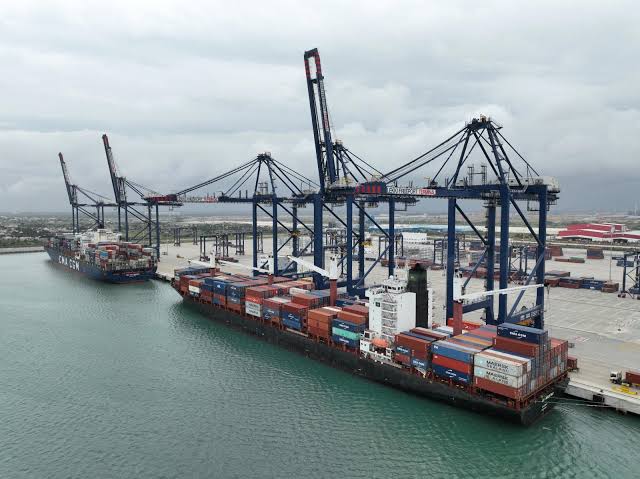
LAGOS, November 27 (Radarr Africa) – Hundreds of millions of naira are tied up in export cargo waiting at the Lekki Deep Sea Port, exporters say, as shipping lines leave booked containers behind and some shipments wait months for vessel space.
Olubunmi Olumekun, president of the Association of West African Exporters and Maritime Professionals, said vessels discharge far more than they load. “A vessel could discharge 1,000 containers and only carry 200 to 300 boxes,” he said, adding that he suspects vessels sail below capacity from Lekki.
Data from the Nigerian Ports Authority (NPA) show that shipping lines moved 83,167 twenty-foot equivalent units (TEUs) of imports and 52,407 TEUs of exports through Lekki in the first half of 2026. The port began full operations in 2023 and has exceeded its annual handling capacity of 1.2 million TEUs, according to the NPA. The second phase of its master plan, which would take capacity to 2.5 million TEUs, has not started construction.
Exporter Oladapo Komolafe said a container that gated in on a Friday in 2024 and 2025 was loaded on the Saturday, whereas the wait is now about two weeks. After 10 free days, he said, storage charges rise to N2,600 a day for a 20-foot container and N3,200 for a 40-foot container.
Lekki handled 46% of cargo throughput across Nigeria’s six operating ports in the first half of 2026, NPA data show, and about 76% of that cargo was generated by operations at the Dangote refinery, a $20bn plant running at 650,000 barrels per day. Vessel turnaround time at the port rose from 2.1 days to 3.3 days within a year, according to the NPA.
The port’s 16.5-metre draft lets large ships arrive full, discharge thousands of containers to lighten, and then enter shallower regional ports. Jonathan Nicol, an industry expert and former president of the Lagos State Shippers’ Association, said Nigeria has no active indigenous ocean-going fleet. “It is impossible to control what you don’t own,” he said.
Agricultural goods make up about half of Nigeria’s non-oil exports, and Nicol warned that perishable cargo could deteriorate, particularly where refrigerated containers are not available.
Congestion on the Lekki-Epe Expressway adds to the delays, with trucks spending hours or days on the road. Nicol cited waits of up to four hours in traffic. Frank Ojadi, a professor at Lagos Business School, said: “There is no quick fix.” He recommended automated traffic counts.
Sani Bala, national secretary of the Association of Maritime Truck Owners, said members had been told to comply with traffic rules. Emmanuel Anda, the NPA’s port manager at Lekki, told truck operators at a stakeholders’ meeting in October to keep to a single lane and use the electronic truck call-up system.
Ajay Tyagi, chief operating officer of Lekki Freeport Terminal, said the terminal has introduced a one-container, one-booking rule and plans to add radio-frequency identification access control. The Lagos State Government said it is developing an enforcement plan.
The Nigerian Ports and Economic Regulatory Authority (NPERA), formerly the Nigerian Shippers’ Council, will act on formal complaints. Juliana Saka, head of its complaints unit, said: “Once the complaints are filed, we will take it up with the shipping companies.” Exporters may ask the regulator to press carriers for dedicated vessel services to Lekki.
Alternatives are limited. Nicol pointed to a longer road route via Epe, Ikorodu and Ijebu-Ode, to barges, for which no jetties are available nearby, and to feeder vessels to older Lagos ports, which add handling costs.
