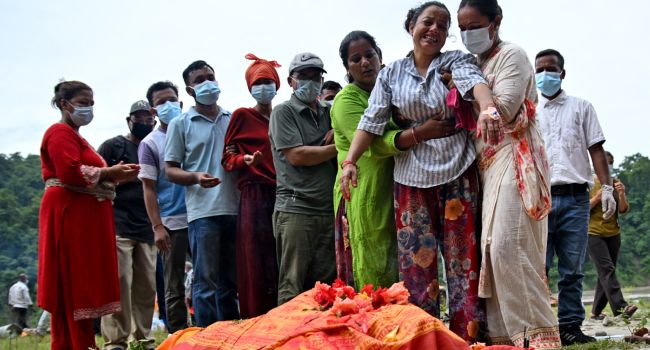
Nepal has begun burying some of the hundreds of victims recovered after a devastating flood swept through parts of the Himalayan region, destroying communities and leaving thousands of people unaccounted for.
Families have gathered at rescue centres and hospitals in desperate attempts to find missing relatives, while others have been forced to identify loved ones among the bodies recovered from the disaster.
The massive flow of ice, rocks and debris that tore through villages and towns on Wednesday has killed at least 797 people in Nepal and Tibet, across the border in China. Some bodies are also feared to have been carried downstream into India.
At least 3,048 people remain missing, including tourists and pilgrims travelling to Tibet’s sacred Mount Kailash. In Nepal alone, 933 hydropower plant workers are among those still unaccounted for.
Rescuers Search for Trapped Workers
Nepali army personnel and engineers continued rescue efforts on Sunday, drilling through debris toward workers believed to be trapped inside a tunnel at the Trishuli 3A hydroelectric project.
The rescue team successfully inserted a pipe into the passage as they worked to reach those trapped inside.
Survivors who escaped the disaster described terrifying conditions when the flood struck.
Surendra Dowluri, 33, from India’s Andhra Pradesh state, was working at the Upper Trishuli-1 site when the disaster occurred.
“We heard a very loud sound… and saw that the turbine floor was submerged with slush, and six workers were stuck in that,” Dowluri told AFP in Kathmandu after being rescued four days after the disaster.
“We managed to rescue five of them, but one person lost his life,” he said, explaining that some workers managed to reach higher ground or construction areas beyond the reach of the rushing water.
Heavy overnight rainfall and rising river levels also complicated rescue operations on Sunday. Water flooded the excavation area before conditions eventually improved, according to the Nepali army.
Glacial Collapse Triggered Disaster
The US Geological Survey said the disaster was caused by the collapse of a glacier, sending a huge wall of water and debris downstream.
The torrent also created large lakes, prompting emergency teams to closely monitor the situation because of the potential danger to ongoing rescue operations.
Near the Tibet border, Chinese rescuers working around a port affected by a deadly mudslide were moved to safety after a landslide created another lake, according to state media.
China has reported 16 deaths in Tibet, with 546 people still missing.
In Nepal, the disaster agency said the number of missing people had risen to 2,502 on Sunday, while confirmed deaths reached 781.
DNA Samples Taken to Identify Victims
The sheer number of bodies recovered has overwhelmed Nepal’s facilities, forcing authorities to begin burials before completing the identification process.
Officials have collected DNA samples from victims to allow families to identify and recover the remains later and carry out traditional funeral ceremonies.
At identification centres, grieving relatives have gathered around LED screens displaying photographs of recovered bodies. Some have struggled to contain their emotions as they searched through the images.
Shobha Adhikary, leaving one identification centre near a temporary morgue, told a local coordinator that she believed she recognised her childhood best friend in one of the photographs.
“It looks like him, for sure,” she said, showing coordinators a photograph of a smiling, middle-aged man.
“My husband and I are best friends with Rajkumar and his wife Geeta,” she said. Geeta has also been missing since Wednesday.
Survivors Face Huge Rebuilding Challenge
For those who survived, the next challenge is rebuilding communities that have been devastated by the floods.
“All the settlements near the river were swept away,” resident Buddhi Ram Dangol told AFP in Nepal’s Nuwakot district.
“There is nothing left.”
International support has begun to arrive, with the United States and Canada each pledging $3.6 million in humanitarian assistance to Nepal.
The United Kingdom has offered $6.8 million, while the United Nations has released $2.5 million in emergency funding. Additional support has also been pledged by the European Union, the International Federation of Red Cross and Red Crescent Societies and other organisations.
Nepal’s economy was already facing significant pressure, leaving the country with limited resources to respond to a disaster of this magnitude.
Foreign Minister Shisir Khanal warned that reconstruction costs could reach “billions of dollars”.
He called for specialised assistance, including heavy-lift drones and technology capable of locating people trapped beneath debris.
Khanal also requested forensic testing equipment to help identify victims and freezer units to preserve bodies, noting that remains recovered from water can deteriorate rapidly.
Climate Change Raises Further Concerns
The foreign minister also highlighted the impact of climate change on Nepal, arguing that the country faces severe climate-related consequences despite having one of the world’s lowest per-capita carbon emissions.
Nepal’s vulnerability is closely linked to its location in the Himalayas, the world’s highest mountain range, where glaciers are melting rapidly as global temperatures rise.
In Tibet, where access for foreign journalists remains highly restricted and Chinese authorities are the primary source of information, 2,141 personnel have reportedly joined search and rescue efforts.
The difficult terrain has slowed operations significantly. Chinese rescuers trying to establish a route to Gyirong Port, identified as the epicentre of the disaster in Tibet, managed to advance only 285 metres (935 feet) on Sunday.
According to the state-run Xinhua news agency, rescue teams still have another 1.25 kilometres to cover before reaching the affected site.
