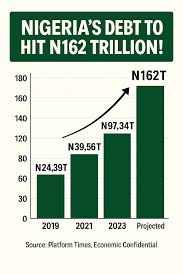
Nigeria’s public debt has climbed to ₦166.79 trillion, putting increasing pressure on government finances and raising questions about the country’s ability to balance debt repayments with investment in economic growth.
The Debt Management Office (DMO) reported that Nigeria’s total public debt stood at ₦166.79 trillion as of June 30, 2026. The figure represents a significant increase from the ₦49.85 trillion recorded in May 2023.
Between March and June 2026 alone, the debt stock increased by ₦7.44 trillion, or about 4.7 percent, from ₦159.35 trillion to ₦166.79 trillion. Compared with June 2025, when total debt stood at ₦152.40 trillion, the latest figure represents a 9.4 percent increase.
In dollar terms, Nigeria’s public debt reached approximately $120.93 billion by June 2026, compared with $99.66 billion a year earlier.
How Nigeria’s debt is structured
Domestic debt accounted for ₦91.59 trillion, representing 54.9 percent of the total debt stock, while external debt stood at ₦75.20 trillion, or 45.1 percent.
Domestic debt increased by about 13.7 percent year-on-year, compared with a 4.6 percent increase in external debt.
The Federal Government accounts for most of the country’s debt, with obligations of approximately ₦152.77 trillion. This comprises ₦86.99 trillion in domestic debt and ₦65.77 trillion in external obligations.
States and the Federal Capital Territory collectively accounted for approximately ₦14.01 trillion.
Exchange rate adds to debt value
One factor behind the increase in Nigeria’s naira-denominated debt is the depreciation of the local currency.
Foreign-currency obligations are converted into naira when calculating the country’s total debt stock. This means a weaker naira can increase the naira value of existing external debt even when the government has not taken on an equivalent amount of new borrowing.
Between May 2023 and June 2026, Nigeria’s external debt increased from $43.7 billion to $54.5 billion, a 24.7 percent rise. However, its naira equivalent increased from ₦20.1 trillion to ₦75.2 trillion.
“While Nigeria’s external debt in USD terms rose modestly from $43.7bn (May 2023) to $54.5bn (June 2026), a 24.7% increase, the Naira equivalent quadrupled from N20.1tn to N75.2tn, a 274% increase. The difference of N35tn is the phantom debt — debt that appears because the Naira collapsed from N460/$1 to N1,535/$1 after the June 2023 FX reform. This revaluation accounts for ∼70% of the Naira increase, meaning Nigeria appears more indebted in Naira but did not actually borrow that money.”
Although exchange-rate movements can explain part of the increase in the naira value of external debt, the government still needs more naira revenue to meet its foreign-currency obligations.
Persistent fiscal deficits
Nigeria has continued to record fiscal deficits, with government spending exceeding revenue.
When revenue is insufficient to cover expenditure, borrowing becomes one of the main ways to finance the gap.
Borrowing can support economic development when it is directed towards infrastructure, productive capacity and investments capable of generating future economic returns. The concern is greater when borrowed funds mainly finance recurrent expenditure without creating assets or additional revenue-generating capacity.
The country’s debt stock has therefore continued to rise alongside persistent fiscal deficits.
Debt servicing puts pressure on revenue
The cost of servicing existing debt is another major concern.
Domestic debt service reached approximately ₦2.14 trillion in the second quarter of 2026. High domestic interest rates can make new borrowing more expensive, particularly when the government relies heavily on the domestic capital market.
This can create a cycle in which government borrows to finance deficits, spends more revenue on debt servicing and has fewer resources available for investment.
The debt-service burden was projected at 69 percent of revenue in 2026. This means a substantial portion of government income is being committed to debt repayment rather than other priorities.
The pressure can limit spending on infrastructure, education, healthcare, electricity, security and industrial development.
What rising debt means for future generations
Public borrowing transfers financial obligations into the future. Debt itself is not necessarily harmful, particularly when it finances projects capable of generating economic value over many years.
Borrowing to expand energy capacity, improve transportation, develop infrastructure or strengthen human capital can create assets that support future economic activity.
However, borrowing mainly to fund consumption, recurrent spending or persistent budget deficits creates a different challenge.
The central question is therefore not simply how much Nigeria can borrow, but what the country gains from each naira borrowed.
The current debt stock of ₦166.79 trillion translates to approximately ₦743,000 per Nigerian based on a population of 223 million. Annual debt service is estimated at ₦9.8 trillion.
Currency risks remain
Nigeria’s external debt also leaves government finances exposed to movements in the exchange rate.
When the naira weakens, the domestic cost of servicing foreign-currency debt rises. This can put additional pressure on government finances at a time when currency depreciation may already be increasing inflation, production costs and household expenses.
Nigeria’s dependence on oil revenue adds another layer of vulnerability because changes in global crude prices and production can affect foreign-exchange earnings and government revenue.
Expanding non-oil exports and diversifying the economy could therefore help strengthen the country’s ability to manage foreign-currency obligations.
Impact on businesses and states
The consequences of rising public debt extend beyond the Federal Government.
States depend on federal allocations and internally generated revenue to finance their programmes and obligations. Higher debt-service costs at the national level can limit the resources available for transfers and development spending.
Government borrowing can also affect private businesses. When the government absorbs a large share of available domestic capital, companies and households may face higher borrowing costs.
Higher financing costs can discourage investment, limit business expansion and affect job creation.
Nigeria’s states also have significant domestic debt. As of June 2026, total domestic debt owed by states and the FCT stood at ₦4.59 trillion.
Lagos had the largest state domestic debt at ₦1.20 trillion, followed by Delta at ₦369.30 billion, the FCT at ₦358.79 billion and Rivers at ₦354.64 billion.
What Nigeria can do
Addressing the debt challenge will require a combination of stronger revenue generation, responsible borrowing and increased economic productivity.
Government revenue can be improved through stronger tax administration, reducing leakages, expanding the formal economy and creating conditions that allow businesses to grow.
Borrowing should also be closely connected to productive investment, with major borrowing programmes assessed according to their expected economic returns, employment potential and contribution to national productivity.
Longer-term and lower-cost financing can help reduce immediate pressure on government finances, while stronger fiscal rules and greater transparency could make it easier for citizens to understand how borrowed funds are being used.
Ultimately, sustainable debt management depends on economic growth.
A larger and more productive economy provides a broader revenue base and makes existing debt obligations easier to manage. The challenge for Nigeria is therefore to ensure that borrowed money contributes to productive capacity rather than simply adding to the country’s financial obligations.
