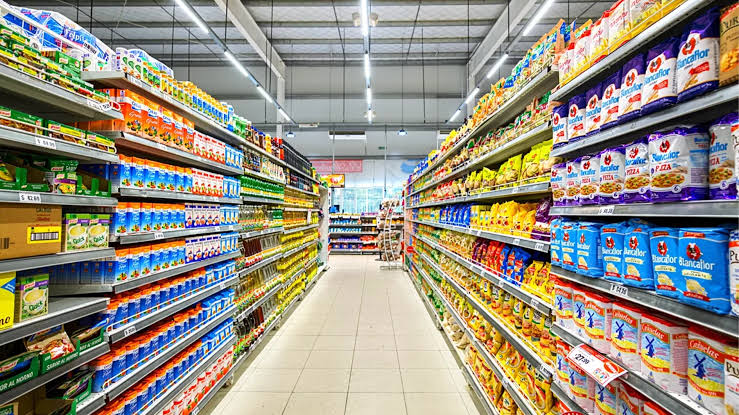
Nigeria’s fragmented retail market is pushing consumer brands to rethink how they reach shoppers, as tight household budgets, rising distribution costs and changing shopping habits keep neighbourhood stores at the centre of everyday commerce.
Research by McKinsey estimates that between 90 and 95 percent of Nigeria’s grocery retail still takes place through traditional trade, giving the country the highest share of traditional retail among the five African markets covered in its 2026 consumer report. (Businessday NG)
The findings highlight a key feature of Nigeria’s retail economy. While digital payments and modern commerce continue to expand, most Nigerians still buy everyday goods from neighbourhood shops, informal outlets and other traditional retail channels.
For consumer-facing companies, this means growth may depend less on replacing traditional retail with supermarkets and other modern formats and more on finding better ways to reach customers through the stores they already use.
McKinsey’s research, based on 5,013 Nigerian consumers as part of a five-country survey involving 9,036 respondents, found that inflation, currency movements and cost-of-living pressures have significantly changed household spending patterns.
Nigeria recorded the strongest affordability pressure among the markets studied, with inflation reaching 33 percent in 2024 while disposable income grew by only 4.5 percent. (Businessday NG)
However, the pressure on household finances has not simply turned Nigerians into shoppers looking only for the cheapest products.
Instead, consumers are becoming more deliberate about what they purchase, how often they shop and what they consider worth paying for.
McKinsey describes this as the rise of the pragmatic consumer, who makes trade-offs between price, quality, health, convenience and affordability.
Neighbourhood shops remain key
The dominance of traditional retail is partly linked to Nigeria’s geography, infrastructure and distribution challenges.
High logistics and distribution costs continue to strengthen the role of neighbourhood stores and informal outlets. Rather than treating these networks as obstacles to modern retail, businesses are increasingly being encouraged to work through them.
“Growth will depend less on trying to replace these networks and more on finding better ways to work through them,” the report said. (Businessday NG)
For consumer goods companies, this could mean moving away from broad distribution strategies and developing more localised approaches that take into account the needs of individual communities.
Digital business-to-business tools, wholesale channels and customised price-and-pack options could help brands reach more consumers while working within existing retail structures.
Nigerians are shopping more frequently
Changing household finances are also influencing how often Nigerians shop.
Across the five markets covered by the research, 73 percent of consumers make urgent grocery trips at least once a week. These top-up and deal-driven trips account for 44 percent of monthly grocery spending.
Store-hopping also increased from 34 percent in 2024 to 38 percent in 2025 as consumers searched for better prices or quality. (Businessday NG)
In Nigeria, limited cash flow, storage constraints and the fragmented retail system encourage many consumers to make smaller and more frequent purchases.
Lower-income households are particularly likely to rely on top-up purchases because they may not have enough cash to buy large quantities at once.
This gives neighbourhood shops an advantage because consumers can purchase smaller quantities close to home rather than travel to larger supermarkets.
The traditional shop is therefore not simply surviving because modern retail has struggled to expand. Its format also matches the way many Nigerians currently manage their money.
Smaller packs offer more flexibility
The changing spending pattern is also driving what is commonly described as “sachetization” — the move towards smaller and more affordable purchasing options.
The approach, which has long been common among fast-moving consumer goods, is increasingly appearing in sectors such as telecommunications, insurance, financial services and media.
For FMCG companies, smaller pack sizes allow customers to buy familiar products without committing a large portion of their available cash at once.
Businesses may therefore need to rethink more than just prices. Pack sizes, payment schedules and product structures can all be adjusted to reflect how consumers earn and spend their money.
At the same time, consumers are still willing to spend more on products they believe provide clear value.
Across the African markets studied, 46 percent of consumers said they actively research promotions, while 73 percent said they stock up during sales. Another 37 percent said they were willing to pay more for high-quality food. (Businessday NG)
This suggests that affordability does not necessarily mean choosing the cheapest option. Consumers are increasingly balancing price with quality, reliability, convenience and trust.
Quality still matters
The research challenges the idea that cost-of-living pressures have made consumers completely price-driven.
Across the five markets, 37 percent of consumers said they consistently pay more for high-quality food, compared with 15 percent in Europe. Another 36 percent said they are willing to shop across different stores to find better quality. (Businessday NG)
Health is also becoming a stronger part of purchasing decisions.
Between 2024 and 2025, the intention to buy health-focused products across the surveyed African markets increased by 66 percentage points. In Nigeria, willingness to pay more for healthier options increased by 44 percentage points.
For brands operating through neighbourhood shops, this means competing on price alone may not be enough.
Companies also need to communicate freshness, safety, quality and health benefits clearly to shoppers.
Digital payments are growing alongside traditional retail
Nigeria’s retail market is becoming increasingly digital even though the physical shopping environment remains largely informal.
The share of cash in Nigeria’s online transaction value fell from 32 percent in 2019 to 11 percent in 2025, while account-to-account transfers increased from 25 percent to 44 percent. (Businessday NG)
This creates a hybrid retail environment where neighbourhood stores remain important while the financial infrastructure supporting them becomes increasingly digital.
For retailers, FMCG companies, banks, fintechs and telecom operators, this could create opportunities to introduce digital payments, credit, loyalty programmes, business-to-business ordering and inventory management into existing neighbourhood networks.
Rather than requiring consumers to abandon familiar shops, businesses can use technology to make those stores more connected and efficient.
Connecting neighbourhood commerce
Community-based purchasing is also emerging as a way to improve affordability.
Platforms such as PricePally connect shoppers with suppliers, while digital savings platforms are helping formalise some of the resource-sharing practices that have traditionally existed within Nigerian communities.
Businesses can potentially build products and services around these community networks rather than focusing only on individual consumers.
For FMCG companies, this could involve linking distribution with group-buying platforms. Banks could develop products around savings groups, while telecom companies could explore shared connectivity packages.
The broader opportunity lies in connecting wholesalers, distributors, agents, neighbourhood stores and consumers into more efficient local ecosystems.
For brands, the Nigerian retail market is therefore not simply moving from traditional to modern commerce. Instead, the future may be a combination of neighbourhood retail, digital technology and flexible consumer products designed around how Nigerians actually shop and manage their money. (Businessday NG)
Read also on Radarr: Nigerian Consumers Are Changing What They Consider Worth Paying For | Nigerians Buy Dangote IPO Shares Through POS Shops Now
