By Radarr Africa Business Desk
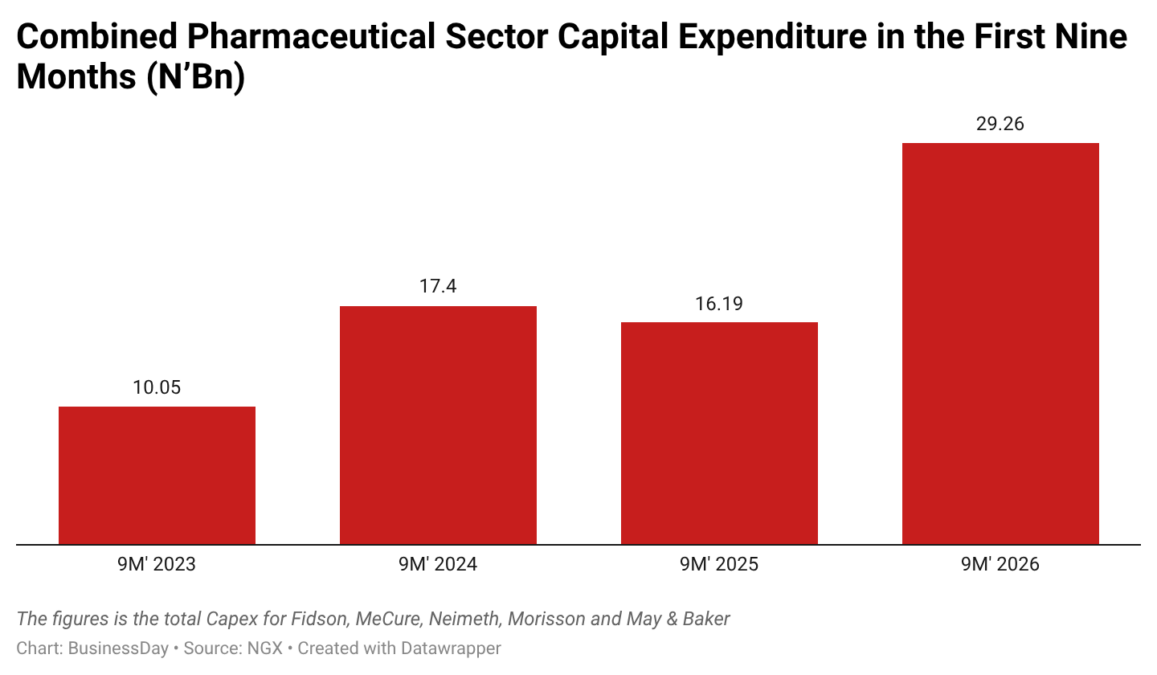
LAGOS, November 16 (Radarr Africa) – Nigeria’s five listed pharmaceutical manufacturers spent a combined N29.26 billion on capital projects in the first nine months of 2026, up 81 per cent from N16.20 billion a year earlier, according to their financial statements.
The five companies are Fidson Healthcare, May & Baker Nigeria, MeCure Industries, Morrison Industries and Neimeth International Pharmaceuticals. Their combined revenue rose 17.2 per cent to N220.27 billion from N187.98 billion, so capital spending rose from 8.6 per cent to 13.3 per cent of revenue.
The nine-month total is the highest in the four years examined. Spending was about N10.05 billion in 2023, N17.40 billion in 2024 and N16.20 billion in 2025.
MeCure Industries accounted for about 57 per cent of the total, with N16.69 billion, up 66 per cent. Fidson Healthcare spent N9.97 billion, nearly double the N5.06 billion of the previous year. May & Baker spent N2.04 billion, up 102 per cent from N1.01 billion, and Neimeth spent N541 million against N69 million. Morrison Industries spent N14 million, compared with a net inflow of N9 million a year earlier.
Abiodun Ogunniyi, Head of Research at IRON Capital, attributes the spending to three factors: expanding local manufacturing capacity, capturing market share after multinationals such as GSK exited Nigeria, and meeting regulatory requirements.
The regulatory driver is the National Agency for Food and Drug Administration and Control’s 5+5 policy, introduced in 2019, which encourages local production of medicines that were previously imported. Affected companies must either build facilities or partner with qualified domestic producers.
NAFDAC’s May 2026 update showed 108 facility layouts approved, 20 new facilities completed and 88 under construction. More than 70 per cent of products covered by the policy are now made locally, compared with a historical import dependence of about 70 per cent. Upgrades must meet current Good Manufacturing Practice standards, which require investment in equipment, quality-control systems and factory upgrades.
Fidson announced a rights issue of about N21 billion in December 2025 to fund manufacturing expansion, product innovation and growth across African markets. Its construction work in progress rose to about N9.51 billion in March 2026 from N6.84 billion in December 2025, and its operating cash generation reached N32.62 billion in the nine months, against N8.82 billion a year earlier. Ogunniyi noted that Fidson has secured a global presence to develop and manufacture generic influenza treatments.
MeCure’s property, plant and equipment rose to N53.07 billion in September from N40.64 billion at the end of 2025. Shareholders approved raising its capital-raising programme from N30 billion to N50 billion in July. Its net financing inflows fell to N4.17 billion from N17.54 billion, with N14.99 billion in term-loan proceeds and N11.86 billion in commercial-paper repayments among the main items.
May & Baker’s 2025 annual report lists plans for additional manufacturing machinery, a herbal production plant, water-treatment and bottling lines for its beverage business and a new sales depot in Abuja. The company is pursuing backward integration to lower production costs and is diversifying beyond pharmaceuticals.
Neimeth is developing a new World Health Organisation-compliant manufacturing facility in Amawbia, Anambra State, and upgrading its existing factory in Oregun, Lagos. Its shareholders approved a N20 billion capital-raising programme in 2025.
Combined operating cash flow for the five companies was N49.47 billion in the nine months, up from N7.04 billion, though Fidson and MeCure accounted for most of the increase. Financing activities moved from a net inflow of N13.38 billion to a net outflow of N14.70 billion.
Ogunniyi said investors should watch capacity utilisation, margins and export revenue, and whether companies can sustain their investment without straining balance sheets. The commercial test will be how quickly new facilities and production lines come into operation and whether they generate lasting earnings and cash flow.
