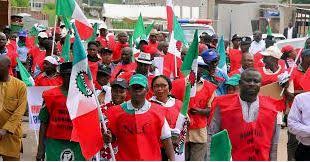
Nigeria’s organised labour has moved a step closer to a nationwide strike after the Nigeria Labour Congress (NLC) rejected the federal government’s position that negotiations on a new minimum wage should wait until June 2027, almost three years after the current ₦70,000 floor came into force.
The rejection, reported by Vanguard on Thursday, keeps alive a 14-day ultimatum the union issued in a letter dated 13 October. It sets labour and government on a collision course at a time when households are still struggling with high living costs despite a recent easing in headline inflation.
What happened
In its letter to the Minister of Labour and Employment, Muhammad Maigari Dingyadi, the NLC led by Joe Ajaero asked for talks on a new national minimum wage to begin by 17 October. The union said it was not demanding that a new wage be paid straight away. Instead, it wants the tripartite committee formed, nominations called for and an agenda agreed early, so that a fresh wage is ready well before the next review date.
The NLC also listed other demands. These include bringing petrol prices back to where they stood when the ₦70,000 wage was signed in 2024, delivering tax relief agreed with labour in 2023, granting immediate wage awards to cushion workers, and settling outstanding claims by health workers under JOHESU and the Joint Public Sector Negotiating Council.
The minister’s reply was quick but firm. He said the ₦70,000 wage, signed into law on 29 July 2024, falls due for review on 1 June 2027 under the law’s three-year cycle, and that starting a new round now would be premature. He pointed to the 133% rise from the old ₦30,000 floor and to government programmes such as the Presidential CNG Initiative, food security measures and social support schemes. The tripartite committee, he said, would be convened at the appropriate time.
Labour was not satisfied. The NLC argued that dialogue without firm timelines and relief measures offers workers little, adding that “procrastination is no longer a policy choice.” The two sides also disagree on the legal clock, with the union arguing that the review timetable should be counted from the 2019 wage law rather than from 2024.
Why it matters
The dispute comes as the cost of living remains a sore point. Data from the National Bureau of Statistics showed headline inflation slowed to 14.63% in September, its fourth monthly decline this year, but energy costs have climbed sharply. Petrol now sells for more than ₦1,400 a litre at many stations in Abuja, far above levels seen when the current wage was agreed.
For businesses and investors, a national strike would add a fresh layer of uncertainty. Past nationwide labour actions have shut government offices, disrupted public services and slowed economic activity, and a prolonged stoppage would be unwelcome as the economy tries to build on falling inflation and lower interest rates. Radarr has previously reported on public servants staging a warning strike over petrol prices, a sign that fuel costs have become a central grievance.
For the government, an early wage review would add pressure on federal and state budgets that are already stretched by heavy debt service costs.
What to watch
The key date is the expiry of the ultimatum. Vanguard did not report a precise deadline, but a 14-day window counted from the 13 October letter would end in the last week of October. Watch for whether the labour ministry offers a compromise, such as inaugurating the tripartite committee earlier than planned, and whether the NLC’s organs formally approve industrial action.
The end of the NNPC petrol discount scheme on 31 October is another pressure point. If pump prices rise again once the discount lapses, labour’s case for urgent relief is likely to grow louder, and so will the risk of a showdown.
