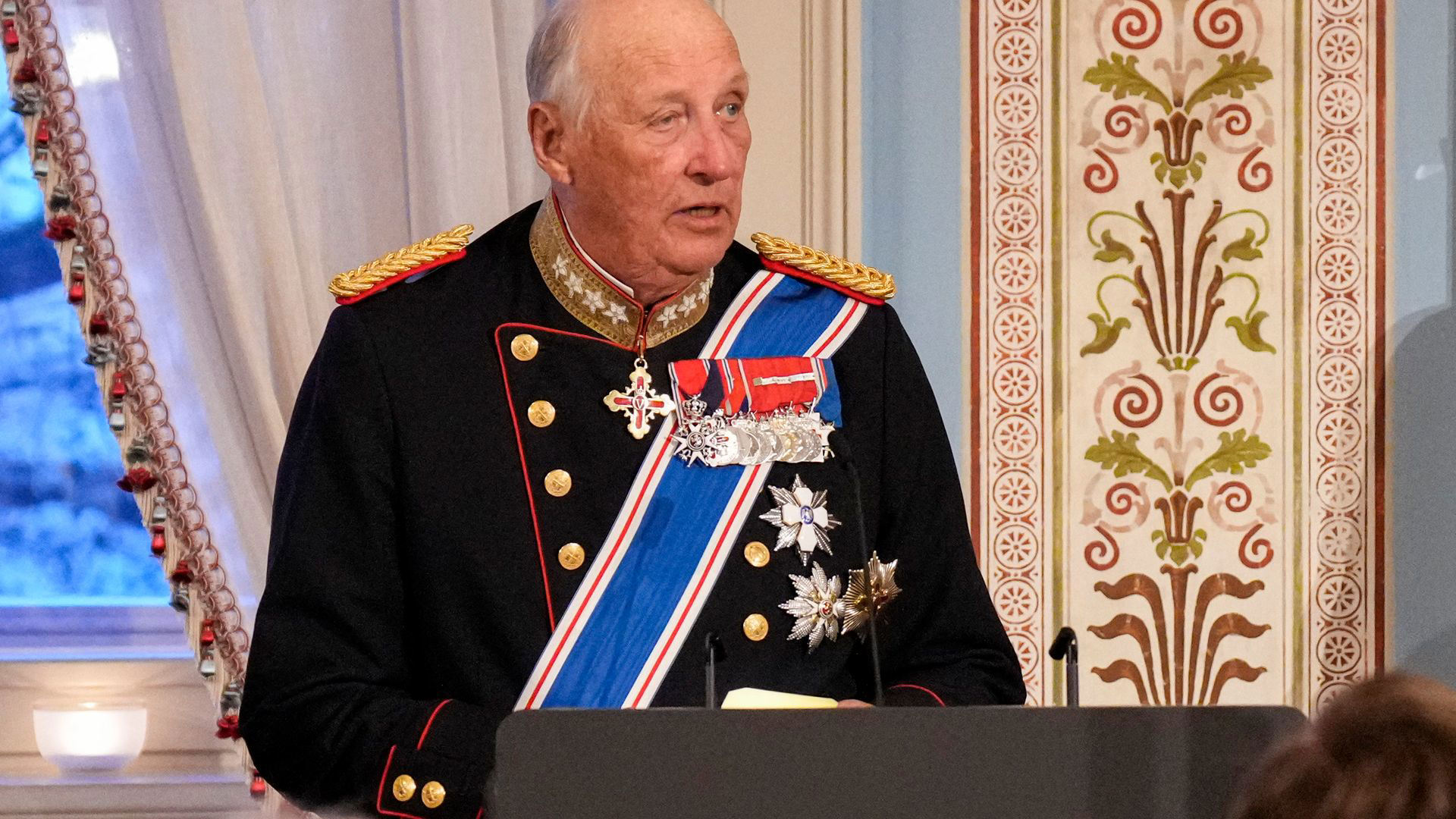
Norway is mourning the death of King Harald V, who passed away at the age of 89, with his 53-year-old son, Crown Prince Haakon, automatically succeeding him as monarch.
Harald, Europe’s oldest reigning monarch, had been receiving treatment at Oslo University Hospital since August 17 after being diagnosed with haemolytic anaemia. The condition occurs when red blood cells are destroyed faster than the body can replace them and can cause symptoms such as fatigue and shortness of breath.
Palace Confirms King Harald’s Death
The Norwegian royal palace announced the king’s death on Friday, saying he died peacefully at the hospital in Oslo.
“It is with deep sadness that we announce that His Majesty King Harald passed away today. King Harald passed away peacefully at Oslo University Hospital on Friday, August 28 at 6:35 am,” (0435 GMT), it said in a statement.
Following the announcement, the Norwegian flag at the Royal Palace in Oslo was lowered to half-mast as the country began a period of mourning.
Harald had been in hospital for nearly two weeks, and concern over his health intensified on Thursday after the palace said his condition was “extremely serious”.
Members of the royal family gathered around him during his final hours. Queen Sonja, Crown Prince Haakon, Haakon’s wife Mette-Marit and their adult children spent much of Thursday at the hospital. Reports also said Haakon remained at his father’s bedside overnight.
Norwegians Pay Tribute to the King
News of Harald’s death prompted members of the public to gather outside the Royal Palace in central Oslo.
People brought flowers and stood in groups to pay their respects to a monarch who had become widely regarded as a unifying figure in Norwegian society.
Kaspara Bolstad, 24, described Harald as “a very steady and warm king”.
“I think the entire Norwegian people see him as a role model and as someone who brings people together. Whether you’re for or against the monarchy, I think he’s well-liked across the board,” she said.
Magnus Skaugseth, 27, also praised the late monarch’s approach to public life.
“He was so inclusive and committed to having values that are inclusive in the society we live in today. When there is so much division and polarisation, he was a pillar pointing in the opposite direction,” Skaugseth said.
King Harald’s 35-Year Reign
Harald became Norway’s king in 1991 following the death of his father, King Olav V.
During his reign, he faced a number of health challenges, including illnesses that eventually required him to have a pacemaker fitted. His health problems also led him to reduce the number of official engagements he attended.
Despite those difficulties, Harald repeatedly rejected the possibility of abdication. He maintained that his commitment to the monarchy was lifelong after taking an oath before the Norwegian parliament.
Norwegian Prime Minister Jonas Gahr Store cancelled a planned work trip to Germany on Thursday as concerns about the king’s health grew.
A Difficult Year for Norway’s Royal Family
Harald’s death comes after a particularly difficult year for the Norwegian royal family.
In February, the king was hospitalised in Tenerife after suffering from an infection and dehydration during a private holiday with Queen Sonja.
Queen Sonja, also 89, was briefly hospitalised in May following heart-related problems.
The family has also faced controversy surrounding Crown Prince Haakon’s wife, Mette-Marit, particularly over her reported links to the late American sex offender Jeffrey Epstein.
Her son from a previous relationship, Marius Borg Hoiby, has also faced significant legal difficulties. He was sentenced in June to four years in prison after being convicted of two rapes and 32 other charges, including violence against a former partner. He has appealed the verdict.
Mette-Marit, 53, has also been dealing with a serious lung condition and underwent a lung transplant in July.
Despite the challenges surrounding the royal family, the Norwegian monarchy remains broadly popular among the public.
Much of that support has been attributed to King Harald’s reputation as a unifying figure and his relatively modest and down-to-earth public image.
