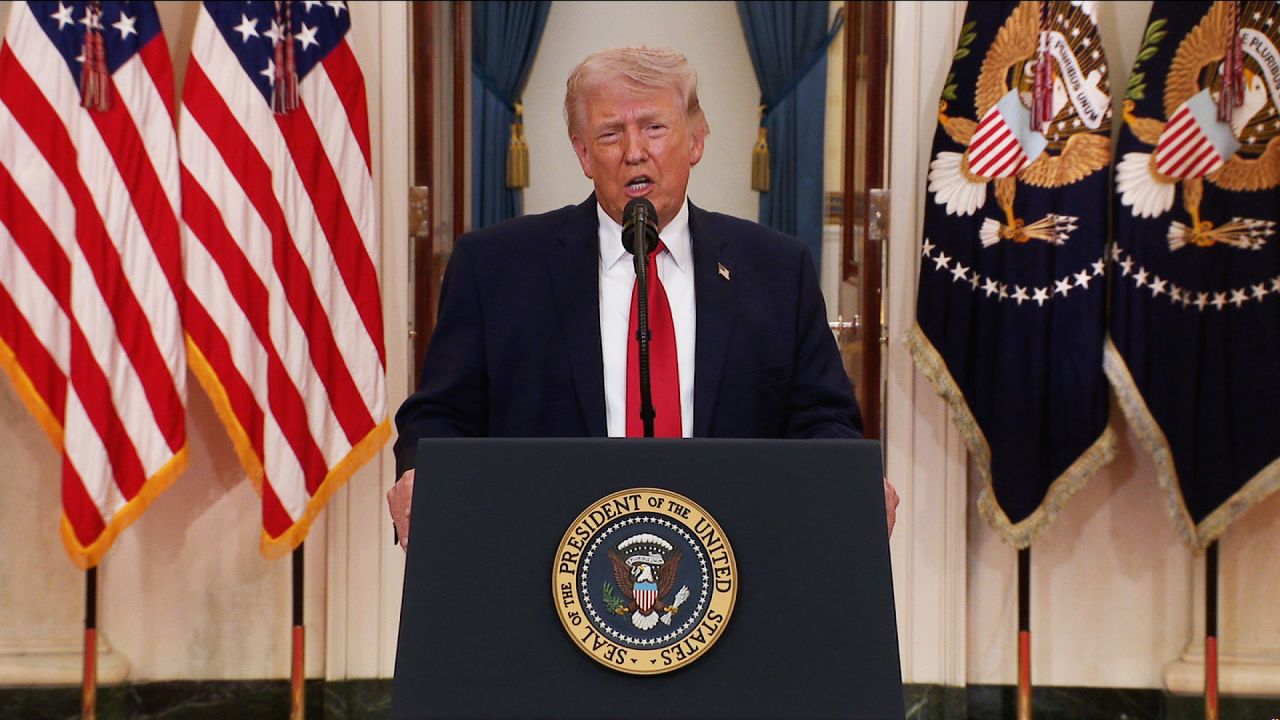
US President Donald Trump has threatened to respond forcefully after the United States and Iran exchanged fire for the first time in several weeks, raising concerns that the six-month conflict could once again escalate into major hostilities.
Trump’s warning came as his Treasury Secretary, Scott Bessent, pledged to continue Washington’s economic pressure campaign against Tehran in an effort to weaken Iran’s economy.
The two countries remain locked in a standoff after six months of war. Iran continues to restrict shipping through the strategically important Strait of Hormuz, while the United States maintains a counter-blockade targeting Iranian ports.
The latest escalation began on Sunday when the United States launched strikes against an Iranian island in the Strait of Hormuz. Iran responded shortly afterward with attacks on US military positions across the Middle East.
The exchange has heightened fears of a wider conflict, with Trump warning that Washington would retaliate.
“We’re going to hit them hard,” Trump said, according to a Fox News reporter who spoke to him briefly. “There will be a response.”
The United States said its forces targeted Iranian rocket launchers on Larak Island to prevent Tehran from placing mines in the critical shipping corridor.
Iran subsequently launched missile and drone attacks toward Jordan and the United Arab Emirates, saying the strikes were aimed at US forces stationed in the region.
However, Iranian President Masoud Pezeshkian called for dialogue on Monday, signalling a possible diplomatic opening.
“We continue to strive for a path of agreement and understanding, and we believe that continuing the war is neither in our interest, nor in the interest of the region,” he said at a summit in Kyrgyzstan, adding “the solution to the existing problems is dialogue and cooperation.”
Missiles and Drones Fuel Regional Tensions
Iranian state media reported that three people were killed and several others wounded in the US strike on Larak on Sunday.
Iran’s powerful Revolutionary Guards claimed that a ballistic missile attack targeting two US military bases in Jordan caused “heavy damage”.
Trump, however, told Fox that all missiles fired at American forces had been intercepted except one, which was assessed as posing no threat. Jordan’s military said it had intercepted eight missiles but did not identify where they originated.
Iran also claimed to have targeted US personnel at an air base in the UAE and said it had shot down an American drone over the Strait of Hormuz.
Authorities in Abu Dhabi confirmed that a drone had been intercepted over the country’s waters but rejected reports that Al Minhad Air Base had been attacked, describing the claims as “baseless.”
Iran’s Revolutionary Guards later said they had brought down another US drone over the Strait of Hormuz on Monday evening.
Iran’s armed forces central command also renewed its warning to neighbouring countries against allowing the United States to use their territory as a launchpad for attacks on Iran.
Meanwhile, a tanker travelling out of the Strait of Hormuz reported being struck by three “unknown projectiles” near Oman’s northeastern coast, according to the UK Maritime Trade Operations agency. No casualties or environmental damage were reported.
US Intensifies Economic Pressure on Iran
The latest exchange came after several weeks of relative calm, during which the Trump administration increasingly focused on what it described as “economic warfare” against Tehran.
Earlier on Monday, Trump described Iran as “a Failed Nation” in a social media post, claiming that its military had been devastated, its financial situation was deteriorating “and their leadership is in total disarray”.
US Treasury Secretary Scott Bessent said Washington would continue applying economic pressure.
“We are going to continue exerting pressure, and we’ve had very good discussions here already,” Bessent told reporters on the sidelines of a G20 meeting in North Carolina.
He suggested that a significant development in the pressure campaign could occur “within weeks or months”.
Iran has also used economic pressure against the United States by restricting traffic through the Strait of Hormuz. The blockade has disrupted global markets and contributed to higher prices for American consumers during a closely contested US midterm election year.
Before the war, approximately one-fifth of the world’s oil supply travelled through the strategic waterway.
Strait of Hormuz Remains Major Flashpoint
Six months into the conflict, shipping through the Strait of Hormuz remains heavily restricted.
Trump has nevertheless claimed that the US Navy has “total control” of the waterway. Washington also announced last week that it had completed operations to clear explosives from the strait.
Iran has rejected the US claim and insists it remains in control of the crucial maritime route.
The Revolutionary Guards said Monday that a “rogue” oil tanker caught fire near the strait after hitting two mines while attempting to use an “illegal route.”
The US military dismissed the allegation as “disinformation,” saying: “No ships have hit mines in the Strait of Hormuz.”
Diplomatic Efforts Continue
International mediators have spent months trying to negotiate an end to the conflict, but an earlier ceasefire and memorandum of understanding eventually collapsed.
Iran has recently urged Washington to return to an earlier agreement.
Iranian Foreign Minister Abbas Araghchi told state television on Monday that “the solution is completely clear and straightforward: the United States must return to its commitments”.
“In that case, everything can be put back on the right track,” he added.
The latest exchange of attacks, however, has added fresh uncertainty to diplomatic efforts and raised concerns that tensions between Washington and Tehran could once again spiral into a broader regional confrontation.
