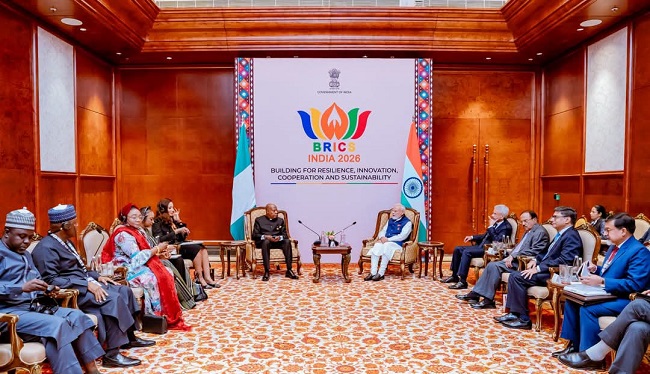
Nigeria and India have agreed to work towards restoring bilateral trade to its previous peak of nearly $15 billion, with Indian Prime Minister Narendra Modi calling for stronger crude oil purchases from Nigeria.
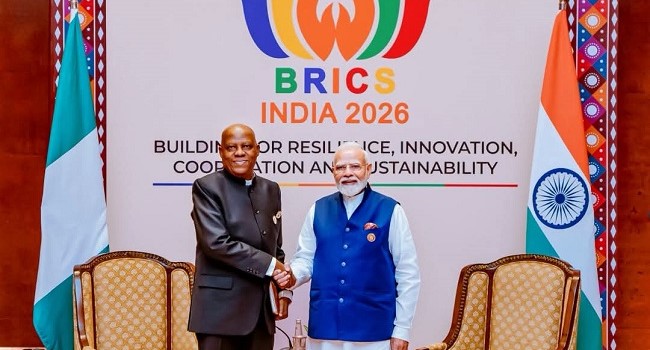
The commitment was reached during a bilateral meeting between Vice President Kashim Shettima and Prime Minister Narendra Modi on the sidelines of the BRICS Leaders’ Summit in New Delhi.
Trade between Nigeria and India dropped from $14.95 billion in 2021–2022 to $7.13 billion in 2024–2025, largely due to a decline in India’s crude oil purchases from Nigeria. The trade value later improved to approximately $9 billion in 2025–2026.
Modi highlighted the importance of rebuilding energy trade as part of efforts to return economic relations between both countries to previous levels.
Shettima assured the Indian leader that President Bola Ahmed Tinubu’s administration would consider India’s request to resume stronger crude oil purchases from Nigeria.
Nigeria, India Expand Cooperation Beyond Oil
While crude oil remains central to the trade relationship, both countries agreed to broaden their economic cooperation into emerging and high-growth sectors.
Areas identified for stronger collaboration include financial technology (fintech), digital public infrastructure and the creative industries.
Nigeria and India also agreed to explore partnerships in defence technology, electricity generation and clean energy.
Other areas of interest include pharmaceuticals, healthcare, skills development and capacity building.
Shettima emphasised Nigeria’s desire to move beyond traditional commodity exports by attracting investments that can support domestic manufacturing, create employment and promote technology transfer.
He said such partnerships would be particularly important in unlocking the potential of Nigeria’s young population.
Nigeria Adapting India’s Women-Led Development Model
On social development, Minister of Women Affairs Hajiya Imaan Sulaiman-Ibrahim said Nigeria is adapting India’s women-led self-help group model through the Nigeria for Women Programme Scale-Up.
According to her, the initiative uses Women Affinity Groups to promote financial inclusion, grassroots businesses and social protection.
The programme forms part of Nigeria’s broader economic strategy aimed at supporting the country’s ambition of becoming a $1 trillion economy.
Shettima Calls for Global Governance Reforms
Nigeria also used the BRICS platform to reiterate its call for reforms to global governance structures and international financial institutions.
The Vice President argued that existing international institutions should better reflect current economic and demographic realities.
“Nigeria supports a more representative, equitable and responsive global governance architecture, including reform of the United Nations Security Council and the international financial system,” Shettima said.” BRICS amplifies the voice of the Global South and advances a more inclusive international order, consistent with Nigeria’s call for institutions that reflect contemporary economic and demographic realities.”
Shettima also positioned Nigeria as a gateway to Africa’s vast market through the African Continental Free Trade Area (AfCFTA).
He urged BRICS countries to move beyond dialogue and focus on practical initiatives capable of delivering measurable economic benefits.
Nigeria Highlights AI, Fintech and Digital Innovation
The Vice President pointed to initiatives such as 3MTT, Project BRIDGE and national artificial intelligence programmes as examples of Nigeria’s efforts to strengthen its innovation ecosystem.
He said the country’s young population is increasingly driving development in areas including artificial intelligence, fintech and digital public infrastructure.
“We welcome deeper BRICS cooperation in artificial intelligence, digital public infrastructure, fintech, telecommunications, cybersecurity, biotechnology and advanced manufacturing, because developing countries must produce technology, create knowledge and own intellectual property. A nation that owns no technology risks renting its future,” he said.
Shettima said Nigeria’s international partnerships should ultimately translate into jobs, stronger trade, technology transfer and increased domestic productive capacity.
“Our partnerships must create jobs, expand trade, transfer technology, and strengthen our nations’ productive capacity. We must build a future in which Africa moves from the margins of global development to the frontiers of global growth and innovation,” the VP added.
Modi Emphasises BRICS Cooperation and Inclusion
Earlier, Indian Prime Minister Narendra Modi opened the summit by stressing the importance of diversity and inclusion within BRICS.
He said the bloc’s approach should extend beyond governments to include entrepreneurs, farmers, researchers, women and young people.
Modi highlighted initiatives such as BRICS CONNECT, while also stressing the need to balance economic development with environmental sustainability.
“We may be rooted in different realities, but together, we rise through cooperation and blossom for humanity,” he said.
The renewed Nigeria-India engagement signals an effort by both countries to rebuild trade ties, strengthen energy cooperation and expand economic partnerships into technology, manufacturing, healthcare and other sectors with the potential to drive long-term growth.
