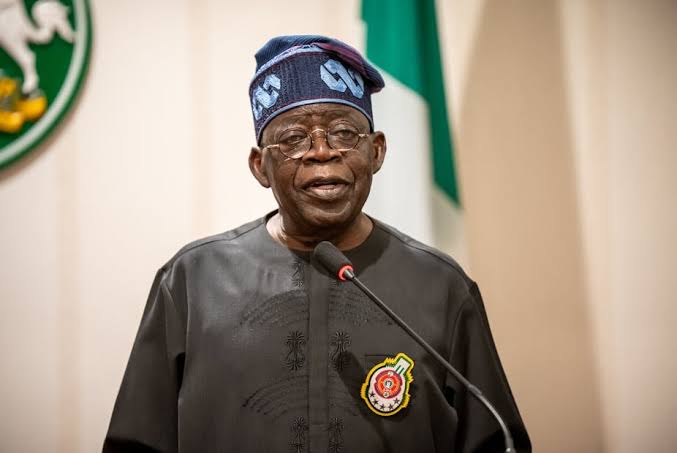
ABUJA — Supporters of President Bola Tinubu under the Tinubu Must Stay (TMS) group have responded to opposition calls for his removal, citing economic growth, student loans and compressed natural gas (CNG) conversions among the outcomes they say support continuity in his administration.
The response followed the reported arrest of five youths in Borno State who were wearing “Tinubu Must Go” branded T-shirts. The African Democratic Congress (ADC) condemned the arrests and subsequently adopted the statement as one of its campaign slogans, with several of its supporters also wearing the shirts.
On Thursday, ADC presidential candidate Atiku Abubakar ended his Independence Day address with the refrain “Tinubu must go”, which he repeated three times.
Speaking at a State of the Nation address at the ADC headquarters in Abuja on October 1, Atiku rejected the President’s claim that Nigeria had entered an “age of prosperity”.
He concluded: “We have chosen a different course, peacefully and together, through the power of our votes; the message is clear: Tinubu must go. Tinubu must go. Tinubu must go”
However, in a statement signed by its National Convener, Engr. Ibrahim Uba, TMS said it was established by “citizens who support continuity of the Tinubu administration and want to promote their case through facts, data and public engagement.”
The group acknowledged that the administration’s reforms had imposed costs on Nigerians, while pointing to measures including the removal of the petrol subsidy and foreign-exchange reforms.
“Those measures have imposed substantial costs on households, with Nigerians experiencing higher living, transportation and energy costs.
“The challenges should neither be ignored nor understated. At the same time, public discussion should examine the administration’s full record—including measurable outcomes, unresolved problems and the longer-term objectives of its reforms.”
TMS cites economic growth
On the economy, the group said: “Nigeria’s economy recorded 4.43 per cent real GDP growth in the second quarter of 2026, compared with 4.23 per cent in the corresponding quarter of 2025 and 3.89 per cent in the first quarter of 2026, according to the National Bureau of Statistics NBS.
“Headline inflation stood at 15.39 per cent in August 2026, down marginally from 15.43 per cent in July. While this represents a moderation in the rate of inflation, it does not mean that prices have fallen; the Consumer Price Index continued to rise, meaning households still faced increasing prices, albeit at a slower rate.
“The Nigerian Education Loan Fund NELFUND reported by June that more than 1.5 million students had benefited from the student-loan programme, with over ₦282 billion disbursed.”
The group also highlighted the 3 Million Technical Talent (3MTT) programme, saying it “has recorded more than 160,000 trained fellows across three cohorts, with about 1.87 million people registered and in the programme’s broader pipeline.”
CNG and housing programmes
On transportation, TMS said: “Current official figures indicate that more than 120,000 vehicles have been converted to CNG, supported by over 400 certified conversion centres and more than 90 refuelling stations.”
It also cautioned that “the challenge now is ensuring that this expanding infrastructure translates into meaningful and widespread reductions in transportation costs for Nigerians.”
On housing, the group said the Renewed Hope Housing Programme and Federal Housing Authority projects had delivered more than 10,000 housing units across the federation, with more than 300,000 jobs projected or associated with the programme.
The group acknowledged limitations to its figures and stressed that government programmes should be judged by their impact on citizens.
“TMS recognises that statistics do not erase hardship and that government programmes should be assessed not merely by announcements or expenditure, but by their actual impact on citizens.
“Our purpose, therefore, is not to deny Nigeria’s difficulties. It is to ensure that public debate about those difficulties also recognises many documented positive interventions and allows competing claims to be tested against evidence,” the statement added.
TMS said it would pursue its case “peacefully, factually and democratically,” adding that “Nigeria’s future belongs to all Nigerians, and the electorate holds the ultimate judgment on political leadership.”
Read also on Radarr: Tinubu Appoints Mulisiu Oseni as NERC Chairman After Senate Confirms Board | 2027: Obi Calls On Nigerians To Defend Their Votes
