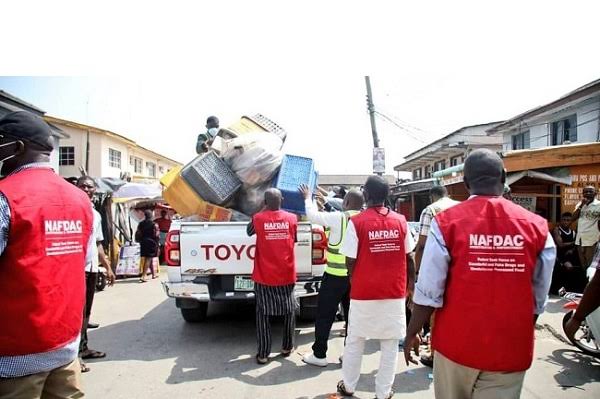
When regulators uncover counterfeit products in a commercial market, the immediate headlines often focus on the value of goods seized and the suspects arrested. But there is another question worth asking: what does an enforcement operation mean for the legitimate businesses operating in the same trading environment?
That question has become particularly relevant following a recent operation at the Lagos International Trade Fair Complex.
On October 14, 2026, the National Agency for Food and Drug Administration and Control (NAFDAC) announced that it had seized counterfeit products worth more than ₦2 billion and arrested two suspects during a raid at the complex. The agency said its investigation uncovered more than 20 illegal stores allegedly linked to counterfeit drinks, the revalidation of expired alcoholic beverages and the stocking of banned imported products.
The management of the trade fair complex condemned the activities and said investigations had begun.
The operation highlights the challenge facing regulators: removing unsafe and illegal products while ensuring that commercial spaces remain suitable for legitimate businesses.
Why Enforcement Matters to Commerce
Counterfeit and substandard products can expose consumers to health risks and undermine trust in the market. They can also place legitimate traders at a disadvantage when illegal sellers offer products without meeting the same regulatory requirements.
For businesses that follow the rules, enforcement can help protect consumers and strengthen confidence in the products being sold.
But the effectiveness of a raid cannot be measured by the value of goods seized alone. It also matters whether investigations identify those responsible, prevent the products from returning to the market and support compliance among legitimate traders.
What Happens to Traders After a Raid?
A raid may raise practical concerns for businesses operating in the affected area. Traders may want to know whether their premises, stock or documentation could be subject to inspection and what records they should keep to demonstrate compliance.
However, it would be inaccurate to assume that every trader in a market is involved in wrongdoing or that all legitimate businesses are affected in the same way.
The consequences depend on the scope of the operation, the evidence gathered and any actions taken by the relevant authorities or market management.
For that reason, the experience of traders following an operation deserves closer examination. Do legitimate businesses have clear information about compliance requirements? Are they able to verify the products they purchase from suppliers? What happens when a supplier provides goods that later turn out to be non-compliant?
These questions can help explain the commercial consequences of enforcement beyond the initial seizure.
The Cost of Compliance
For businesses selling regulated products, compliance can involve checking supplier records, verifying product registration where required, maintaining invoices and ensuring that goods are properly labelled and sourced.
These measures help businesses demonstrate where their stock came from and reduce the risk of selling unsafe or non-compliant products.
NAFDAC’s wider enforcement figures show the scale of the regulatory challenge. Between January and August 2026, the agency recorded 474 new cases, 821 product seizure entries and 213 raids. It also reported 179 establishments closed or sealed during the period.
The figures cover several categories of regulated products, including cosmetics, drinks and drugs. NAFDAC clarified that the seizure entries represent recorded enforcement activity and do not, by themselves, establish the physical quantity or monetary value of goods seized.
The figures therefore point to a broad enforcement effort, but they do not establish how many legitimate traders were affected or how much businesses spent on compliance.
Beyond the Raid
The longer-term test is whether enforcement makes it harder for counterfeit products to circulate while allowing legitimate businesses to operate with confidence.
That requires investigations, evidence gathering, appropriate sanctions and clear communication about the rules businesses must follow. Traders also need to know how to check products and suppliers before committing money to stock.
The recent Trade Fair Complex operation provides a starting point for examining those issues. The next step is to establish what happened after the raid, how legitimate traders were affected, and what measures the authorities and market management are taking to prevent a repeat.
For consumers, the goal is safer products. For legitimate businesses, it is a market where compliance is taken seriously and illegal operators cannot gain an unfair advantage.
