Ethiopia has become Africa’s fifth-largest economy following a major revision of its gross domestic product (GDP) figures, which increased the measured size of its economy by 59.2% for the 2024/2025 fiscal year.
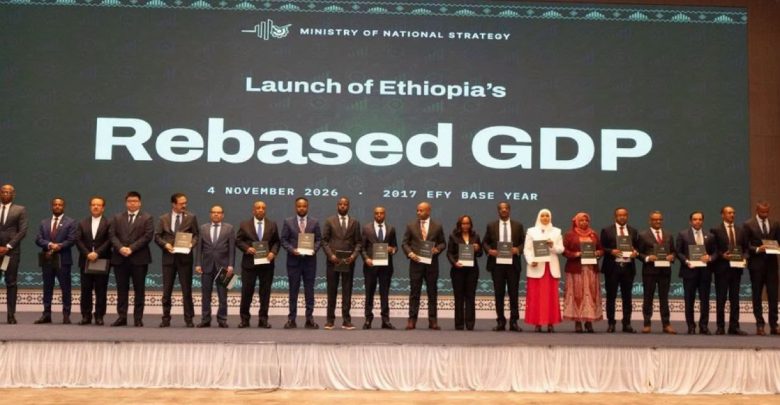
The country’s Finance Minister, Fitsum Assefa, announced the revised figures on November 4, 2026, following the government’s decision to update its national accounts and incorporate economic activities that were not adequately reflected in the previous calculations.
Under the new estimates, Ethiopia’s GDP for the 2024/2025 fiscal year reached 24.03 trillion birr, equivalent to approximately $201.4 billion, compared with the previous estimate of 15.09 trillion birr, or about $126.4 billion.
The government also reported that the economy expanded to 31.86 trillion birr, equivalent to approximately $210.7 billion, in the 2025/2026 fiscal year.
The revised figures place Ethiopia behind South Africa, Egypt, Nigeria and Algeria in Africa’s nominal economic rankings, moving it ahead of countries including Morocco and Kenya based on the available estimates.
Services and manufacturing feature in revised calculations
The rebasing exercise updates the reference year used to calculate economic output from 2015/2016 to 2024/2025. The government said the previous framework no longer adequately reflected changes in the structure of the economy.
The updated calculations incorporate information from additional sources, including an agricultural census, household surveys, state-owned enterprises and nonprofit institutions.
Services account for almost 36% of Ethiopia’s revised economic output, making the sector the largest contributor. Agriculture represents approximately 32%, while industry accounts for about 30%.
The services sector includes activities such as transport, telecommunications, banking and aviation. The revision also seeks to capture expanding activities in digital finance, financial technology and other modern services.
GDP rebasing is a statistical exercise that updates the economic information and methods used to measure a country’s output. It can produce a significantly higher estimate without meaning that the economy suddenly generated the same percentage increase in new goods and services.
Implications for government debt and investment
The revised figures could affect how investors, creditors and international financial institutions assess Ethiopia’s public finances.
A larger GDP estimate reduces debt-to-GDP and other economic ratios when the amount of debt remains unchanged. This could improve some headline indicators as Ethiopia continues efforts to restructure its external debt following its 2023 Eurobond default.
However, the revision does not reduce the country’s outstanding debt, interest payments or foreign-currency obligations.
The new figures could also affect the assessment of government revenue as a share of GDP. A larger measured economy does not automatically mean that the government collects more taxes, making revenue mobilisation an important part of the country’s economic reform programme.
Ethiopia has been implementing reforms to attract foreign investment, including opening parts of its telecommunications and banking sectors to international participation. The country also introduced a more market-based exchange-rate system in 2024 under an economic reform programme supported by the International Monetary Fund.
The government expects the economy to continue expanding, with projected growth of 10.2% in the fiscal year ending July 2027.
The rebasing provides a more updated picture of Ethiopia’s economic structure and changes its position in continental rankings. However, sustaining growth, increasing government revenue and resolving debt challenges will determine whether the revised economic size translates into stronger financial conditions.
