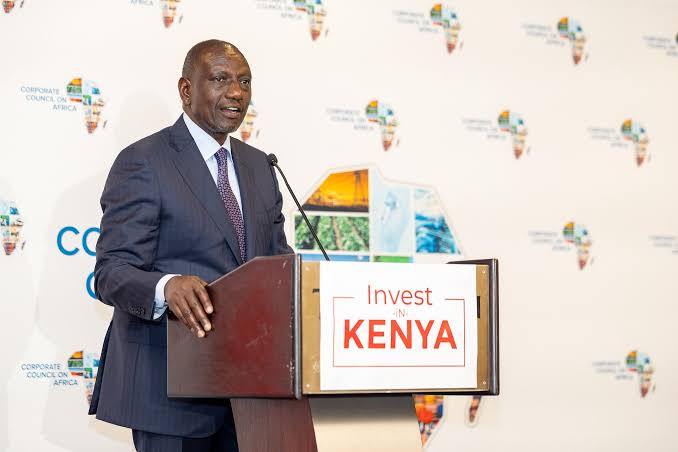
Kenyan President William Ruto has announced plans to expand financing for local manufacturers through an Industrialisation Fund that will offer loans at single-digit interest rates, as the government seeks to increase domestic production and reduce dependence on imported goods.
Ruto made the announcement on November 4, 2026, during the Kenya Industrialisation Summit and Changamka Shopping Festival at the Kenyatta International Convention Centre in Nairobi.
He said the government was in the final stages of establishing the Industrialisation Fund, which is expected to provide businesses with more affordable financing to establish, expand or modernise manufacturing operations.
The proposed facility is expected to begin with loans of between 5 million and 20 million Kenyan shillings, with the government planning to progressively increase the lending capacity to 100 million and 200 million shillings.
Ruto said the initiative was intended to address financing constraints facing businesses interested in manufacturing and support the country’s wider industrialisation ambitions.
Government targets lower borrowing costs
Access to affordable credit has remained a major challenge for manufacturers in Kenya, particularly smaller businesses that need funding to purchase machinery, expand production capacity and manage operating costs.
By offering loans at single-digit interest rates, the government hopes to reduce the cost of borrowing and encourage more businesses to invest in local production.
The Industrialisation Fund is expected to support enterprises at different stages of development, although the government has not yet disclosed its initial capitalisation, funding sources, application requirements or implementation timetable.
Ruto also urged Kenyans to prioritise locally manufactured products, arguing that increased domestic demand could help businesses expand, create jobs and strengthen local supply chains.
Kenya’s manufacturing sector contributed 7.1% to GDP in 2025, down from 7.3% in 2024. Manufacturing output grew by 2% to 3.8 trillion shillings during the year, according to the country’s 2026 Economic Survey.
The government has set an ambition to increase manufacturing’s contribution to GDP to 20% by 2030.
$200 million Green Investment Fund
Ruto also referred to plans for a Green Investment Fund targeting $200 million in capitalisation.
However, the Green Investment Fund is a separate initiative from the newly announced Industrialisation Fund. Kenya’s government had already begun developing the green financing facility earlier in 2026.
The government committed $40 million through the Kenya Development Corporation, while Britam was appointed as the fund’s general partner to help mobilise an additional $160 million from private and institutional investors.
The facility is designed to support businesses adopting environmentally sustainable technologies and practices.
Its priority areas include clean transport, energy-efficient construction, climate-smart agriculture, renewable energy and circular waste management.
The fund uses a blended-finance approach, combining public resources with private investment to support projects that may otherwise struggle to secure long-term financing.
What the initiatives could mean for businesses
The two financing initiatives reflect Kenya’s effort to use investment and affordable credit to strengthen domestic production.
For manufacturers, cheaper loans could make it easier to invest in equipment, increase output and compete with imported products. Smaller businesses could also benefit if the lending arrangements provide access to financing that commercial banks may consider too expensive or risky.
The Green Investment Fund could create additional opportunities for businesses developing renewable energy solutions, sustainable production systems and other climate-related projects.
However, the effectiveness of both initiatives will depend on their implementation, the amount of funding mobilised and the eligibility requirements for businesses.
Kenya’s manufacturing sector continues to face challenges involving electricity costs, infrastructure, access to finance and competition from imported goods.
The proposed funds could help address some of these constraints, but their long-term impact will depend on whether financing reaches productive businesses and translates into higher output, exports and employment.
