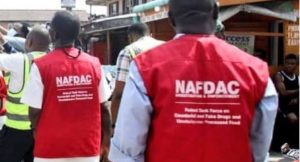
The National Agency for Food and Drug Administration and Control (NAFDAC) has uncovered a suspected counterfeit alcoholic drinks production facility valued at more than ₦500 million in Aba, Abia State. But beyond the equipment and materials recovered, the discovery raises a broader question: what happens after suspected counterfeit products are seized?
The agency said its officials discovered the facility at No. 25 Omenazu Street, Aba, on October 19, 2026, following intelligence about suspected illegal alcohol production. The premises reportedly contained empty bottles, sealing machines, bottle caps, cartons, tanks holding unidentified liquid mixtures and drums containing ethanol.
NAFDAC also reported finding tree bark immersed in ethanol and said the suspected operator fled when officials arrived. As of its public announcement, the agency had not disclosed whether any arrests had been made in connection with the discovery. Punch reported on the operation.
The discovery came days after NAFDAC seized suspected counterfeit packaging materials valued at more than ₦200 million from five shops at Old Court Road Market, also in Aba. The agency said the materials included labels, corks and packaging bearing the names of several consumer brands. The Guardian reported on that operation.
The two discoveries have brought renewed attention to the regulator’s efforts to tackle suspected counterfeit products. They also highlight the stages that follow a raid, from investigating a suspected operation and assessing recovered materials to identifying those responsible and determining whether a case can proceed to court.
From a Raid to a Laboratory Investigation
A raid is an important enforcement step, but the discovery of suspicious equipment or unidentified liquids does not, by itself, establish the precise composition of a product or prove that a particular suspect committed an offence.
NAFDAC’s Laboratory Services Directorate is responsible for analysing regulated products and determining their quality and safety after appropriate testing. Its stated functions also include analysing samples collected during enforcement operations to support sanctions and prosecutions.
According to the agency’s official laboratory services information, its laboratories examine regulated products against relevant standards and specifications.
For a suspected counterfeit alcohol operation, laboratory analysis can help establish what recovered liquid contains and whether samples meet applicable safety and quality standards. Investigators may also need to examine packaging materials, production equipment and other evidence to understand how the suspected operation worked.
The distinction matters because the value of recovered equipment is not the same as the value of confirmed counterfeit products. In the Aba case, NAFDAC’s reported figure of more than ₦500 million refers to the estimated value of equipment, materials and other components found at the facility.
Until testing and investigations establish further details, the findings should be described as suspected counterfeit production rather than proof that every liquid or item recovered was unsafe or counterfeit.
Who Is Held Accountable?
After suspicious materials are recovered, investigators must establish who was responsible for the operation and gather evidence that can support any legal action.
NAFDAC’s Investigation and Enforcement Directorate is responsible for investigating suspected violations, conducting raids and collaborating with the agency’s legal unit on the arraignment and prosecution of suspects.
The directorate’s responsibilities, published on NAFDAC’s official website, include gathering intelligence, investigating alleged offences and coordinating the storage and destruction of certain regulated products.
In the Aba operation, the agency said the suspected operator fled when its officials arrived. Its public announcement did not identify an arrested suspect or disclose whether a prosecution had begun.
That leaves important questions unanswered. Has NAFDAC identified the person believed to be operating the facility? Have investigators traced the source of the recovered materials? Are there other individuals or businesses under investigation? Has the agency submitted any samples for analysis?
The answers would help establish whether the operation has moved beyond the initial discovery to a formal investigation with identifiable suspects and evidence.
They would also provide a clearer picture of the challenges involved in dismantling suspected counterfeit production networks.
What Happens to Seized Products?
Seizure is not necessarily the final stage of an enforcement operation. Depending on the circumstances, recovered items may need to be documented, stored, sampled or retained as evidence while investigations continue.
Where regulated products are confirmed to be counterfeit, dangerous, adulterated or otherwise subject to enforcement action, NAFDAC says its Investigation and Enforcement Directorate can coordinate or supervise their destruction.
The agency outlines its approach to the destruction of violative products on its compliance and enforcement page.
However, the handling of suspected products must be distinguished from the disposal of materials that have been confirmed to require destruction. Investigators may need to preserve evidence for testing and legal proceedings before determining the appropriate next step.
For the Aba facility, the agency’s public announcement described what officials found but did not provide a complete account of the subsequent handling of every recovered item.
Confirming whether samples were tested, which items were retained as evidence and whether any products were formally destroyed would help explain the progress of the case.
Aba’s Previous Counterfeit Product Cases
The latest discovery also recalls an earlier NAFDAC operation in Aba.
In December 2023, the agency announced that it had raided more than 240 shops at Eziukwu Market, also known as Cemetery Market, following an intelligence-led operation targeting suspected counterfeit beverages and other consumer products. NAFDAC reported that some products were destroyed, others were taken to its warehouse, and 10 people were arrested at the time.
The agency’s account is available in its December 2023 enforcement report.
The earlier operation provides context for the latest discovery, but it does not establish that the two cases involve the same people or businesses.
A useful next step would be to establish what happened to the suspects arrested in 2023, whether charges were filed and what the outcomes of any court proceedings were. Such information would show what the enforcement process has delivered beyond the immediate seizure of products.
It would also help determine whether the latest operation represents a separate case or forms part of a wider pattern of suspected illegal production that authorities are still working to address.
Why the Next Steps Matter to Consumers
The consequences of counterfeit or adulterated alcoholic beverages can extend beyond financial losses to manufacturers and traders. Depending on the substances involved and the level of contamination, unsafe alcohol can pose serious health risks.
Consumers may struggle to identify suspicious products when packaging resembles that of established brands. This makes regulatory testing, effective investigations and reliable public information important parts of the response.
NAFDAC advises the public to report suspected illegal manufacturing activities through its official channels. The agency’s published contact information includes its toll-free line, 0800-1-NAFDAC, although consumers should confirm the currently active reporting details on the agency’s website.
For the public, the central issue is not only how much equipment or packaging officials recover during a raid. It is whether investigations establish what happened, whether those responsible are identified where evidence supports it, and whether unsafe products are kept out of circulation.
The Aba discovery has put the suspected operation under scrutiny. The next stage will depend on the evidence gathered, the findings of any laboratory analysis and the outcome of the investigation.
Until those details are made public, the questions surrounding arrests, testing and prosecution remain open. Answering them will be essential to understanding what the latest NAFDAC operation has achieved beyond the initial seizure.
