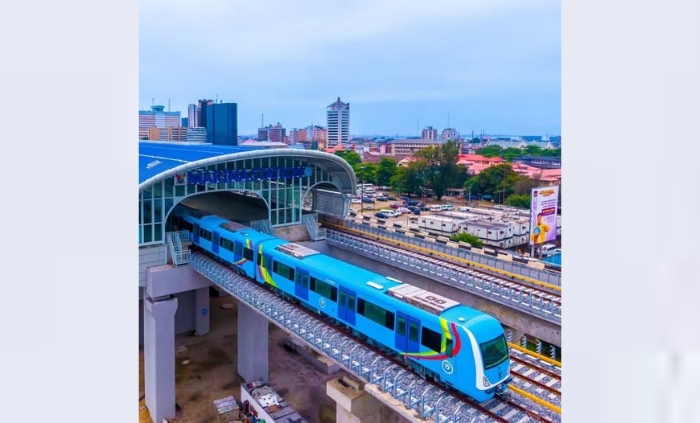
The Federal Government’s plan to extend Lagos’ Red Line railway to Murtala Muhammed International Airport could offer travellers an alternative to road transport, but concerns over accessibility, luggage handling and connections to other transport services may affect its adoption.
Festus Keyamo, Minister of Aviation and Aerospace Development, announced plans to extend the rail line from Ikeja into the airport complex to improve passenger movement and reduce dependence on road travel.
Olubunmi Onabanjo-Kuku, Managing Director of the Federal Airports Authority of Nigeria (FAAN), said the proposed route would include five stops serving Terminal 1, Terminal 2, the Hadron Cargo area, airport offices and a location around Bisam.
However, transport experts and travellers say the project’s usefulness will depend on how easily passengers can reach stations, move their luggage and connect to their final destinations.
Last-mile connectivity remains a major concern
Adejumo John, a transport expert and researcher, said the rail link’s success would depend on its integration with other transport services.
Passengers travelling from areas such as Lekki, Ajah, Festac and parts of Surulere may still need to navigate traffic to reach the railway, limiting the time saved by using the train.
John said first-mile and last-mile connections would be essential, particularly for travellers who need secure parking facilities or convenient transfers between transport modes.
He recommended feeder buses, organised ride-hailing pick-up points and secure park-and-ride facilities around stations to make the service more accessible.
Without these connections, passengers living far from the rail corridor may continue to prefer direct car journeys to the airport.
Travellers weigh convenience against cost
Some travellers have welcomed the proposed rail connection but questioned whether it would provide sufficient convenience for passengers living outside the railway corridor.
Azubuike Uchenna, a passenger, said the difficulty of reaching the airport had previously forced him to stay near the facility before flights, despite leaving home several hours ahead of departure.
He welcomed the plan for people living close to the railway but questioned its usefulness for travellers coming from areas farther away, including parts of Lagos Island, Festac and Ojo.
Joy Odinaka, another traveller, said she spends between ₦8,000 and ₦10,000 on a taxi to the airport, with journeys sometimes taking up to three hours.
Despite the cost and traffic delays, she said a direct car journey remained more convenient because passengers could travel with their luggage without having to navigate stations and transfers.
Her concerns highlight the need to consider luggage space, station accessibility and the distance between rail stops and airport check-in areas when designing the service.
Fares and train frequency will influence demand
John said predictable journey times could become one of the railway’s main advantages, particularly for passengers who currently face uncertain traffic conditions around Ikeja and the airport road corridor.
However, he said fares would need to remain competitive with taxis, ride-hailing services and private vehicles.
Train frequency and reliability would also influence passenger confidence. John suggested that services running every 15 to 20 minutes could make the railway more useful, while long or unpredictable waiting times could discourage people travelling to catch flights.
For airport users, reliability is especially important because missing a flight can carry significant financial and logistical consequences.
The government would therefore need to communicate clear schedules and maintain dependable services to encourage travellers to make the train part of their airport journey.
Red Line expansion could improve airport access
The Lagos Red Line is a 37-kilometre commuter railway connecting Agbado and Oyingbo, with stations including Iju, Agege, Ikeja, Oshodi, Mushin and Yaba.
Extending the line into the airport complex could provide a more direct public transport connection between the city and the airport, while complementing other rail and bus services.
The proposal is part of wider efforts to improve airport infrastructure and passenger movement in Lagos. However, the rail extension remains under development, with environmental assessments, design reviews and procurement processes still to be completed, according to FAAN.
The final impact will depend on the completed route, travel times, fares, service frequency and ease of transferring between stations and terminals.
For the project to attract passengers beyond those living near the railway, the government will need to address the entire journey from home to airport check-in, rather than focusing only on the rail connection itself.
Read also on Radarr: AfDB and Germany deepen transport and rail cooperation | Lagos State Reduces Minimum Land Size for Estate Development to 5,000sqm
