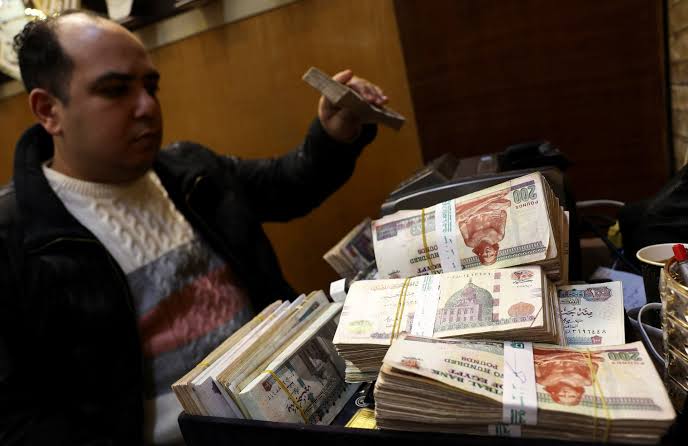
Egypt’s central bank has increased its benchmark interest rates by 100 basis points as the country’s currency continues to weaken against the US dollar, marking its first rate hike since March 2024.
The Central Bank of Egypt (CBE) announced the decision on Thursday, October 29, 2026, raising its overnight lending rate from 20 percent to 21 percent and its overnight deposit rate from 19 percent to 20 percent.
The move comes as the Egyptian pound faces mounting pressure, having fallen to a record low of 56 pounds per dollar on Monday, according to LSEG data.
The rate increase also surprised financial analysts. A Reuters survey of 13 analysts had predicted that the central bank would maintain existing rates for a sixth consecutive meeting.
Egypt raises rates to protect its currency
The CBE said the decision was intended to keep inflation expectations under control and protect the country’s progress in reducing inflation.
It cited challenging external economic conditions and increased uncertainty as reasons for tightening monetary policy.
Higher interest rates can make investments denominated in the local currency more attractive, potentially encouraging investors to hold Egyptian pounds rather than switch to foreign currencies.
The move can also reduce domestic spending by making loans more expensive, helping to moderate demand and ease inflationary pressure.
However, the policy comes with economic costs. Higher borrowing rates could increase financing expenses for businesses and households, potentially slowing investment, consumer spending and economic activity.
Egyptian pound falls to a record low
The central bank’s decision follows a sharp decline in the Egyptian currency.
The pound weakened to 56 against the US dollar on October 26, its lowest level on record, according to LSEG data.
The depreciation has raised concerns about imported inflation because Egypt depends heavily on foreign purchases of essential goods, including food and fuel.
Higher import costs could put additional pressure on domestic prices, particularly if the currency continues to lose value.
The pound’s decline has also occurred amid renewed regional tensions, higher international oil prices and uncertainty surrounding global financial conditions.
Inflation slows despite currency pressure
Egypt’s latest interest rate increase comes even as inflation has shown signs of easing.
Annual urban inflation declined to 13.9 percent in September 2026, down from 14.5 percent in August.
Core inflation, which excludes certain volatile price components, also dropped to 14.1 percent from 14.9 percent over the same period.
Despite the improvement, policymakers appear concerned that further currency depreciation, rising oil prices and geopolitical uncertainty could reverse the progress made in controlling inflation.
The decision therefore suggests that the central bank is prioritising price stability and currency confidence despite the possibility of higher borrowing costs.
Analysts expect tight monetary policy to continue
Jamil Naayem of S&P Global Market Intelligence said Egypt’s monetary policy was likely to remain tight through the rest of 2026 and into early 2027.
He linked the outlook to pressure on the Egyptian pound, higher oil prices and renewed risks of escalating regional conflicts.
Naayem explained that a return to gradual interest rate reductions would depend on easing external price pressures and improving inflation expectations.
The central bank, meanwhile, expects Egypt’s economic growth to remain broadly stable in the third quarter of 2026, close to the 4.7 percent recorded in the second quarter.
The latest rate increase highlights the difficult balance facing Egyptian policymakers as they attempt to support the currency, control inflation and maintain economic growth.
Whether the higher rates will stabilise the pound without discouraging business investment and household spending remains a key concern for the country’s economy.
