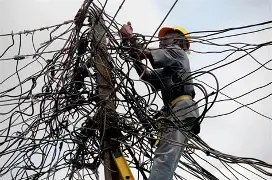
The Federal Government is considering the establishment of a nationwide call centre to enable electricity consumers to report power supply problems and have their complaints addressed.
Minister of Power, Joseph Tegbe, disclosed the plan on Wednesday during the commissioning of a 3MW captive solar hybrid power project at Yakubu Gowon University, formerly known as the University of Abuja.
Tegbe also revealed plans to create a dedicated reporting channel through which Nigerians can quickly report vandalism of critical electricity infrastructure for immediate intervention.
“My office is working on a call centre where electricity complaints across the country can be lodged and resolved. This initiative will provide sustainable job opportunities for our youth nationwide.
“In addition, we plan to provide a dedicated channel where vandalism of critical assets can be reported for immediate action and remediation,” he said.
The minister urged students and staff of the university to help protect the newly installed solar infrastructure by reporting any attempt to vandalise the system, transformers, transmission towers and other electricity assets.
He disclosed that a joint team comprising the Nigeria Police Force, Nigeria Security and Civil Defence Corps and the Economic and Financial Crimes Commission was already working to tackle the vandalism of power infrastructure across the country.
Tegbe said the 3MW solar project would provide a more dependable power source for teaching and research activities at the university. He, however, stressed that the project’s long-term performance would ultimately determine the value of the investment.

Optimization NEW!
The solar project was delivered under Phase II of the Energising Education Programme (EEP), implemented by the Rural Electrification Agency (REA) through the World Bank-funded Nigeria Electrification Project (NEP).
According to the minister, the Yakubu Gowon University project is among several federal government initiatives aimed at improving electricity supply to tertiary institutions and creating a more reliable environment for academic activities.
Phase II of the Energising Education Programme also covers six other institutions: the University of Maiduguri and its teaching hospital with 12MW; Federal University Gashua in Yobe State with 1.5MW; Federal University of Agriculture, Abeokuta with 3MW; University of Calabar and its teaching hospital with 7MW; Michael Okpara University of Agriculture, Umudike with 3MW; and the Defence Academy in Kaduna State with 2.5MW.
“Across successful phases, the program is extending this investment in education to different parts of our country. This sustained investment is a testimony to this administration’s consistency of purpose. There is perhaps no better place to demonstrate the practical value of Nigeria’s energy transition than a university.
“Energizing education also protects the investments already made in academic facilities and specialist equipment. It reduces the disruption that weakens research and makes learning more difficult. These benefits extend beyond the campus, through graduates whose skills strengthen the economy and research that helps solve the country’s problems.
“The commissioning is not the conclusion of the investment. It is the beginning of its most important phase,” Tegbe said.
The minister further announced plans to extend similar projects to public universities across Nigeria and gradually take the institutions off the national grid.
According to him, the strategy is intended to provide universities with a more stable electricity supply and support round-the-clock academic activities.
The proposed electricity complaints centre is expected to provide consumers with a direct avenue for reporting supply challenges, while the dedicated vandalism channel would allow authorities to respond more quickly to attacks or damage involving critical power infrastructure.
